If you are comparing megawatt-hour battery systems for a factory, a solar plant or an EV charging hub, the 1MW/2MWh containerized energy storage system is the format you will meet most often: two hours of megawatt power inside one shipping-container footprint. The H098-2MWh from huadaenergy integrates a 3,360Ah / 598.4V LiFePO4 battery bank built with cell-to-pack (CTP) technology, a 1MW power conversion system, liquid or air cooling and HFC-227ea fire suppression in a 40ft container of 25,800kg. This guide decodes each specification, maps the certification documents — IEC 62933, UN38.3, MSDS, RoHS — to real procurement requirements, and shows where a 2MWh container earns its keep.
What Is a 2MWh Containerized Energy Storage System?
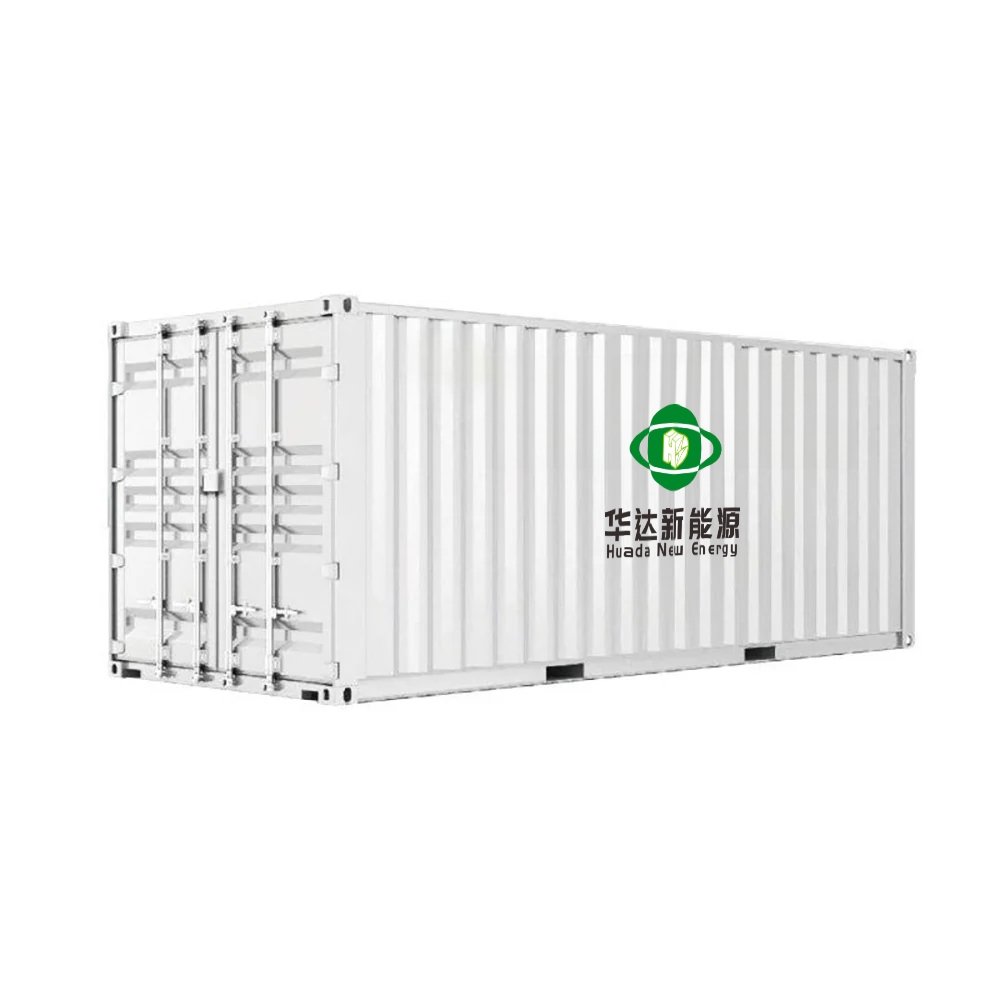
A 2MWh containerized energy storage system is a complete battery power plant — battery racks, power conversion system (PCS), battery management system (BMS), energy management system (EMS), thermal management and fire suppression — pre-installed and pre-tested inside a standard 40-foot ISO container and delivered as one shippable unit. On site it needs only a prepared foundation, cable termination and grid connection. The H098-2MWh measures 12,192 × 2,438 × 2,896mm and weighs 25,800kg, so it ships like any 40ft container. See the H098-2MWh product page for the full datasheet.
The Three Numbers That Define Any BESS
Every quotation reduces to three numbers: rated power (MW), stored energy (MWh) and duration (hours). Energy divided by power gives duration — 2,010.6kWh ÷ 1,000kW ≈ 2 hours — and the ratio also gives the C-rate: the H098-2MWh discharges at roughly 0.5C. Lower C-rates reduce heat generation — one reason the bank is rated for 6,000+ cycles at 70% SOH. Check whether energy is quoted at AC or DC terminals: 2–5% conversion losses make the same “2MWh” differ.
What Arrives Pre-Installed — and What You Build
Inside the container, CTP battery packs with multi-level protection, the 1MW PCS (1.1MW peak), an EMS reporting over 4G, thermal management and HFC-227ea clean-agent fire suppression are factory-fitted, and every unit completes full-function factory acceptance testing (FAT) before shipment. Site work reduces to foundation, cable connection, grid tie and commissioning.
Why the 2-Hour Format Still Dominates in 2026
Two-hour systems remain the storage market’s workhorse in 2026 because they match the price windows and demand-charge periods behind most project revenue. BloombergNEF’s H2 2026 outlook (October 2026) projects 188GW/535GWh of new storage in 2026 — 45% more gigawatts than 2025’s record 112GW/307GWh — rising to 209GW/638GWh in 2027 and a cumulative 3.1TW/11.1TWh by 2036. China’s National Energy Administration reported 167GW/435GWh of new-type storage in operation by September 2026, averaging just 2.61 hours. CATL’s October 2026 delivery of the first 5.64MWh EnerQB units, designed for 8-hour duty, to Quinbrook’s planned 3GW/24GWh Australian portfolio shows the long-duration wave is real — but multi-day firming is a different job from the demand-charge management and solar shifting most C&I buyers face, which sit in this container’s 2-hour window.
Key Specifications of the H098-2MWh, Explained
Every headline number on the datasheet traces back to three simple electrical relationships, and knowing them lets you audit any supplier’s claims. The subsections decode the values that matter most in tender evaluation.
| Item | H098-2MWh | What it means for buyers |
|---|---|---|
| Battery capacity | 3,360Ah / 598.4V (2,010.6kWh) | LiFePO4 bank in CTP architecture |
| Rated / peak power | 1MW / 1.1MW | About 0.5C, with 10% surge headroom |
| AC output | 400V (−20% ~ +15%), 1,444A rated / 1,588A max | Standard industrial low voltage; current follows Ohm’s law at 400V |
| Battery voltage range | 467.5–682.5V | Roughly ±18% around nominal for state-of-charge swing |
| Cycle life | 6,000+ cycles at 70% SOH | More than 15 years at one daily cycle |
| Container | 40ft, 12,192 × 2,438 × 2,896mm, 25,800kg | Standard high-cube transport envelope |
| Temperature | Discharge −20°C~50°C; charge −5°C~50°C; storage 0°C~45°C | Defines heater and climate-control needs at the site |
| Cooling | Liquid or air (specified per project) | Matched to climate and throughput |
| Fire suppression | HFC-227ea clean agent | See the certification section for the agent question |
| Communication | RS485 / CAN local; 4G remote | Cloud monitoring with real-time status and fault records |
| Certification | IEC 62933, UN38.3, MSDS, RoHS 2.0 | Detailed below — each covers a different risk |
598.4V and 3,360Ah: How 2,010.6kWh Is Assembled
LiFePO4 cells have a nominal 3.2V, so 598.4V ÷ 3.2V = 187 cells in series, and 187 × 3.2V × 3,360Ah = 2,010,624Wh — exactly the rated 2,010.6kWh. The amp-hours come from paralleling cell groups inside each pack. CTP (cell-to-pack) construction skips the traditional module enclosure, cutting parts, busbars and connections to raise packing density and reduce potential failure points; the trade-off is field service — ask how pack repair and spares are handled.
1,444A Is Not a Mystery: Ohm’s Law at 400V
The rated AC current is three-phase arithmetic: I = P ÷ (√3 × V) = 1,000,000W ÷ (1.732 × 400V) ≈ 1,443A, rounded to 1,444A on the datasheet, with 1,588A available at the 1.1MW peak. Use it to size cables and switchgear — and to spot datasheets whose current does not match power and voltage.
6,000+ Cycles at 70% SOH: Reading Cycle Life Honestly
Cycle life is only meaningful with its endpoint stated: the H098-2MWh is rated for over 6,000 cycles while retaining 70% state of health (SOH), supporting more than 15 years of daily cycling. A 70% endpoint yields more rated cycles than the 80% endpoint quoted for smaller batteries, so normalize tenders as cycles × capacity × SOH. At 6,000 cycles × 2,010.6kWh, the bank shifts roughly 12GWh over its life — a calculation from rated figures, not a performance promise; actual throughput depends on depth of discharge, temperature and strategy.
Liquid or Air Cooling: When Each Choice Wins
The container can be specified with liquid cooling for uniform pack temperatures, or air cooling for simpler maintenance. Hot climates favor liquid cooling; milder sites with tight service budgets often choose air. The 3MWh variant of the series ships liquid-cooled as standard.
Certifications Explained: IEC, UN38.3, MSDS and RoHS
The H098-2MWh is documented against IEC 62933, UN38.3, MSDS and RoHS 2.0 — covering system-level safety, transport safety, chemical hazard communication and restricted substances respectively. None is a fire-propagation certificate, so knowing what each does — and does not — cover matters before you commit.
| Document | What it covers | What it does not cover | What to request |
|---|---|---|---|
| IEC 62933 series | System-level safety for grid-integrated electrochemical EES across the lifecycle | National grid codes; local fire-code approval | Which edition and parts the system is documented against |
| UN38.3 | Transport safety tests T.1–T.8 for lithium batteries; Class 9 dangerous goods | Site fire safety or performance | UN38.3 test summary matching the shipped cell model and quantity |
| MSDS / SDS | Composition, hazards, handling, first aid, emergency response | Certification of any kind | Current revision matching the shipped cells |
| RoHS 2.0 (2011/65/EU) | Restricted hazardous substances for equipment placed on the EU market | Chemical rules outside the EU | Declaration of conformity with the RoHS directive |
IEC 62933-5-2:2025 — The New Benchmark for Grid-Connected Safety
The second edition of IEC 62933-5-2, published on 9 December 2025, is the first major revision of the grid-integrated electrochemical storage safety standard since 2020, covering the whole BESS lifecycle. Asking which edition a supplier documents against quickly separates current paperwork from legacy files.
UN38.3 and MSDS: Getting the Container Through Customs
A 25,800kg container of lithium cells ships as Class 9 dangerous goods, and UN38.3 (tests T.1–T.8) is the transport gate for legal sea freight. Confirm that the UN38.3 summary matches your cell model and quantity — a mismatch is a common cause of import delays.
The UL 9540A Question for North American Projects
North American authorities increasingly expect large-scale fire-test data: NFPA 855’s 2026 edition adds Annex G.11 expectations for large-scale fire testing, and UL 9540A Edition 6 (published March 2026, effective January 2027) formalizes the installation-level test. IEC documentation does not substitute for this data, so US and Canadian projects should request UL 9540A reports for the offered configuration — in writing.
Fire Suppression Agent: A Procurement Decision, Not a Footnote
HFC-227ea suppresses electrical fires without water or residue — but it has a global warming potential of about 3,220 per US EPA data, and HFCs are being phased down under the Kigali Amendment and Regulation (EU) 2024/573. Low-GWP agents such as FK-5-1-12 (GWP below 1) are already specified in new projects, and since 2025 the EU has tightened placement rules for fire-protection equipment containing HFCs. For EU or ESG-screened projects, ask whether a low-GWP agent can be specified — a purchasable option.
Where a 2MWh Container Earns Its Keep
A 1MW/2MWh container fits the jobs where two hours of megawatt power changes site economics: shifting midday solar into the evening peak, flattening factory demand spikes, buffering fast-charging plazas, and diesel-hybrid weak-grid sites.
Solar Co-Location and Renewable Firming
BloombergNEF counted 69GW/196GWh of storage paired with 299GW of solar by the end of 2025, driven by curtailment and midday price cannibalization. The container absorbs curtailed midday generation and releases it across the evening peak.

Industrial Demand-Charge Management
Factories with 400V connections can couple directly at low voltage — 1,444A at 400V delivers the full 1MW — shaving demand peaks and relieving transformer pressure without a substation upgrade.
EV Charging Hub Buffering
Fast-charging plazas often face grid connections smaller than their peak draw. A 2MWh buffer lets chargers run at full power while the battery absorbs the difference, as covered in our off-grid EV charging guide.
H098-2MWh Compared: The Container Family and the Cabinet Option
Within the H098 series, the practical choice is energy per footprint: four models share one platform, from a 20ft 500kWh unit to a 40ft liquid-cooled flagship.
| Model | Energy | Rated power | Container | Cooling |
|---|---|---|---|---|
| H098-500kWh | 502.6kWh | 250kW | 20ft, 11,500kg | Air |
| H098-1MWh | 1,005.3kWh | 500kW | 20ft, 16,200kg | Air |
| H098-2MWh | 2,010.6kWh | 1MW | 40ft, 25,800kg | Liquid or air |
| H098-3MWh | 3,153.9kWh | 1MW | 40ft, 32,000kg | Liquid |
Container or Cabinet: Where the Crossover Sits
Below roughly 300kWh, outdoor cabinets such as the H098-315kWh cabinet ESS (150kW/316.4kWh, IP55, air-cooled) suit phased rollouts and crane-constrained sites. From about 1MWh upward, containers typically win on delivered cost per kilowatt-hour and factory-integration depth — hence the 2MWh format’s default role in megawatt-scale quotations.
How to Choose: A Buyer’s Checklist Before You Sign
De-risk the purchase by converting the datasheet into written questions:
- Duration and metering: is capacity quoted at AC or DC terminals, and does 2 hours match your tariff window?
- Grid interface: 400V direct coupling or a transformer upstream, and which grid-code documents are supplied?
- Climate fit: compare the −20°C~50°C discharge and −5°C~50°C charge windows with your site, then choose cooling.
- Certification package: IEC 62933 edition, UN38.3 summary matching your cells, MSDS revision, RoHS declaration — plus UL 9540A data for North America.
- Fire agent: ask for a low-GWP option if your market or lender requires it.
- Service and expansion: parallel limits, EMS multi-container support, spares, CTP field repair and the SOH commitment in warranty terms.
Frequently Asked Questions
How much space does a 2MWh containerized BESS need?
One standard 40ft footprint: 12,192 × 2,438 × 2,896mm and 25,800kg on a prepared foundation. Add door clearance and any fire-code separation distances.
What is the difference between 1MW and 2MWh?
Power and energy are different quantities. 1MW is the rate at which the system delivers electricity; 2,010.6kWh is the amount stored. Dividing one by the other gives about 2 hours at rated power.
Can the system be expanded later?
Yes. The H098-2MWh supports parallel connection, and multiple containers can operate together — the family spans 500kWh to 3MWh on one platform. Confirm EMS capacity and transformer headroom at design stage.
Which certifications do I need before importing one?
For shipping: UN38.3 and the MSDS. For system acceptance: IEC 62933 documentation and the RoHS declaration for the EU. Beyond that, requirements are project-specific — UL 9540A data for North America, local grid codes, lender criteria.
Is liquid cooling or air cooling better?
Liquid cooling holds pack temperatures uniform, supporting cycle life and hot-climate operation; air cooling has fewer components and simpler maintenance. Match the choice to site climate and daily throughput.
How long will the batteries last?
The LiFePO4 bank is rated for more than 6,000 cycles while retaining 70% state of health, supporting over 15 years of daily cycling. Actual life depends on depth of discharge, temperature control and operating strategy.
About huadaenergy
Huada New Energy (huadaenergy) manufactures the H098 containerized series — 500kWh to 3MWh — alongside cabinet ESS, home storage and LiFePO4 battery lines at its facility in Huizhou, China. Every container completes full-function FAT testing before shipment, and OEM/ODM customization is available for EPC contractors and distributors. Explore the 2MWh containerized ESS product page, compare the 1MW/1MWh and 1MW/3MWh variants, or contact us for a stamped datasheet.
Last updated: 2026-11-09