H096 193kWh Off-Grid EV Charging Station: 120kW DC
Last updated: 22 October 2026
A 193kWh off-grid EV charging station changes where DC fast charging can go: the hudanewenergy H096 carries its own 193 kWh LiFePO4 battery and dual DC guns, delivering 120 kW (up to 180 kW) on a scenic route, in a remote car park or at a temporary event — no grid upgrade, no civil works, no connection queue. That matters in 2026, when electric car sales passed 20 million units in 2025 (IEA, 2026) while grid reinforcement for high-power chargers still takes one to three years in many markets. This guide explains how the H096 works, what its specification means for operators, how to pair it with solar and storage, and how to choose the right unit.
What Is the H096 193kWh Off-Grid EV Charging Station?
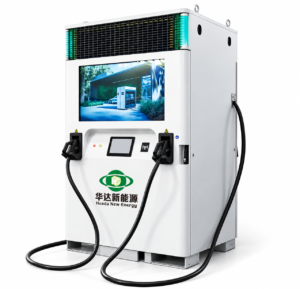
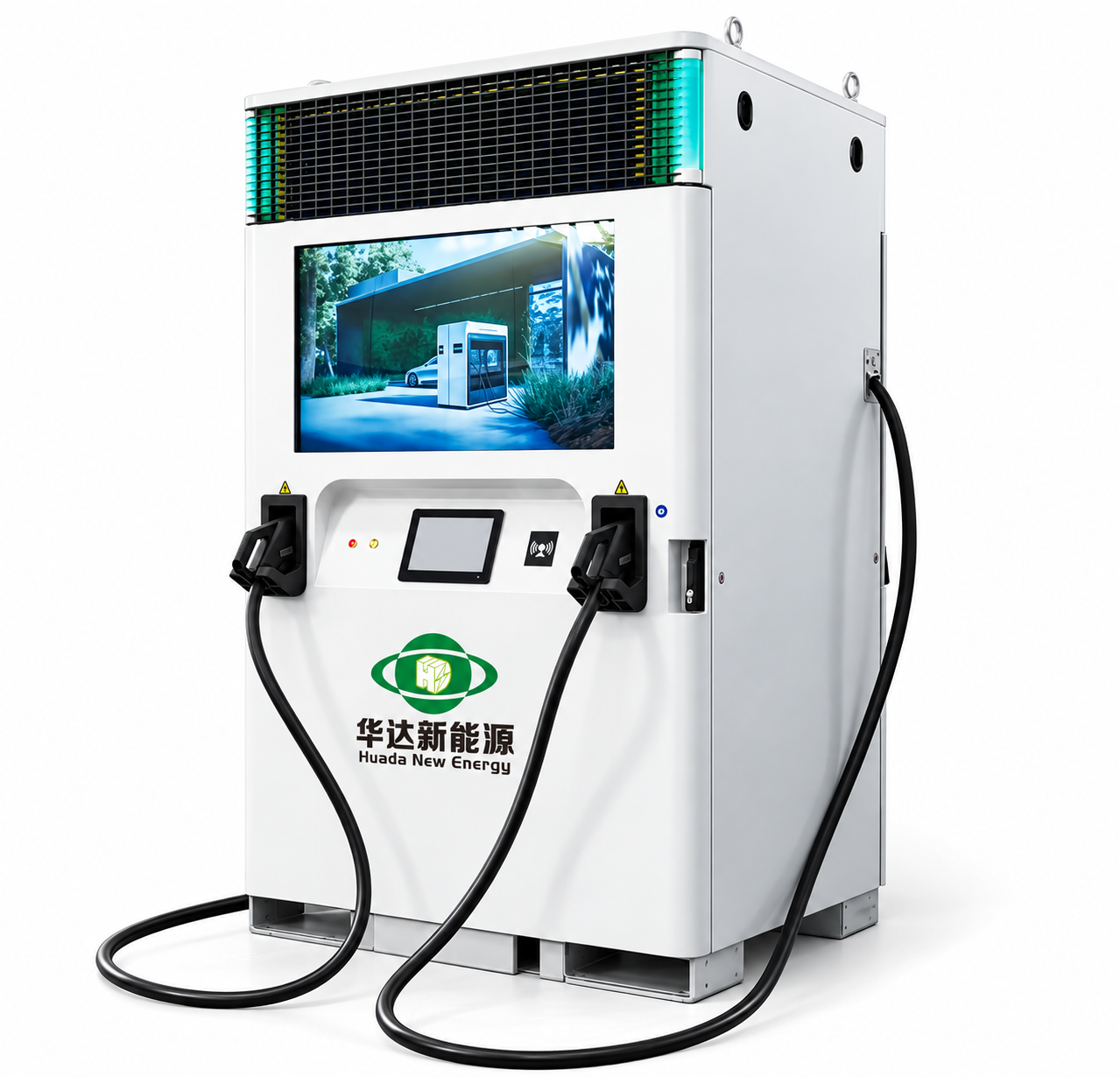
The H096 is an integrated DC fast-charging station that stores 193 kWh of electricity in a built-in 614.4 V LiFePO4 battery and dispenses it through two liquid-cooled charging guns, so charging power is decoupled from the local grid connection. Instead of waiting for a utility to install a bigger transformer, an operator places the cabinet, connects either a low-power AC feed or nothing at all, and starts selling fast charging.
Inside the Cabinet
The hudanewenergy H096 193kWh off-grid EV charging station packs the battery, power modules, thermal system and two 7 m DC guns into a 1340 × 1100 × 2280 mm cabinet weighing 1600 kg — roughly one parking space. Standard hoisting rings let a crane or forklift place it in minutes. The enclosure is rated IP55, operates from −30 °C to +50 °C and at altitudes up to 3000 m, and the battery system is certified to GB/T 36276, GB/T 34131, GB/T 34120 and GB/T 34133. A 4G modem with LAN/CAN/RS485 interfaces provides remote monitoring out of the box.
Two Ways to Refill the Battery
Where a 380 Vac (3P+N+PE) supply exists, the station recharges at up to 60 kW — a full 193 kWh in roughly 3.2 hours — so operators can buy off-peak electricity and sell it at peak hours. Where no grid exists at all, the DC gun-to-gun method refills the battery from a vehicle-side session or another charging unit, keeping the station in service anywhere. Both paths feed the same 193 kWh LFP pack, as the diagram below shows.
Why Off-Grid EV Charging Stations Are a 2026 Priority
Battery-buffered charging stations have become a 2026 priority because public charging demand is growing faster than grid connections can be built: global electric car sales exceeded 20 million units in 2025 — one in four new cars — while ultra-fast chargers above 150 kW still represent only about 15% of the world’s more than 7 million public charge points (IEA Global EV Outlook 2026). Roughly 1.8 million public charge points were added worldwide in 2025, yet highway coverage remains uneven: about 60% of EU motorways had ultra-fast charging at least every 50 km as of 2024, versus roughly 30% in the United States and 15% in Canada (IEA, 2026).
Europe adds a hard deadline. AFIR (Regulation (EU) 2023/1804) requires a fast-charging pool every 60 km along the core TEN-T network — at least 400 kW per pool by 31 December 2025, rising to 600 kW including two charge points of at least 150 kW by 31 December 2027 (ICCT, 2023). Grid connection, however, stays a national matter, and industry reports put high-voltage reinforcement queues at 12–36 months in many markets (EVSE Group, 2026). A battery-buffered station such as the H096 closes that gap: it deploys in weeks on a weak or absent connection, and relocates if traffic shifts.
Key Specifications and What They Mean
The H096’s specification is built around one pairing — a 193 kWh LiFePO4 battery feeding 120 kW (180 kW maximum) of DC output — and each parameter below maps to a concrete operating decision for buyers.
| Parameter | Value | What It Means for Buyers |
|---|---|---|
| Rated energy | 193 kWh (LiFePO4) | Roughly three to four 50 kWh EV top-ups per full battery |
| Battery platform | 614.4 V (480–700.8 V range) | LFP chemistry for thermal stability and long cycle life |
| Rated output power | 120 kW, up to 180 kW max | DC fast charging, not slow AC top-ups |
| Output voltage / current | DC 200–1000 V / 0–250 A | Covers 400 V and 800 V vehicle platforms |
| Charging guns | 2 × 7 m cables | Two vehicles charge simultaneously |
| AC recharge input | 60 kW · 380 Vac (3P+N+PE) · 45–55 Hz | Full refill in about 3.2 h; off-peak arbitrage possible |
| Off-grid refill | DC gun-to-gun | Operates where no grid connection exists |
| Thermal management | Intelligent liquid cooling | Sustained high-power output in hot climates |
| Protection / climate | IP55 · −30 °C to +50 °C · ≤3000 m | Outdoor installation from deserts to cold regions |
| Connectivity | 4G · LAN / CAN / RS485 | Remote monitoring and fleet management integration |
| Cabinet | 1340 × 1100 × 2280 mm · 1600 kg | One parking space; crane placement via hoisting rings |
| Certifications | GB/T 36276 · 34131 · 34120 · 34133 | Battery, BMS, converter and charging-interface compliance |
| Connector standard | GB/T standard; CCS2 / Type 2 customizable | Configured for your target market |
Two numbers matter. The DC 200–1000 V window serves both legacy 400 V vehicles and newer 800 V platforms; and the 193 kWh battery against 120 kW rated output gives about 1.6 hours of continuous rated discharge — enough for 20–40 minute sessions, not sustained fleet loads. For heavier daily throughput, scale up through the 100kW/215kWh cabinet BESS.
Real-World Applications
An off-grid EV charging station earns its place wherever a grid connection is absent, capped or expensive. Three scenarios cover most requests hudanewenergy receives.
Tourist Areas, Scenic Routes and Remote Parking
Beach resorts, national parks and rural hotels often sit far from three-phase supply, yet guests arrive in electric vehicles expecting to charge. The H096 installs on a level surface with no trenching or transformer pad, and its IP55 cabinet withstands salt air, dust and rain; when the battery empties, it tops up from a modest feed or switches to gun-to-gun refilling.
Peak Shaving at Existing Charging Plazas
Where the grid exists but demand charges punish peak draws, the 193 kWh battery buffers the site: vehicles draw 120 kW bursts while the grid sees only the 60 kW recharge load. Operators also recharge at off-peak tariffs and dispense at peak hours, capturing the spread on every kWh sold — the arbitrage pattern IEA reports in storage-backed charging (IEA, 2026).
Fleet Depots, Events and Emergency Response
Logistics yards, bus terminals, exhibitions and construction sites need temporary high-power charging without permanent infrastructure; because the cabinet lifts by crane, it can serve a six-week event and redeploy elsewhere. Roadside-assistance fleets also use it as a mobile fast-charging point.
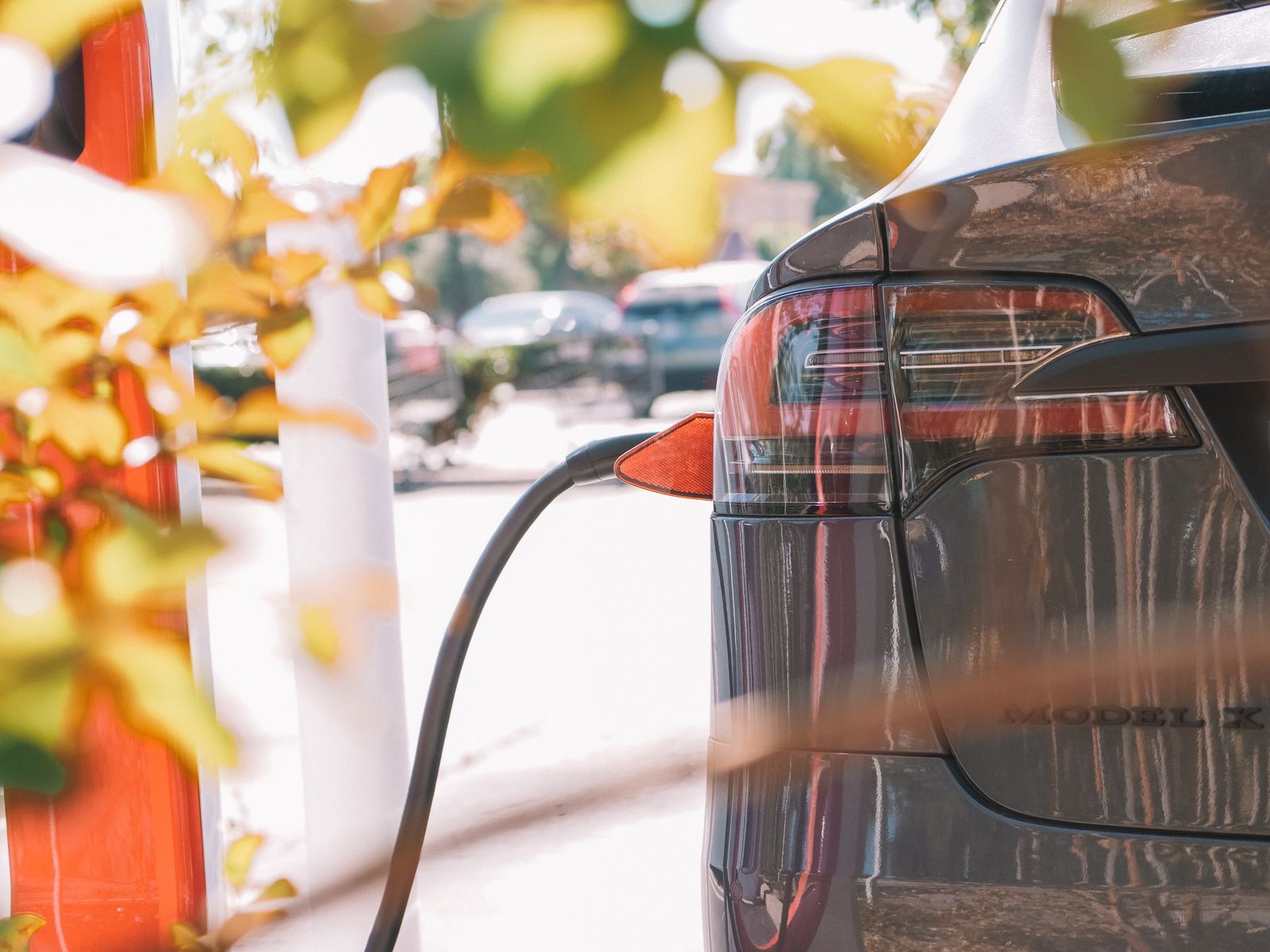
How to Pair the H096 into a Solar-Storage-Charging Site
A solar-storage-charging site puts PV generation, a battery buffer and DC chargers on one AC bus, with the H096 as the charging stage: paired with a hudanewenergy ESS cabinet that has a built-in MPPT, it charges vehicles from sunshine, off-peak grid power, or its own 193 kWh battery.
Small and Medium Sites: Cabinet ESS with Built-In MPPT
The 100kW/215kWh cabinet BESS accepts up to 120 kW of PV through a built-in MPPT (850 V maximum, 200–950 V working range), so rooftop solar connects without a separate PV inverter; its 400 V three-phase output feeds the H096’s 380 Vac input at up to 60 kW. The 150kW/315kWh cabinet ESS doubles PV headroom to 240 kW.
Larger Hubs: Container-Scale Solar-Storage-Charging
Highway service areas and logistics parks combine PV, a container BESS and several chargers. The 250kW/500kWh containerized ESS takes PV, grid and genset inputs, MWh-class units such as the 500kW/1MWh model scale the buffer, and the 60–240kW CCS2 DC charging station takes over when traffic needs more dispensing points.
| Site Profile | PV Input | Storage | Charging Stage |
|---|---|---|---|
| Resort car park, roadside café | Up to 120 kWp via cabinet MPPT | 215 kWh cabinet (100 kW) | H096, 120 kW, dual guns |
| Retail plaza, fleet depot | Up to 240 kWp via cabinet MPPT | 315 kWh cabinet (150 kW) | H096 plus second unit |
| Highway hub, logistics park | 250 kWp and above | 500 kWh – 1 MWh container | CCS2 stations, 120–240 kW |
Three sizing rules of thumb apply (planning assumptions, not guarantees): expect roughly 3–4 kWh per kWp per day in mid-latitude markets, keep AC coupling into the H096 within its 60 kW input, and size storage to cover three to four back-to-back sessions between PV or grid windows.
Off-Grid EV Charging Station vs Grid Upgrade vs Diesel Generator
The choice between a battery-buffered station, a grid reinforcement and a diesel generator comes down to deployment time, running cost and site flexibility.
| Criteria | H096 Battery-Buffered Station | Grid Reinforcement | Diesel Generator |
|---|---|---|---|
| Deployment time | Weeks | 12–36 months (industry reports, 2026) | Days |
| Grid dependency | None, or 60 kW trickle feed | New transformer and feeder required | Fuel logistics only |
| Peak charging power | 120 kW rated / 180 kW max | Limited by new connection size | Depends on genset rating |
| Energy cost driver | Off-peak electricity | Tariff + demand charges | Diesel fuel price |
| Emissions / noise | None on site | None on site | Exhaust and noise |
| Relocatable | Yes, by crane | No | Yes |
A worked example — based on assumptions, not a quoted return — shows the arbitrage logic: if a site buys electricity at an off-peak rate and sells at roughly twice that rate at peak, one full 193 kWh cycle (about 3.2 hours at 60 kW) returns roughly double the energy cost before losses. Actual economics depend on local tariffs and utilisation, so model your own tariff structure before ordering.
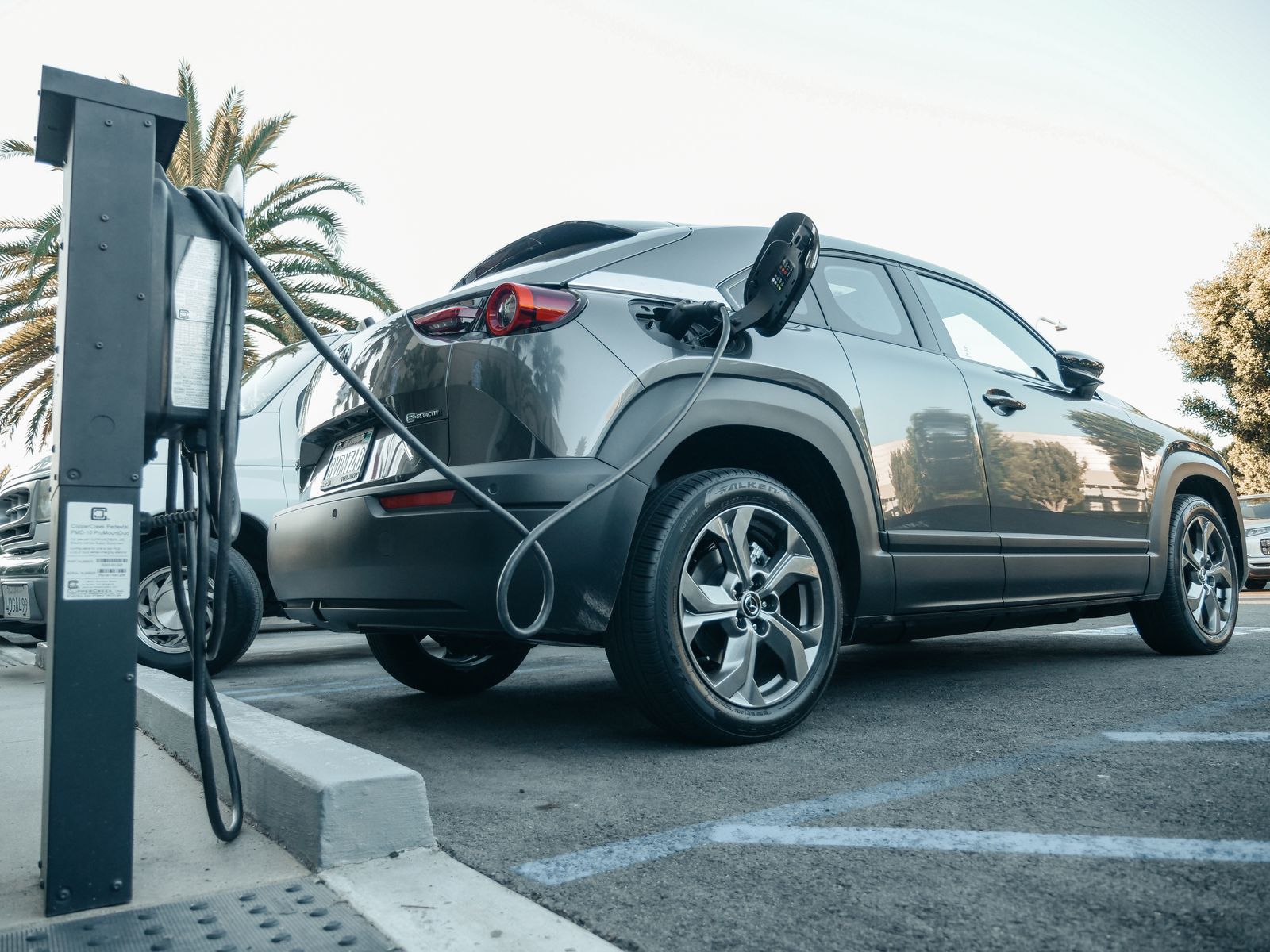
How to Choose the Right Off-Grid EV Charging Station
The right unit depends on five questions. Work through this checklist before requesting a quote:
- Daily energy demand: estimate sessions per day and kWh per session; one full battery serves roughly three to four 50 kWh top-ups, multiplied by the cycles your recharge power allows.
- Connector standards: match your market — GB/T in China, CCS2 across Europe and much of Asia, Type 2 where required; the H096 ships with GB/T and customizes to CCS2 or Type 2.
- Vehicle compatibility: confirm the output window (DC 200–1000 V, 0–250 A) covers your fleet, including 800 V models.
- Climate and environment: check the temperature range, IP rating and altitude limit against your site; liquid cooling is strongly advisable above 30 °C ambient.
- Recharge flexibility: decide whether a 380 Vac feed, gun-to-gun refilling, or both fit your model, and verify 4G / LAN/CAN/RS485 monitoring integrates with your platform.
Frequently Asked Questions
Do I need a grid connection to operate the H096?
No. The H096 stores 193 kWh in its built-in LiFePO4 battery and delivers 120 kW DC fast charging without any grid upgrade. A 380 Vac supply recharges it at up to 60 kW; without one, DC gun-to-gun refilling keeps it in service.
How many vehicles can it charge per day?
One full battery covers roughly three to four typical 50 kWh top-ups, and a 60 kW feed refills it in about 3.2 hours — so a grid-connected site serves on the order of 6–12 vehicles per day. Fully off-grid sites should schedule refills.
Which charging connectors does it support?
The standard configuration uses GB/T guns, customizable to CCS2, Type 2 and other formats for export markets. Each gun has a 7 m cable, and two guns charge simultaneously.
How does the station recharge without a grid?
Through DC gun-to-gun refilling: the station transfers energy into its own 193 kWh battery from a charging session or another unit. Where a PV array is available, pairing the H096 with a cabinet ESS that has a built-in MPPT lets solar replenish the buffer first, so remote and temporary sites stay in service without any fixed supply.
Can it operate in extreme heat or cold?
Yes. The H096 is rated for −30 °C to +50 °C, with intelligent liquid cooling stabilising battery and power-electronics temperatures during sustained output. The IP55 enclosure resists dust and water jets outdoors, up to 3000 m altitude.
Will it charge every electric vehicle model?
The DC 200–1000 V output and 0–250 A current window cover virtually all electric vehicles on the road today, including both 400 V and 800 V platforms. Confirm your market’s connector standard when ordering.
About hudanewenergy
hudanewenergy (Huada New Energy, Huizhou, China) manufactures LiFePO4 systems across portable power stations, home storage, golf cart batteries and C&I energy storage, including the cabinet and container ESS lines that pair with the H096. Every unit is fully function-tested before shipment, with reinforced export packaging and OEM/ODM customization of guns, branding and protocols. To configure a single unit or a complete solar-storage-charging site, contact hudanewenergy for a quote or browse the 60–240kW CCS2 charging station.
Last updated: 22 October 2026