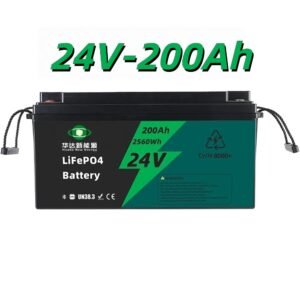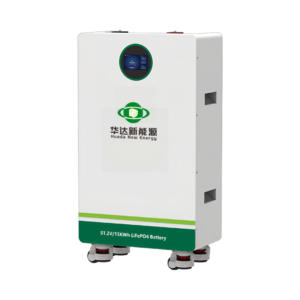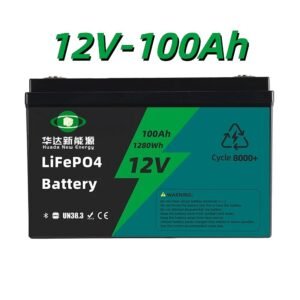
If you are replacing a 24V lead-acid bank in 2026, a 24V 200Ah LiFePO4 battery delivers 5,120Wh of usable energy, a rated life of about 8,000 charge-discharge cycles and roughly half the weight of the lead-acid equivalent, in the same drop-in footprint. This guide explains what those numbers mean — cells, BMS, C-rate, cycle life, IP55, UN38.3 and CE — using the Huada 24V 200Ah LiFePO4 battery as the reference product, for buyers who must judge a datasheet before judging a price.

What Is a 24V 200Ah LiFePO4 Battery?
A 24V 200Ah LiFePO4 battery is a lithium iron phosphate pack that connects eight 3.2V, 200Ah prismatic cells in series — an 8S1P configuration — to produce a nominal 25.6V and 200Ah, which equals 5,120Wh of stored energy in a single housing. In practice, that is one case measuring 520 × 245 × 220 mm, weighing about 38 kg, fitted with M8 terminals and a built-in battery management system — a direct replacement for four 6V deep-cycle lead-acid batteries wired in series, without rewiring.
Three voltage figures define the operating window: 25.6V nominal (8 × 3.2V), a maximum charging voltage of 28.0–29.2V — reached by constant-current charging at 0.2C, then constant voltage at 29.2V until current falls to 0.02C or below — and a 20.0V discharge cut-off (2.5V per cell). Internal resistance is rated at 35 milliohm or less, which keeps voltage sag low at high currents.
Why the 24V 200Ah Segment Is Moving in 2026
The 24V 200Ah LiFePO4 format went mainstream in 2026 as pack prices hit record lows and major brands launched their own 25.6V/200Ah drop-in models. BloombergNEF’s Battery Price Survey (December 2025) put average lithium-ion pack prices at a record-low USD 108/kWh after an 8% annual drop — USD 81/kWh for LFP packs and USD 70/kWh for stationary storage. Spot data from InfoLink (May 2026) showed Chinese LFP storage cells trading around RMB 0.34–0.41/Wh, although lithium carbonate volatility briefly lifted LFP cell prices 10–30% in H1 2026 before easing.
Product launches confirm the shift: on 2 November 2026 Victron Energy announced that its SuperPack NG 25.6V/200Ah LiFePO4 drop-in model was finally available, months after its planned Q2 2026 launch — a sign that 24V/200Ah demand from boat and vehicle builders outran supply. Market research agrees: Expert Market Research (2026) sizes the RV battery market at USD 1.45 billion (2025) growing to USD 3.07 billion by 2035, lithium-ion leading at 11.4% CAGR, and Grand View Research projects the marine battery market to reach USD 2,821.5 million by 2033 (18.5% CAGR). Buyers should also note the US tariff on Chinese non-EV lithium-ion batteries, which rose to 25% in 2026 — landed cost, not ex-works price, should drive quotations.
Key Specifications and What They Mean
The table below lists the rated values of the Huada 24V 200Ah LiFePO4 battery as published on its product page, alongside a plain-language reading of each row.
| Item | Rating | What it means for buyers |
|---|---|---|
| Nominal voltage | 25.6V (8S1P) | Direct replacement for 24V lead-acid banks |
| Rated capacity | 200Ah / 5,120Wh | One case replaces a full lead-acid string |
| Internal resistance | ≤35mΩ | Low voltage sag at high current draw |
| Cycle life | 8,000+ @ 0.2C to 80% capacity | Years of daily deep cycling; see below |
| Max charge voltage | 28.0–29.2V | Check inverter/charger absorption setpoint |
| Charge current | 100A standard / 200A max | 0.2C full charge in about 5 hours |
| Discharge current | 200A continuous / 400A pulse (<3s) | Runs 3–5kW inverters without sag |
| Discharge cut-off | 20.0V | BMS-protected deep discharge limit |
| Self-discharge | ≤3.5% per month @ 25°C | Ready after long seasonal storage |
| Charge temperature | 0°C to 45°C | Never charge below 0°C without low-temp protection |
| Discharge temperature | −20°C to 60°C | All-season deep-cycle operation |
| Water/dust rating | IP55 | Dust-protected, resists water jets (IEC 60529) |
| Cell format | Prismatic LFP, 8S1P | Fewest connections; the dominant format in drop-in batteries |
| Dimensions / weight | 520 × 245 × 220 mm / approx. 38 kg | Lead-acid equivalent banks weigh 75 kg or more |
| Terminals / monitoring | M8 / Bluetooth | State of charge visible from a phone app |
| Certification | UN38.3, CE | Air and sea freight as Class 9; EU compliance |
Two rows deserve extra attention. First, the C-rate: 0.2C means current equals one fifth of capacity — 40A here — so a full 0.2C cycle lasts about five hours; the 8,000+ cycle rating applies at this gentle rate, while sustained currents near the 200A maximum (1C) typically reduce cycle life, which is why inverter sizing matters. Second, the temperature windows: charging is permitted from 0°C to 45°C, and charging a standard LFP battery below 0°C without a low-temperature cutoff or heater risks lithium plating (Energy Resources Insights, 2026).
How Long Does It Last? Cycle Life and Total Throughput
Rated for 8,000 cycles at 0.2C until capacity fades to 80%, the Huada 24V 200Ah LiFePO4 battery can move an estimated 32.8 MWh of energy over its service life. The maths: 8,000 cycles × 5,120Wh × 80% usable capacity ≈ 32.8 MWh, assuming daily cycling at the rated depth of discharge. One cycle per day implies more than 21 years by cycle count alone; in practice calendar ageing usually becomes the limiting factor, so treat the figure as a durability indicator rather than a warranty commitment.
The contrast with lead-acid is structural: sealed lead-acid batteries typically deliver around 500 cycles (Dakota Lithium, cited by Energy Resources Insights, 2026), and lead-acid chemistry prefers shallow discharge, so a 5,120Wh bank cycled at 50% DoD yields roughly 2.6 MWh over 1,000 cycles. Total cost per usable kilowatt-hour, not sticker price, decides deep-cycle purchases.
Certifications Explained: UN38.3, CE and What Comes Next
The Huada 24V 200Ah LiFePO4 battery is listed on its product page with UN38.3 and CE certification, and the two marks matter at different stages of the buying journey.
UN38.3 is the transport safety test in the UN Manual of Tests and Criteria (T.1–T.8: altitude, thermal, vibration, shock, external short circuit, impact, overcharge and forced discharge). A pack that passes is classified as a Class 9 dangerous good, shippable legally by air and sea; the product page confirms this battery is certified for air and sea transport with documents included, so ask for the test summary with every quotation — freight forwarders will request it.
CE marks conformity with EU law; for lithium batteries the governing framework is Regulation (EU) 2023/1542, the EU Battery Regulation, whose obligations phase in on a fixed timetable:
| Date | Requirement under EU 2023/1542 | Status / relevance |
|---|---|---|
| 18 Aug 2024 | CE marking obligation for batteries placed on the EU market | In force; applies to this product |
| 18 Aug 2026 | Battery labelling requirements (capacity, chemistry, separate collection symbols) | In force since August 2026 |
| 18 Feb 2027 | Digital battery passport for industrial batteries above 2kWh | This 5,120Wh pack falls within scope |
| 18 Aug 2028 | Carbon footprint declaration for LMT batteries | Watch for extension to other categories |
One honesty note: UN38.3 is a transport certification, not a performance or grid-safety standard, and CE does not replace application standards such as IEC 62619 (industrial lithium batteries) or UL 1973 (stationary and auxiliary power), which some project tenders specify. Stamped datasheets, certification copies and test summaries can be requested together with pricing through the enquiry form on the product page.
LiFePO4 vs Lead-Acid: The Numbers Over a Service Life
Over a typical service life, a 24V 200Ah LiFePO4 battery delivers several times more usable energy per kilogram than an equivalent lead-acid bank, with no maintenance, no venting and no acid-leak risk.
| Item | Huada 24V 200Ah LiFePO4 | Lead-acid (same size) |
|---|---|---|
| Cycle life (to 80% capacity) | 8,000+ cycles @ 0.2C | Typically 500–1,500 cycles |
| Weight | Approx. 38 kg | Approx. 75 kg or more |
| Self-discharge (25°C) | ≤3.5% per month | Significantly higher |
| Usable capacity | Deep discharge to 80% DoD | Usually limited to about 50% DoD |
| Maintenance | None — fully sealed | Regular checks and topping-up |
| Installation | Drop-in, plug-and-play | Heavy lifting and venting required |
On cost, the gap narrows every year: with LFP pack prices at USD 81/kWh (BloombergNEF, 2025) and historically volatile lead prices on the London Metal Exchange, lifetime cost per usable kWh now favours lithium in most deep-cycle applications, though seasonal or rare cycling may still justify lead-acid.
Real-World Applications
A 24V 200Ah LiFePO4 battery fits wherever a 24V lead-acid bank used to be the default, from RV house power to telecom standby, each stressing a different part of the datasheet.
RV and camper house power
Motorhome and caravan builders are moving house banks to lithium; Expert Market Research (2026) notes factory interest in higher-voltage architectures and connected BMS data. For owners, one 38 kg case replaces roughly 75 kg of lead-acid, doubling usable capacity at 80% DoD and cutting recharge time.

Marine house batteries
On boats, the IP55 sealed casing and absence of liquid acid make LiFePO4 a practical house-bank upgrade in humid engine spaces; Grand View Research projects the marine battery market to reach USD 2.82 billion by 2033 as builders convert. Verify charger profiles and mind the 0°C charging floor in winter lay-up.

UPS and telecom standby
Standby systems float for years, so low self-discharge (≤3.5% per month) and a maintenance-free sealed case matter more than C-rate. Towers and remote cabinets gain Bluetooth visibility, letting site crews check state of health without a site visit.

Off-grid solar storage
Paired with a 3–5kW inverter, one 5,120Wh case stores a full day of solar surplus for cabins and rural homes, and the product page lists parallel-ready capacity for larger off-grid loads. For smaller systems, the 24V 100Ah LiFePO4 battery covers 2,560Wh loads at lower cost per case.
How to Choose the Right 24V 200Ah LiFePO4 Battery
Choosing between suppliers comes down to eight checks.
- Cell grade and format: grade-A prismatic LFP cells with a published internal resistance (≤35mΩ here) and a clear 8S1P topology.
- BMS protections: overcharge, over-discharge, over-current and short-circuit protection, plus cell balancing — confirmed in writing, not assumed.
- Current ratings: M8 terminals rated 200A continuous and 400A pulse (under 3 seconds) if you run large inverters.
- Environment: IP55 sealing for outdoor bays and engine rooms; confirm charge and discharge temperature windows for your climate.
- Certification and shipping documents: UN38.3 test summary and CE declaration supplied with the order; ask about IEC 62619 or UL 1973 for project tenders.
- Monitoring and integration: Bluetooth as standard here; RS485/CAN and custom protocols available through the OEM/ODM programme.
- Configurability: logo, packaging and capacity customisation for distributors (OEM/ODM supported on this model).
- Warranty and after-sales: a written warranty policy with technical support, stated before the purchase order.
Buyers comparing platforms should also read the 12V 200Ah LiFePO4 battery for 12V systems, and our earlier selection-focused walkthrough, the 24V 200Ah LiFePO4 Battery Guide.
Frequently Asked Questions
How long does a 24V 200Ah LiFePO4 battery last?
More than 8,000 cycles at 0.2C to 80% capacity, implying roughly 32.8 MWh of lifetime throughput under stated assumptions — over 21 years of daily cycling by cycle count, with calendar ageing usually the real limit first.
Can I replace my 24V lead-acid batteries with a 200Ah LiFePO4 battery without changing my charger?
In most cases yes, because the pack is a drop-in replacement with the same voltage platform and installation size. Verify that your charger or inverter absorption voltage falls within the 28.0–29.2V window and that no equalisation stage is enabled, since lithium batteries do not tolerate equalisation.
What does 0.2C mean on a 200Ah battery datasheet?
C-rate expresses current relative to capacity. 0.2C of a 200Ah battery is 40A, so the 8,000-cycle rating applies at a gentle 40A charge and discharge; sustained currents near the 200A maximum will typically reduce cycle life, and 400A pulses are permitted only for under three seconds.
Is a LiFePO4 battery safe on a boat or in a humid RV bay?
LiFePO4 is a chemically stable phosphate chemistry, and this pack adds an IP55-rated sealed case (IEC 60529) that resists dust and water jets. No liquid acid can spill, and the built-in BMS guards against overcharge, over-discharge, over-current and short circuit.
What certifications does the Huada 24V 200Ah LiFePO4 battery come with?
UN38.3 covers transport as a Class 9 lithium battery by air and sea, documents included; CE reflects conformity with EU law under Regulation (EU) 2023/1542. Ask for the test summary and CE documents with your quotation.
Can I connect multiple 24V 200Ah batteries together for more capacity?
The product page describes parallel-ready capacity for off-grid homes and cabins. Configuration limits depend on the BMS design and your charge sources, so confirm the intended series or parallel arrangement with the factory before ordering; RS485 or CAN communication options are available via OEM/ODM.
About huadaenergy
huadaenergy (Huada New Energy) manufactures LiFePO4 batteries and energy storage systems in Huizhou, Guangdong, China, serving distributors, installers and project buyers worldwide. The portfolio spans portable power stations, 12V/24V lead-acid replacement batteries, golf cart batteries, home storage, and cabinet and containerized ESS, with OEM/ODM customisation for logo, packaging, capacity and BMS protocols. To request pricing, stamped datasheets and certification documents, send an enquiry through the contact page or email sales@huadaenergy.com.
Last updated: 2026-11-14