12.8V 150Ah Portable DC Battery Pack: Field Scenarios
Last updated: 2026-11-06
A 12.8V 150Ah portable DC battery pack carries 1,920Wh of lithium iron phosphate energy in a 15.5 kg hand-carry case, and it earns its keep wherever technicians must power DC equipment away from mains power. This guide walks through the field scenarios the pack is built for — telecom maintenance, outdoor inspection and temporary DC power — with the runtime arithmetic, specification table and compliance checks buyers need before ordering.
What Is a 12.8V 150Ah Portable DC Battery Pack?
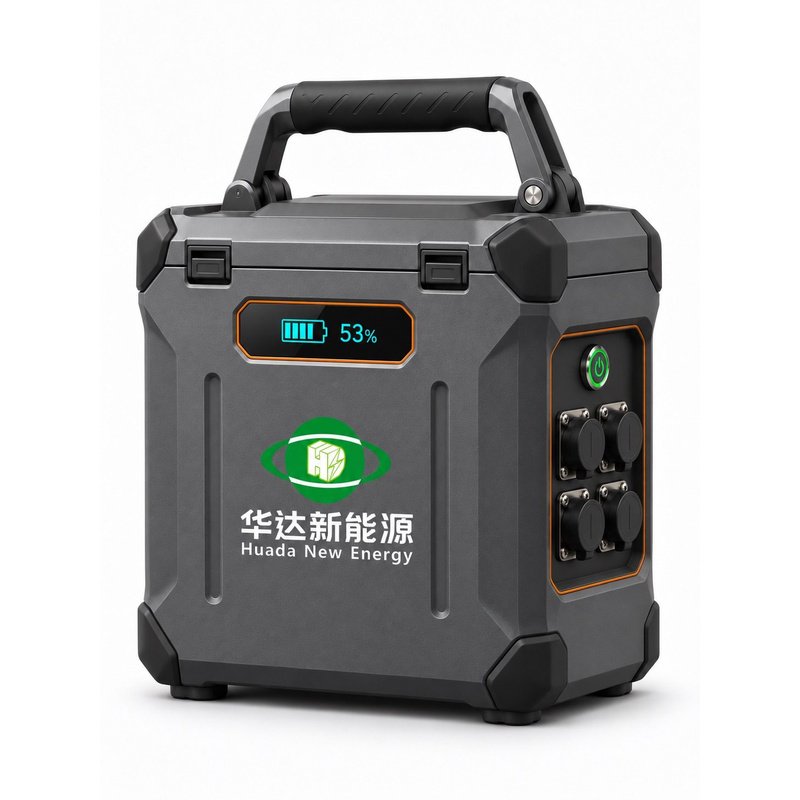
A 12.8V 150Ah portable DC battery pack is a sealed lithium iron phosphate (LiFePO4) energy store rated at 1,920Wh that feeds 12.8V DC directly to compatible equipment through fused output connectors — no inverter, no fuel and no installation. The huadaenergy pack reaches its rating with four EVE LF150 cells in a 4S1P configuration, holds a 10–14.6V DC operating window, and ships in an engineering-PP carry case of 385 × 295 × 170 mm weighing no more than 15.5 kg. At 1,920Wh in 15.5 kg, the system stores roughly 124Wh per kilogram, several times what a sealed lead-acid case of the same mass can hold.
Three interface details define how the pack behaves on site:
- Two 20A DC outputs. Each branch is rated 20A on an LP20-4P connector and protected by its own fuse, so a short on one load cannot take down the other. The standard discharge current is 40A total, about 512W at 12.8V.
- A dedicated DC charge input. The LP20-3P charge port accepts 20A standard and maximum, using a compatible lithium-battery charger.
- Local and wireless monitoring. The LCD shows state of charge, voltage, current and temperature; Bluetooth is standard for app-based checks, with optional RS485/CAN for project-specific communication.
Not a Power Station: Why the Missing Inverter Matters
This product is a DC source, not an AC power station: the documentation lists no AC inverter output, so laptops or mains appliances need the inverter inside the connected device or a separate unit. That constraint is deliberate — removing the DC-AC conversion stage cuts cost, weight and standby losses, which matters when the load is native 12V DC equipment such as telecom test sets, routers and inspection instruments. Buyers whose crews need AC outlets should compare it with the H092-1000Wh portable power station or the trolley-case 2.5kWh portable power station, both of which add inverter output.
Why Field Teams Are Replacing Small Generators in 2026
Field service teams are under cost pressure to stop running small generators for short work windows, because diesel has become expensive and volatile. The GSMA’s Mobile Net Zero 2026 report found that mobile operators burned about 2.5 billion litres of diesel and gasoline in 2024 at an estimated cost of USD 3 billion, and it records fuel prices rising more than 40% in the second quarter of 2026 (GSMA, 2026). In Sub-Saharan Africa alone, operators consumed around half a billion litres of diesel in 2024, with tower companies adding another 900 million litres — and every litre reaches a tower site by truck and jerrycan before a technician can run a single test.
Where the 1,001–2,000Wh Segment Fits
Portable battery demand is scaling alongside that fuel problem: Persistence Market Research sizes the global portable power station market at USD 1.8 billion in 2026, rising to USD 4.9 billion by 2033 at a 15.4% CAGR, with LiFePO4 chemistry holding about 47% of the battery-type mix in 2026 and the 1,001–2,000Wh capacity segment growing fastest at a 17.8% CAGR (Persistence Market Research, 2026). The huadaenergy pack, at 1,920Wh, sits at the top of that fastest-growing band: large enough for a full working day of DC loads, still liftable by one person.
Key Specifications and What They Mean
Every specification on this 12.8V 150Ah portable DC battery pack describes a field constraint rather than a brochure number, and the table below quotes each value from the huadaenergy product documentation for this model.
| Specification | Value | What it means for the buyer |
|---|---|---|
| Chemistry / cells | LiFePO4, EVE LF150, 4S1P | Thermally stable olivine cathode; four cells in series give the 12.8V nominal platform |
| Nominal capacity | 12.8V / 150Ah / 1,920Wh | Full-day DC energy for dispersed worksites; no cobalt in the cathode |
| Operating voltage | 10–14.6V DC | Matches native 12V DC equipment; 2.5–3.65V per cell window |
| DC outputs | 2 × 20A on LP20-4P, independent branch fuses | 40A total standard discharge, roughly 512W at 12.8V |
| DC charge input | LP20-3P, 20A standard / 20A maximum | Full recharge in roughly 7.5–9h from empty, charger-dependent |
| Monitoring | LCD (SOC, voltage, current, temperature) / Bluetooth standard | Field checks without opening the case; app functions depend on the supplied BMS software |
| BMS protection | Overcharge, over-discharge, overcurrent, short circuit, temperature | Protection runs continuously inside the pack, not in a separate box |
| Optional communication | RS485 / CAN | Project-specific integration where remote telemetry is required |
| Temperature limits | Charge 0 to +60°C; discharge −10 to +65°C; storage −5 to +50°C | Covers hot-climate field work; no charging below freezing |
| Dimensions / mass | 385 × 295 × 170 mm / ≤15.5 kg | One-person carry between sites; fits a vehicle footwell |
| Enclosure | Engineering PP, black, folding handle and latches | Repeated transport handling; corner protection on the case |
Runtime Math You Can Check
Runtime equals usable energy divided by load power, and the only assumption a buyer must add is how much of the 1,920Wh the BMS releases. The datasheet does not state a depth-of-discharge limit, so the chart below assumes 90% usable energy — treat it as an estimate and confirm the usable-energy factor in the configuration sheet.
At that 90% assumption, 1,728Wh runs a 30W telecom test terminal for roughly 58 hours, a 50W communications router for about 35 hours, a 100W inspection kit for around 17 hours and a 300W portable fridge for close to 6 hours. Crews that draw the full 40A (about 512W) get a shorter window of roughly 3.4 hours — the pack is sized for DC electronics, not for sustained high-power loads.
Real-World Application Scenarios
The product documentation names four field uses — telecom service, outdoor inspection, temporary DC power and outdoor work — and the three scenarios below show how the specification converts into daily practice.
Telecom Site Maintenance and Commissioning
Telecom crews need DC power for test sets, terminals and temporary routers during installation, commissioning and fault-finding, often at sites where the only available source is the tower’s own limited supply. The scale of that work is large: mobile operators consumed about 300TWh of electricity in 2024, roughly 1% of global electricity use, and energy per transmitted unit of data fell about 15% per year between 2019 and 2025 even as 5G densification adds equipment on towers (GSMA, 2026). A carry-case DC pack lets the technician work on the equipment bay without coupling to the site’s live power system, and two fused 20A branches keep a radio test set and a lighting load electrically separate.

Outdoor Inspection and Survey Work
Inspection teams walk or drive between dispersed points — solar plants, pipelines, cable routes, antenna masts — and their instruments are almost all native 12V DC devices. A fixed battery installation or a small generator does not follow the inspector; a 15.5 kg case does. The LCD state-of-charge readout gives a per-stop energy check without an app, and Bluetooth logs voltage and temperature history through a compatible application. Because discharge is rated down to −10°C, morning inspections in cool seasons stay within limits, though charging below 0°C is not permitted, so depleted packs should warm up before recharging.

Temporary DC Power at Worksites and Remote Equipment
Short-duration worksites — sensor trials, temporary telemetry, evening roadworks, event equipment — need a DC source that deploys in minutes and leaves no fuel residue. The pack’s 40A total standard discharge covers multiple low-power DC loads at once, and the integrated BMS handles overcharge, over-discharge, overcurrent, short-circuit and temperature faults unattended. For stationary 12V duty between these mobile jobs, the 12V 200Ah LiFePO4 battery is the fixed-installation counterpart. For longer deployments, storage guidance is explicit: keep the pack near 50% state of charge and perform charge-discharge maintenance every three months.
Certifications and Compliance: What to Confirm Before Ordering
Certification planning for this model starts from an honest fact: the supplied product documentation does not list certificates, an ingress-protection rating, warranty terms, cycle life or shipping data for this pack, and huadaenergy supplies the configuration sheet, technical documentation and available test reports on request. Buyers should treat certification as a per-order document set, not as printed claims. The framework those documents map onto is well defined:
| Compliance item | What applies to a 1,920Wh LiFePO4 pack | Status |
|---|---|---|
| UN 38.3 (UN Manual of Tests and Criteria) | Tests T.1–T.8 for lithium cells and batteries; lithium-ion batteries ship as UN 3480 or UN 3481, Class 9 dangerous goods | Request the test summary with every order; required for air and sea freight |
| Regulation (EU) 2023/1542 | Battery labelling obligations apply from 18 August 2026; at 1.92kWh the pack sits below the 2kWh industrial-battery threshold for carbon-footprint declarations (2026) and the battery passport (2027) | Confirm classification with the supplier; below 2kWh avoids those two milestones |
| EU radio and EMC compliance | The Bluetooth module brings the pack under the Radio Equipment Directive 2014/53/EU, which covers EMC, safety and spectrum for radio equipment | CE declaration of conformity to request per order |
| RoHS 2 (Directive 2011/65/EU) | Restricted-substances limits for electrical equipment sold in the EU | Certificate on request |
| IEC 62619 / IEC 62133-2 | Safety standards for industrial lithium batteries and for sealed lithium cells in portable applications | The typical certificate set buyers specify for tenders |
Two practical notes follow from the table. First, because the documentation does not assign every connector or state a peak-current rating, load lists should be validated against the configuration sheet rather than against figures from other huadaenergy models. Second, freight teams should book the pack as Class 9 dangerous goods and attach the UN 38.3 test summary and safety data sheet to the shipping file — the absence of these documents at customs costs more than any certificate.
How to Choose the Right Portable DC Battery Pack
Choose a portable DC pack by matching five checks against your actual load list rather than by comparing headline watt-hours alone:
- Voltage and connector compatibility. Confirm every device accepts 10–14.6V DC and that LP20-4P field connectors (or an adapter) match your leads.
- Current per branch. Keep each 20A branch within its fuse rating; split loads across the two outputs so a fault on one cannot drop the other.
- Usable energy, not nameplate. Ask for the depth-of-discharge or usable-energy factor, then divide 1,920Wh by your load's watts honestly.
- Environment. Match the 0 to +60°C charging and −10 to +65°C discharge windows to your climate, and plan a dry, non-flood-prone storage spot.
- Documentation. Request the UN 38.3 test summary, CE/RoHS declarations and the configuration sheet with the quotation — before the purchase order, not after.
Frequently Asked Questions
Is a 12.8V 150Ah DC battery pack the same as a portable power station?
No. A portable power station includes an AC inverter and mains-style sockets, while this pack supplies 12.8V DC only through two fused 20A outputs and has no AC output listed in its documentation. It is the lighter, simpler choice for native 12V DC equipment; crews needing AC outlets should use a power station instead.
What can I run on the two DC outputs at the same time?
Each output is rated 20A with its own branch fuse, for 40A of total standard discharge — about 512W across both outputs at 12.8V. Keep each individual load at or below 20A (roughly 256W at 12.8V) and confirm connector and voltage compatibility before connecting.
How long will the pack run my equipment?
Divide about 1,728Wh of estimated usable energy (assuming 90% of 1,920Wh, an assumption to confirm in the configuration sheet) by your load's wattage. A 50W router runs roughly 35 hours, a 100W instrument kit about 17 hours and a 300W load nearly 6 hours.
Which certifications does the pack ship with?
The supplied documentation does not list certificates for this model, so the correct move is to request the current configuration sheet, available test reports and freight documents — including the UN 38.3 test summary — with your quotation. huadaenergy supplies certification documentation per order rather than printing unverifiable claims.
Can I charge it from a solar panel?
Not directly as documented: the pack charges through a dedicated LP20-3P DC input at 20A using a compatible lithium-battery charger. A solar charging setup therefore needs a PV panel plus a DC charger that presents the correct lithium charge profile to the input; direct panel connection is not supported.
How does the weight compare with a lead-acid equivalent?
This pack weighs no more than 15.5 kg for 1,920Wh, while a sealed 12V 150Ah lead-acid battery typically weighs around 40–48 kg and delivers only about half the usable energy per cycle. One person can carry the LiFePO4 case; a lead-acid equivalent usually takes two.
About huadaenergy
Huada Technology (huadaenergy) builds lithium battery storage at its Huizhou production base in Guangdong, China, covering portable power stations, 12V to 48V LiFePO4 packs, home batteries, and cabinet and containerised C&I systems. Portable products are assembled, inspected and full-function tested before shipment, with OEM/ODM options on capacity, connectors, branding and protocols. To request the configuration sheet, certification documentation or a sample of the 12.8V 150Ah portable DC battery pack, contact the huadaenergy sales team.
—
Last updated: 2026-11-06