A 1000W portable power station with a 1,024Wh LiFePO4 battery covers the power gap that phone banks and fuel generators leave open: enough wattage for a campsite fridge, a router, a laptop and tools, in a 13 kg case with no fumes and no fuel. The H092 from huadaenergy is built for exactly that job — 1,000W of pure sine wave AC (2,000W peak), seven output ports, four charging methods and a 3,000+ cycle battery pack — and it is available to distributors and outdoor-power brands under OEM/ODM terms. This guide breaks down the specifications, the runtime math, the comparisons against lead-acid units and gasoline generators, and the paperwork you should request before ordering.
What Is the H092 1000W Portable Power Station?
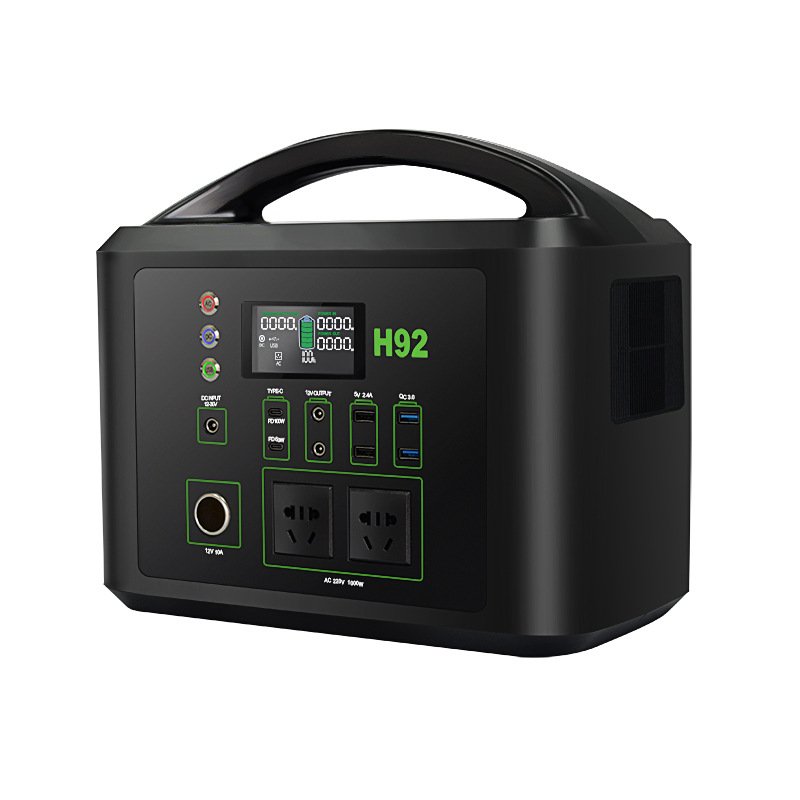
The H092 1000W portable power station is a rechargeable lithium power pack that combines a 1,024Wh LiFePO4 battery (40Ah at 25.6V), a 1,000W pure sine wave inverter with a 2,000W peak, and a panel of AC, USB-C, USB-A, DC and car outputs in one 350 × 200 × 304 mm case weighing 13 kg. The inverter is available in 110V/60Hz or 220V/50Hz configurations, so the same platform serves North American, European and other markets. Charging comes from four routes: a 12–30V solar input up to 180W with MPPT tracking, a 28V wall adapter, 100W USB-C PD, or the car socket while driving.
Key Specifications at a Glance
| Item | H092-1000Wh | What It Means for Buyers |
|---|---|---|
| Battery | 1,024Wh — 40Ah / 25.6V LiFePO4, grade-A prismatic cells | Stable chemistry, long cycle life, no cobalt |
| AC output | 1,000W rated / 2,000W peak, pure sine wave, 110V/60Hz or 220V/50Hz ×2 | Runs motor-driven tools; safe for laptops, cameras, CPAP |
| Cycle life | 3,000+ cycles with more than 80% capacity remaining | Roughly 8 years of daily use before reaching 80% |
| Solar input | 12–30V, 6A, max 180W (MPPT) | Works with most folding panels |
| Other inputs | 28V adapter; USB-C PD 5–20V up to 100W | Recharge from the grid or a laptop charger |
| Outputs | 2× AC; USB-A 5V/2.4A ×2; QC3.0 ×2; Type-C 100W PD + 60W PD; car socket 14V/15A; DC5521 13.5V/5A ×2; 6W LED light | Up to seven devices at once |
| Temperature | Charge −5°C to 50°C; discharge −20°C to 50°C | Winter camping and hot worksites covered |
| Protection | Over-temperature, over-voltage, over-current, overcharge, over-discharge, short circuit | BMS runs on every charge cycle |
| Size / weight | 350 × 200 × 304 mm; 13 kg with carry handle | One-hand carry into a car boot |
| Certification | CE, FCC, RoHS (as listed on the product page) | Core compliance documents for EU/US buyers |
Why the 1,000W Class Is Growing Right Now
Demand is concentrating in exactly the capacity band the H092 occupies. Persistence Market Research (2026) puts the global portable power station market at US$1.8 billion in 2026, heading to US$4.9 billion by 2033 at a 15.4% CAGR, with LiFePO4 chemistry already holding around 47% of the market by battery type. The same report identifies the 1,001–2,000Wh class as the fastest-growing segment — and 1,024Wh sits at its entry point, which is where value-driven buyers and distributors typically start.
Resilience demand is the other engine. U.S. utilities recorded an average interruption time of roughly 11 hours per customer in 2024 once major weather events are included, the worst in a decade (EIA, 2025). A 13 kg, indoor-safe battery that runs a router, lights and laptops through an outage — silently and with zero exhaust — is the response most households actually deploy, because gasoline generators cannot be run indoors and fuel goes stale in storage.

Runtime Math: What 1,024 Wh Actually Powers
At 1,024Wh, the H092 delivers about one kilowatt-hour of usable energy per charge, and product-page runtime estimates translate that into practical terms: around 110 phone charges, 17 hours for a 60W laptop, 104 hours for a 10W Wi-Fi router, or 20 hours for a 50W portable fridge (product-page estimates; actual runtime varies with load, temperature and inverter overhead). The 2,000W surge matters as much as the rating: compressor fridges, pumps and angle grinders draw two to three times their running power at start-up, and a pure sine wave 2,000W peak absorbs that spike without tripping.
Real-World Applications
The H092 covers three recurring jobs where 1,024Wh is the right size: multi-day camping trips, indoor outage backup and mobile work sessions.
Camping and Overlanding
Lights, drone batteries, a 50W portable fridge and phones for a weekend draw well under 1kWh per day, so one H092 charge covers a multi-day trip; the 180W MPPT solar input refills roughly 15–20% per hour of good sun in practice. There is no noise, no exhaust and no fuel canister to carry, which is why campsite operators increasingly prefer battery-powered guests.
Home Backup
Through an outage, the H092 keeps a router, lamps, laptops and phone charging alive indoors — something no gasoline generator can do safely. For buyers whose grid reliability is poor, pairing one unit for indoor essentials with the 193kWh off-grid EV charging station for larger loads is a two-tier resilience strategy rather than a substitute.

Remote Work and Content Crews
A laptop, a monitor, a router and camera batteries total well under 300W, so a full working day (8 hours) consumes roughly a third of the pack. Location photographers can run lights and chargers all day and top up from a folding panel between setups; the 6W emergency LED doubles as a fill light in a pinch.

H092 vs Lead-Acid Stations vs Gasoline Generators
The H092’s advantages over the two common alternatives are measurable, not stylistic. Over its rated 3,000+ cycles at 80%+ capacity, a 1,024Wh LiFePO4 pack delivers roughly 2.46 MWh of energy (1,024Wh × 3,000 × 0.8 — arithmetic based on assumptions; real duty cycles vary). A lead-acid power station of the same nominal capacity, cycled to 50% depth for 400 cycles — a typical sealed lead-acid service life — delivers around 0.2 MWh before replacement. That is roughly a 12-fold difference in lifetime delivered energy per unit purchased, which is why LiFePO4 already holds about 47% of the market by battery type (Persistence Market Research, 2026).
Against a 1,000W gasoline inverter generator — typically 12–25 kg plus fuel, 50–58 dB running noise and unusable indoors (typical specification ranges; models vary) — the H092 trades runtime-per-litre for silence, indoor safety and zero maintenance. For camping, indoor backup and content work, that trade is decisive; for multi-day high-wattage worksite power beyond 1kW, a fuel generator or a larger unit such as the 2500W trolley-case station or the 3.6kWh model still makes sense.
| Criterion | H092 (LiFePO4) | Lead-acid station (typical) | 1kW gasoline generator (typical) |
|---|---|---|---|
| Usable energy | 1,024Wh (full depth) | ~512Wh (50% DoD assumed) | Fuel-limited |
| Cycle life | 3,000+ to ≥80% | ~300–500 cycles to 50% DoD | Service-life driven |
| Lifetime delivered energy | ~2.46 MWh (assumption-based) | ~0.2 MWh | Fuel-dependent |
| Weight | 13 kg | 25–35 kg typical | 12–25 kg + fuel |
| Noise | Silent (fan under load) | Silent | 50–58 dB typical |
| Indoor use | Yes | Yes | No |
| Maintenance | None | None | Oil, plugs, fuel freshness |
| Emissions on site | None | None | Exhaust + fuel storage |
Certifications Explained: CE, FCC and RoHS
The H092 is listed on its product page with CE, FCC and RoHS certification — the three documents most buyers encounter first. CE marks conformity with applicable EU directives and regulations for the product as placed on the market; FCC compliance covers electromagnetic emissions for the U.S. market; RoHS 2 (Directive 2011/65/EU) restricts hazardous substances such as lead, mercury and cadmium in the electronics. Each of these claims is stated on the product page, and stamped reports should be requested per order.
Certification context matters for sourcing decisions in 2026. The third edition of ANSI/CAN/UL 2743 — the safety standard for portable power packs — was published in September 2025, and North American retailers are tightening requirements accordingly; the same scrutiny followed CPSC recalls of more than a million lithium power banks in 2025 (CPSC, 2025). Buyers planning retail channels in the U.S. and Canada should therefore confirm with the factory which UL 2743 test documentation is available for the H092 platform, and on what timeline, before committing to shelf programs. For transport, the product ships as a certified lithium-battery shipment by sea and air freight with documents included (per the product page) — ask for the transport documentation pack with your quotation.
| Requirement | Listed for H092 | Covers |
|---|---|---|
| CE | Yes (product page) | EU market conformity |
| FCC | Yes (product page) | U.S. electromagnetic compliance |
| RoHS 2 (2011/65/EU) | Yes (product page) | Hazardous-substance restriction |
| UL 2743 (3rd ed., 2025) | Request per order | North American retail benchmark |
| Lithium transport docs | Included with shipment | Sea/air freight compliance |
How to Choose a 1000W Portable Power Station
Selection should be driven by five checks rather than headline wattage:
- Chemistry and cycles. Confirm LiFePO4 cells and a stated cycle rating (the H092: 3,000+ cycles to more than 80% capacity). Avoid unspecified “lithium-ion” with no cycle figure.
- Inverter quality. Pure sine wave output is non-negotiable for laptops, CPAP machines and tool motors; check the peak rating for compressor start-ups (H092: 2,000W peak).
- Input flexibility. A station you cannot refill is dead weight; look for solar (12–30V, MPPT), wall and USB-C PD inputs (H092 supports all three).
- Output count and standards. Match the port list to your gear: 100W USB-C PD for laptops, QC3.0 for phones, regulated DC for fridges.
- Documentation. Request CE/FCC/RoHS reports, the transport document pack and, for North American retail, UL 2743 status — before the first purchase order, not after.
Frequently Asked Questions
What can the H092 power at the same time?
Up to seven devices across its output ports, within the 1,000W continuous / 2,000W peak AC limit. A typical mix — 50W fridge, 60W laptop, router, lights and phone charging — draws under 200W simultaneously.
How long does the H092 run a fridge or router?
Product-page estimates give 20 hours for a 50W portable fridge and 104 hours for a 10W Wi-Fi router per full charge. Actual figures vary with compressor duty cycle, ambient temperature and inverter overhead.
How long does the battery last?
The H092 uses grade-A prismatic LiFePO4 cells rated for more than 3,000 cycles with over 80% capacity remaining — several times the service life of lead-acid equivalents.
Can I charge it with a solar panel?
Yes. The solar input accepts 12–30V at up to 180W with MPPT tracking, so most folding panels work directly. Wall adapter (28V) and 100W USB-C PD charging are also supported.
Which certifications does the H092 have?
The product page lists CE, FCC and RoHS. Shipments are prepared as certified lithium-battery shipments with transport documents included; request stamped reports and any UL 2743 documentation for your target market with your quotation.
Do you support OEM/ODM for our brand?
Yes. huadaenergy offers logo printing, packaging, capacity and Wi-Fi/Bluetooth APP customization for the H092 platform, with wholesale and distributor pricing available on request.
About huadaenergy
huadaenergy (Huizhou Huada Technology Co., Ltd.) manufactures LiFePO4 batteries and energy storage systems in Huizhou, Guangdong, China — from portable power stations and 12V–51.2V battery packs to home storage and container-scale BESS. Grade-A prismatic cells, in-house BMS integration and OEM/ODM customization are standard across the range. To request a quotation, stamped datasheets or OEM terms for the H092, visit the H092 product page or contact the sales team.
Last updated: 2026-11-07