10kWh Home Battery Specs Explained: 51.2V, 200Ah, H096
Last updated: 2026-11-05
A 10kWh home battery stores about one day of electricity for a typical single-family house, and three numbers explain where that figure comes from: 200Ah of charge multiplied by 51.2V of nominal voltage equals 10,240Wh. This guide unpacks each specification on the huadaenergy H096-10kWh home battery datasheet — capacity, voltage window, cycle life, IP rating and certification — in the order a buyer should read them, and flags where the numbers mislead.

What Is a 10kWh Home Battery in Plain Numbers?
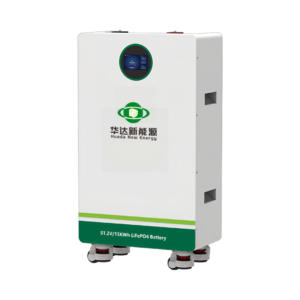
A 10kWh home battery is a lithium iron phosphate pack rated at roughly ten kilowatt-hours of direct-current energy, enough for one day of consumption in a household using 8–11 kWh. The H096-10kWh reaches that with 200Ah at 51.2V inside a floor-standing cabinet of 460 × 245 × 620 mm weighing 95 kg — about 0.11 m² of floor, or one fridge footprint. It stores DC energy; a hybrid inverter converts it to AC, so battery and inverter are quoted separately.
Why 51.2V Means Sixteen Cells in Series
51.2 volts is sixteen 3.2V LFP cells connected in series, the architecture behind almost every 48V-class residential battery. The datasheet’s 40–58 V window works out to 2.50 V and 3.63 V per cell, the limits at which the BMS interrupts discharge or charge. Hybrid inverters built for a 48V bus expect this range, so the cabinet retrofits without a replacement inverter.
Usable Capacity, Nameplate Capacity and Depth of Discharge
Usable capacity is the energy the BMS releases; nameplate capacity is charge multiplied by nominal voltage. The 10.24 kWh figure is the nameplate calculation, 200 Ah × 51.2 V. If the BMS holds back the bottom of the window as a protection floor, delivered energy is lower. Ask two questions of any supplier: what depth of discharge does the BMS allow, and is the headline gross or net? A 10 kWh cabinet permitting 90% depth delivers 9 kWh.
Why These Specifications Matter More in 2026
Specification literacy matters in 2026 because home batteries are now paid for by self-consumption rather than export tariffs, so a cabinet sized against the wrong number loses money daily.
Policy Now Pushes Storage, Not Just Solar
Germany’s Solar Peak Act (Solarspitzengesetz), in force since February 2025, stopped feed-in payments for new PV during negative-price hours and caps export at 60% of installed capacity where smart metering and remote control are absent. Since 1 January 2025, German suppliers must also offer dynamic tariffs under EnWG §41a. Midday surplus became a storage problem: every kilowatt-hour not shifted to the evening is bought back at peak price.
What the Market Data Shows
SolarPower Europe’s European Battery Storage Market Outlook 2026–2030 counted 36 GWh of new European battery storage in 2025, 48% above 2024, with 27.1 GWh in the EU-27. The residential segment ran against that trend at 9.8 GWh, about 6% below 2024 after two years of destocking, while more than 50 GWh of European additions are expected in 2026. In the United States, Wood Mackenzie and the American Clean Power Association recorded 676 MW / 1,170 MWh of residential storage in Q2 2026 at a 46% solar attachment rate, and forecast 9% annual growth from 2027 to 2031 after a 4% contraction this year.

The Specifications That Decide Whether a Battery Lasts
Five figures carry most of a residential battery’s lifetime value: capacity, voltage window, cycle life, ingress protection and operating temperature range.
| Specification | H096-10kWh | What it means for the buyer |
|---|---|---|
| Rated energy | 10.24 kWh (200 Ah, 51.2 V) | About one day of use for a household consuming 8–11 kWh per day |
| Chemistry | LiFePO4 (lithium iron phosphate) | Thermally stable cathode; no cobalt in the cell chemistry |
| Voltage window | 40 V – 58 V | Matches 48 V-class hybrid inverters; 2.50–3.63 V per cell |
| Cycle life | 5,000+ cycles to 80% capacity (residential cells); 3,000+ quoted on the cabinet datasheet | 51.2 MWh of lifetime throughput at the current rating, see the derivation below |
| Ingress protection | IP20 (IEC 60529) | Indoor, dry location only: garage, utility room, plant room |
| Operating temperature | Charge −5 to 50 °C; discharge −20 to 50 °C; recommended 20–30 °C | Usable in unheated garages; performance suffers outside the recommended band |
| Communication | RS485 / CAN, WiFi and Bluetooth, local LCD | Wired integration with hybrid inverters, wireless app monitoring |
| Dimensions and mass | 460 × 245 × 620 mm, 95 kg | 0.11 m² footprint; two-person lift or pallet truck on site |
| Certification | CE, FCC, RoHS | EU market access, US radio compliance, restricted substances |
| Series options | 5.12 / 10.24 / 14.33 kWh | Same platform, three capacities for different load profiles |
Capacity and Voltage Window
A 10.24 kWh pack at 51.2V nominal stores 200Ah, and the BMS holds it between 40 V and 58 V. If an inverter’s DC input range does not overlap that window the battery is unusable whatever its capacity.
Cycle Life: What 5,000 Cycles to 80% Actually Measures
A cycle-life claim means the pack kept at least 80% of its original capacity after that many full cycles under a defined protocol. huadaenergy rates the H096 residential cells at 5,000+ cycles to 80%; the cabinet datasheet quotes a conservative 3,000+, which reflects a harsher full-depth test rather than different cells. Charge rate, depth of discharge and ambient temperature move published results by thousands of cycles, so ask for the protocol. At 10.24 kWh per cycle, 5,000 cycles equal about 51.2 MWh of throughput and 3,000 about 30.7 MWh — roughly 13.7 and 8.2 years at one cycle a day.
IP20: Where the Cabinet Can Live
IP20 under IEC 60529 means protection against fingers and solid objects above 12.5 mm, with no water protection at all. That confines the H096-10kWh to dry indoor space — garage, utility room, ventilated cupboard — and rules out outdoor enclosures, wash-down areas and unventilated rooms where condensation forms.
Certifications Explained: CE, FCC and RoHS
CE, FCC and RoHS answer three different questions, and none of them is a performance rating. huadaenergy lists all three for the H096-10kWh alongside its IP20 rating, so read each mark for what it covers and what it leaves untested.
| Mark | Legal basis | What it covers | What it does not cover |
|---|---|---|---|
| CE | Regulation (EU) 2023/1542, conformity applicable from 18 August 2024 | Placing the battery on the EU market: safety, labelling, documentation and phased sustainability duties | Cycle life, capacity retention or fire testing of the installed system |
| FCC | FCC Part 15 (United States) | Radio emissions from the WiFi and Bluetooth module | Electrical safety of the DC installation, or UL 9540A cell-level fire testing |
| RoHS | Directive 2011/65/EU (RoHS 2) | Ten restricted substances, including lead, mercury and cadmium | Performance, lifetime or transport classification |
| IP20 | IEC 60529 | Protection against finger contact and solid objects above 12.5 mm | Water ingress, outdoor use or corrosion resistance |
What Each Mark Actually Proves
CE is the manufacturer’s declaration of conformity with Regulation (EU) 2023/1542, supported by a technical file — not a laboratory certificate, and silent on cycle life. FCC Part 15 covers the WiFi and Bluetooth radio, which is what allows the app to be sold in the United States, not the DC side of the installation. RoHS 2 restricts ten substances and is evidenced by supply-chain material declarations.
The 18 February 2027 Battery Passport Deadline
A 10.24 kWh stationary battery sits above the 2 kWh threshold in Regulation (EU) 2023/1542, so from 18 February 2027 it needs a digital battery passport reachable by QR code, carrying a unique identifier, plant details, chemistry, capacity, performance data and recycled content shares. CE conformity has applied since 18 August 2024, labelling since 18 August 2026, due diligence and the recycled content declaration from 18 August 2027, with minimum shares — 16% cobalt, 6% lithium, 6% nickel and 85% lead — from 2031. Ask any factory whether it can issue a unique battery identifier today.
Where a 10.24kWh Battery Earns Its Keep
A 10.24 kWh cabinet fits where the evening load is predictable and a clear day produces 8–14 kWh of surplus.
Rooftop Solar Self-Consumption
A house exporting 10 kWh at a low feed-in rate and buying 10 kWh back at peak loses the spread twice. Storing the midday surplus and discharging between 18:00 and 23:00 captures it once a day, the main revenue line in markets without capacity payments; 10.24 kWh covers a 3–6 kWh evening block.
Essential-Circuit Backup
Backup is a wiring decision as much as a battery one. The pack keeps lighting, refrigeration, networking and a boiler pump running for many hours, but only if those circuits sit on a backup panel fed by the inverter. Whole-house backup works for short outages; multi-day heating loads exhaust any residential pack within a day.
Off-Grid and Weak-Grid Houses
For a house at the end of a feeder, one cabinet is a starting block rather than a complete system. Two or three units with a 3–5 kWp array and a 5 kW inverter cover 6–9 kWh a day with two days of autonomy; heavier loads suit the 14.33 kWh model in the same series.
10kWh Floor-Standing vs Stackable vs 5kWh
A floor-standing 10.24 kWh cabinet is the simplest choice when the install location is fixed and the load profile is known, while stackable modules and smaller cabinets trade simplicity for flexibility.
| Option | Capacity | Form factor | Choose it when | Trade-off |
|---|---|---|---|---|
| H096-10kWh floor-standing | 10.24 kWh | 460 × 245 × 620 mm, 95 kg, IP20 | Garage or utility room, load profile already measured | Capacity fixed at purchase; needs floor space and a two-person lift |
| H096 5.12 kWh | 5.12 kWh | Smaller cabinet, same platform | Apartment, small evening load, single-circuit backup | Half the autonomy; expansion means a second cabinet |
| H096 14.33 kWh | 14.33 kWh | Larger cabinet, same platform | Heat pump, EV charging, multi-day autonomy target | Higher cost and mass; check floor loading |
| Stackable 10kWh system | 10.24 kWh (2 × 5.12 kWh) | Modular tower | Staged expansion or a narrow install bay | More connections and a taller footprint |
Cost structure explains the gaps. At BloombergNEF’s December 2025 survey averages of USD 108/kWh for battery packs and about USD 70/kWh for stationary-storage packs, the cells inside a 10.24 kWh cabinet represent roughly USD 720 of its cost; the rest is BMS, enclosure, testing, freight and margin. A 5 kWh cabinet therefore rarely costs half of a 10 kWh one.
How to Choose a 10kWh Home Battery
A sensible selection process compares cabinets on numbers that still matter in year six.
- Measure the evening block. Log 30 days of consumption between 17:00 and 23:00; that figure, not annual use, sets the capacity you need.
- Match the voltage window to the inverter. A 40–58 V battery needs a 48 V-class hybrid inverter.
- Read the cycle-life protocol. Charge rate, depth of discharge and test temperature belong in the warranty, not only the brochure.
- Check the IP rating against the room. IP20 is indoor and dry; a coastal plant room needs a higher rating.
- Ask for the certification file set. Declaration of conformity, radio test report, RoHS summary, cell transport test summary.
- Confirm service access. Spare parts, firmware policy and warranty handling decide the cost of year six.
Frequently Asked Questions
These are the questions buyers ask most often before ordering.
How long will a 10kWh home battery power a house?
A 10.24 kWh battery covers about one day for a household using 8–11 kWh daily, or roughly 4–6 hours of evening load at 1.5–2.5 kW. On essential circuits only — lighting, refrigeration, networking — it runs for one to two days.
Is 10kWh enough to run air conditioning overnight?
Usually not on its own. A 1.5 kW split unit running eight hours draws about 12 kWh, more than the pack holds before other loads. A 14.33 kWh cabinet, or an inverter-driven unit modulating down to 500 W, changes the arithmetic.
What is the difference between 10kWh and 10.24kWh?
A 10 kWh label is rounded; 10.24 kWh is 200Ah at 51.2V. Ask whether the figure is nameplate or delivered after the BMS reserve, because that gap can reach 10% or more.
Can the H096-10kWh be installed outdoors?
No. IP20 to IEC 60529 is finger-safe but offers no water protection, so the cabinet belongs in a dry indoor location such as a garage or plant room. An outdoor site needs a shelter or a higher IP rating.
Does it work with my existing hybrid inverter?
It does if the inverter accepts a 48 V-class battery with a 40–58 V window and supports RS485 or CAN. Send the inverter model and firmware version to the factory before ordering.
What certifications should I ask for before importing?
The EU declaration of conformity under Regulation (EU) 2023/1542, the FCC Part 15 radio report for the WiFi and Bluetooth module, and the RoHS 2 material summary. For sea or air freight, add the UN 38.3 cell test summary and the MSDS.
About huadaenergy
Huada Technology (huadaenergy) builds lithium battery storage at its Huizhou production base in Guangdong, China, covering portable power stations, 12V to 48V LiFePO4 packs, home batteries, and cabinet and containerised C&I systems. The H096 home series is assembled, inspected and full-function tested before shipment, with OEM/ODM configuration available on capacity, branding, enclosure and protocol. To request the stamped datasheet or the certification file set, contact the huadaenergy sales team.
—
Last updated: 2026-11-05