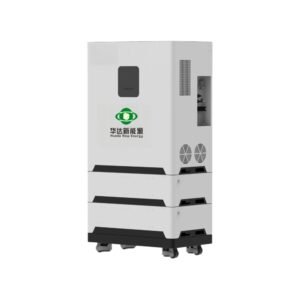
The H096 10kWh stackable home battery is an all-in-one energy storage tower that combines 10.24 kWh of usable LiFePO4 capacity with a built-in inverter, so a household can store daytime solar power and run on it at night without buying or matching a separate inverter. It suits homeowners who want backup power today and room to grow tomorrow: the same platform expands from 5.12 kWh to 20.48 kWh by stacking additional modules. This guide explains the specifications, certifications, total cost position and selection criteria that distributors, installers and homeowners should check before ordering a 10kWh stackable home battery in 2026.
What Is the H096 10kWh Stackable All-in-One Home Battery?
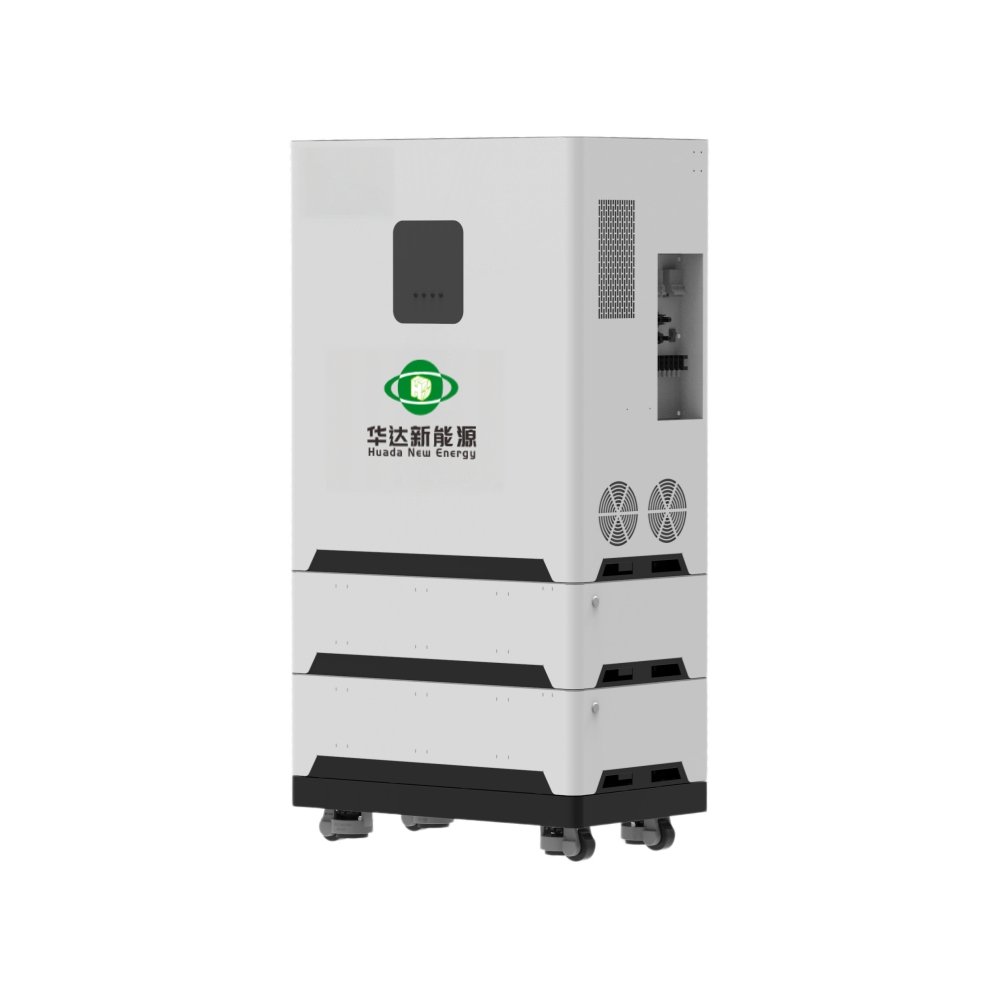
The H096-(5-20)kWh stackable is a floor-standing home battery in which two 51.2V / 5.12kWh LiFePO4 modules are stacked with an integrated inverter into a single tower measuring 637 × 387 × 1075 mm and weighing 169.8 kg. The tower rolls into position on its base, so a single installer can place it without cranes or wall-mounting hardware. Grid connection is single-phase L+N+PE, and the wired links are RS485 / CAN for inverters and energy-management equipment, plus WiFi and Bluetooth for the mobile app.
Why the built-in inverter matters
Because the inverter is integrated, there is no separate inverter to source, size and match — one of the most common sources of cost overruns and commissioning delays in home storage projects. The unit ships assembled, stacked and full-function tested, so on-site work is limited to positioning, wiring and switching on.
The expansion ladder: 5.12 to 20.48 kWh
Each module adds 5.12 kWh on the same platform: one module gives 5.12 kWh, two give 10.24 kWh, three give 15.36 kWh and four give 20.48 kWh. Households that expect an EV charger or a heat pump can start at 10.24 kWh and add modules later instead of replacing the whole system — the 20.48 kWh configuration of the same series tops out the platform.
Why All-in-One Home Batteries Are Gaining Ground in 2026
All-in-one stacks are winning share because they remove engineering work at exactly the moment when home storage demand is broadening beyond early adopters. Europe installed 36 GWh of battery storage in 2025, up 48% year on year and a twelfth consecutive record, with the cumulative fleet passing 100 GWh (SolarPower Europe, 2026). Residential storage contributed 12.3 GWh of that total, and the outlook for 2026 exceeds 50 GWh across all segments.
Cost momentum reinforces the shift. Lithium-ion pack prices fell 8% to a record-low $108/kWh in 2025, and pack prices for stationary storage dropped 45% to $70/kWh — the lowest of any segment for the first time (BloombergNEF Battery Price Survey, December 2025). Sizing is converging too: the average new home battery in Germany, Europe’s largest residential market, reached roughly 10.3 kWh in 2025 (RWTH Aachen Battery Charts, 2026) — almost exactly the 10.24 kWh configuration covered here. An all-in-one tower at that size means one part number to quote, one installation method to train and one app for the homeowner.
Key Specifications and What They Mean
The specification table below covers the two-module 10.24 kWh configuration together with the platform limits (as published on the official product page).
| Item | H096 (5-20)kWh stackable, 10.24 kWh config | What it means for buyers |
|---|---|---|
| Usable capacity | 10.24 kWh (2 × 5.12 kWh modules) | Covers a full evening of typical household use plus morning top-up |
| Battery module | 51.2V / 5.12 kWh / 51.8 kg, LiFePO4 | Safe, thermally stable chemistry; modules are light enough for two-person handling |
| Cycle life | 5,000+ cycles with 80%+ capacity retained | 10.24 kWh × 5,000 cycles ≈ 51 MWh of lifetime throughput |
| Voltage range | 40 V – 58.4 V (nominal 51.2 V) | Standard 16S LiFePO4 window, wide enough for full charge and cutoff |
| Max charge / discharge current | 80 A (≈4.1 kW at nominal voltage, derived) | Runs heavy household circuits; 110% overload handles motor start-up surges |
| Grid connection | L+N+PE single-phase | Standard European single-phase wiring, no three-phase works needed |
| Communication | RS485 / CAN; WiFi + Bluetooth app | Hard-wired BMS/EMS integration plus phone monitoring without extra hardware |
| Dimensions / weight | 637 × 387 × 1075 mm / 169.8 kg | Fits a plant room or garage corner; rolls into place, no crane work |
| Operating temperature | Charge 0–50 °C; discharge −20–50 °C | Unheated garages and plant rooms are fine for discharge in winter |
| Protection level | IP20, indoor installation | Plan a covered location; this is not an outdoor-rated enclosure |
| Certification | CE / FCC / RoHS | See the certification section below for what each covers |
Certifications Explained: What CE, FCC and RoHS Mean for Buyers
The H096 stackable series is certified to CE, FCC and RoHS, as listed on the product page, and each mark answers a different import question. Distributors should treat these three marks as the entry ticket for the two largest storage markets, and request the stamped datasheet for tender or utility paperwork through the product page form.
| Certification | Jurisdiction | What it covers |
|---|---|---|
| CE | European Union / EEA | Conformity with EU health, safety and environmental protection legislation, including low-voltage and EMC directives relevant to a grid-connected storage tower |
| FCC | United States | Electromagnetic interference limits for the WiFi, Bluetooth and RS485/CAN electronics sold into the US market |
| RoHS | EU, widely referenced globally | Restriction of hazardous substances such as lead, mercury and cadmium in the unit’s materials |
| IP20 | IEC 60529 rating scale | Protected against solid objects over 12.5 mm; no water protection — install indoors |
Beyond the marks, protection is enforced at module level: the smart BMS guards against overcharge, over-discharge, short circuit, over-temperature, over-voltage and over-current faults, and every tower is full-function tested before shipment. For OEM / ODM programmes, capacity, branding, enclosure and communication protocol can be customized, and the manufacturer documents multiple patents and High-Tech Enterprise certification. If your market requires additional approvals beyond CE / FCC / RoHS, ask for the certificate pack before contracting — the H096 10kWh all-in-one product page lists the same certification basis across the series.
H096 Stackable vs Lead-Acid and Split Systems
The H096 stackable wins on lifetime energy per footprint and on installation simplicity against both alternatives it typically competes with. The comparison below uses industry-typical figures and the specifications above.
| Criterion | H096 stackable all-in-one | Lead-acid bank + inverter | Split LiFePO4 + hybrid inverter |
|---|---|---|---|
| Cycle life | 5,000+ @ 80% retention | ~500–1,500 deep cycles (industry typical) | 3,000–6,000 (chemistry-dependent) |
| Lifetime throughput at 10 kWh | ≈51 MWh | ≈5–15 MWh, plus 1–3 battery replacements | ≈30–60 MWh |
| Equipment to source | One tower (battery + inverter) | Batteries, inverter, cabling, ventilation | Battery cabinet, inverter, comms matching |
| Installation | Place, wire, switch on | Heavy bank assembly, venting, commissioning | Two vendors to coordinate, matching study |
| Footprint | 0.25 m² floor area | Larger, needs ventilation clearance | Two wall/floor units |
| Monitoring | WiFi/Bluetooth app, module-level BMS | Basic or none | Depends on inverter brand |
A ten-year cost view makes the cycle-life gap concrete. Based on assumptions — one cycle per day at 80% of 10.24 kWh usable, electricity valued at €0.25/kWh, and lead-acid replacement every 3–4 years at industry-typical cycle counts — the H096 tower delivers roughly 30 MWh of shifted solar over ten years without battery replacement, while a lead-acid bank of equal daily throughput requires two to three replacement purchases and still ends the decade with a younger but smaller bank. Buyers should run the same arithmetic on their local tariff before deciding; the assumptions matter more than any single price quote.
Real-World Applications
The H096 stackable earns its keep in homes where consumption is changing, not fixed. Three scenarios cover most enquiries Huada receives.
Evening self-consumption for solar homes
Surplus midday PV charges the stack instead of feeding out at low export rates; the tower discharges through the evening peak. At 10.24 kWh, a household running cooking, lighting, appliances and a heat-pump cycle overnight typically covers most of its non-daylight consumption from storage.
Backup through grid outages
When the grid drops, the built-in inverter switches to backup mode so essential circuits keep running. Discharge is rated to −20 °C, which matters for garages and plant rooms in continental winters.
Growing loads: EV chargers and heat pumps
Start with two modules, then add a third when the EV arrives and a fourth with the heat pump. The stacking interface on the tower is prepared mechanically and electrically for modules three and four, and the 5.12 kWh module is the building block across the range.

How to Choose the Right Stackable Home Battery
The right stackable comes down to five checks that separate a fit-for-purpose tower from a spec-sheet bargain.
- Size to your evening load, not your roof. Match daily kWh consumption after sunset; 10.24 kWh suits most four-person households, and the platform expands to 20.48 kWh.
- Confirm the electrical interface. Single-phase L+N+PE here — verify it matches your market’s wiring before quoting.
- Check communication options. RS485 / CAN for hard-wired integration plus WiFi and Bluetooth app monitoring covers both installer and homeowner needs.
- Read the cycle-life definition. Ask cycles to what depth of discharge and at what retained capacity; 5,000+ cycles at 80%+ retention is the figure to compare against.
- Verify certifications for your market. CE / FCC / RoHS as listed; request the stamped datasheet and certificate pack for utility or tender submissions.
For households that prefer wall or floor formats instead of a tower, the 10kWh floor-standing battery and the 15kWh floor-standing model share the same LiFePO4 platform philosophy; a previous guide compares them in detail in our 15kWh home energy storage article.
Frequently Asked Questions
How much does a 10kWh stackable home battery cost?
Pricing depends on configuration, destination market and order volume, so it is quoted rather than listed. As a market benchmark, lithium-ion pack prices averaged $108/kWh in 2025 and stationary-storage packs reached $70/kWh (BloombergNEF, 2025). Request a quotation with your monthly consumption and essential loads for an exact figure.
Can I expand the 10kWh system later?
Yes. The platform takes one to four 5.12 kWh modules, so capacity can grow from 5.12 kWh to 20.48 kWh by stacking additional modules — no inverter replacement and no system swap are needed.
Does the H096 include an inverter?
Yes. The inverter is built into the tower, which removes inverter selection, matching and a separate wall cabinet from your project. Grid connection is single-phase L+N+PE with 110% overload capability for start-up surges.
How long will a 10kWh battery run my home?
It depends on the loads you back up. As an illustration, essential circuits drawing 0.8 kW average would run for roughly 12 hours from a full 10.24 kWh; heavier whole-house use shortens that. Size against your essential-load list rather than total consumption.
What certifications does the H096 stackable hold?
The product page lists CE, FCC and RoHS certification, with an IP20 enclosure rating for indoor installation. Certificate documents and a stamped datasheet are available on request for regional import and utility requirements.
Is LiFePO4 safer than other lithium batteries for home use?
LiFePO4 chemistry is chosen for thermal stability and long cycle life, which is why it dominates new stationary storage. In this tower, module-level BMS protection adds overcharge, over-discharge, short-circuit and thermal fault guards, and each assembled unit is full-function tested before shipment.
About Huada Energy
Huada Energy (Huizhou Huada Technology) manufactures household and commercial energy storage — stackable towers, wall and floor-standing batteries, cabinet and container ESS, EV charging stations and 12V–51.2V LiFePO4 batteries — with OEM / ODM customization for distributors and installers worldwide. Every home tower is assembled, stacked and full-function tested before shipment, and factory visits are welcome. Explore the complete stackable home battery range or contact sales@huadaenergy.com / +86 138 2316 3795 for a capacity recommendation and quotation.
Last updated: 2026-10-30