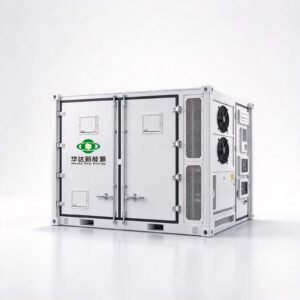
2.5MWh Containerized BESS Certifications: H098-LC2.5KWH
A 2.5MWh containerized BESS only becomes a bankable asset when its compliance file matches the market it lands in. The hudanewenergy H098-LC2.5KWH pairs 2,507kWh of LFP/314Ah cells with a compliance list spanning IEC 62619, IEC 62933, IEC 62477-1, IEC 61000-6-2&4, UL 9540A and UN38.3. This guide explains what each of those documents actually proves, which ones are certificates and which are only test reports, and what to ask a supplier before a container ships.
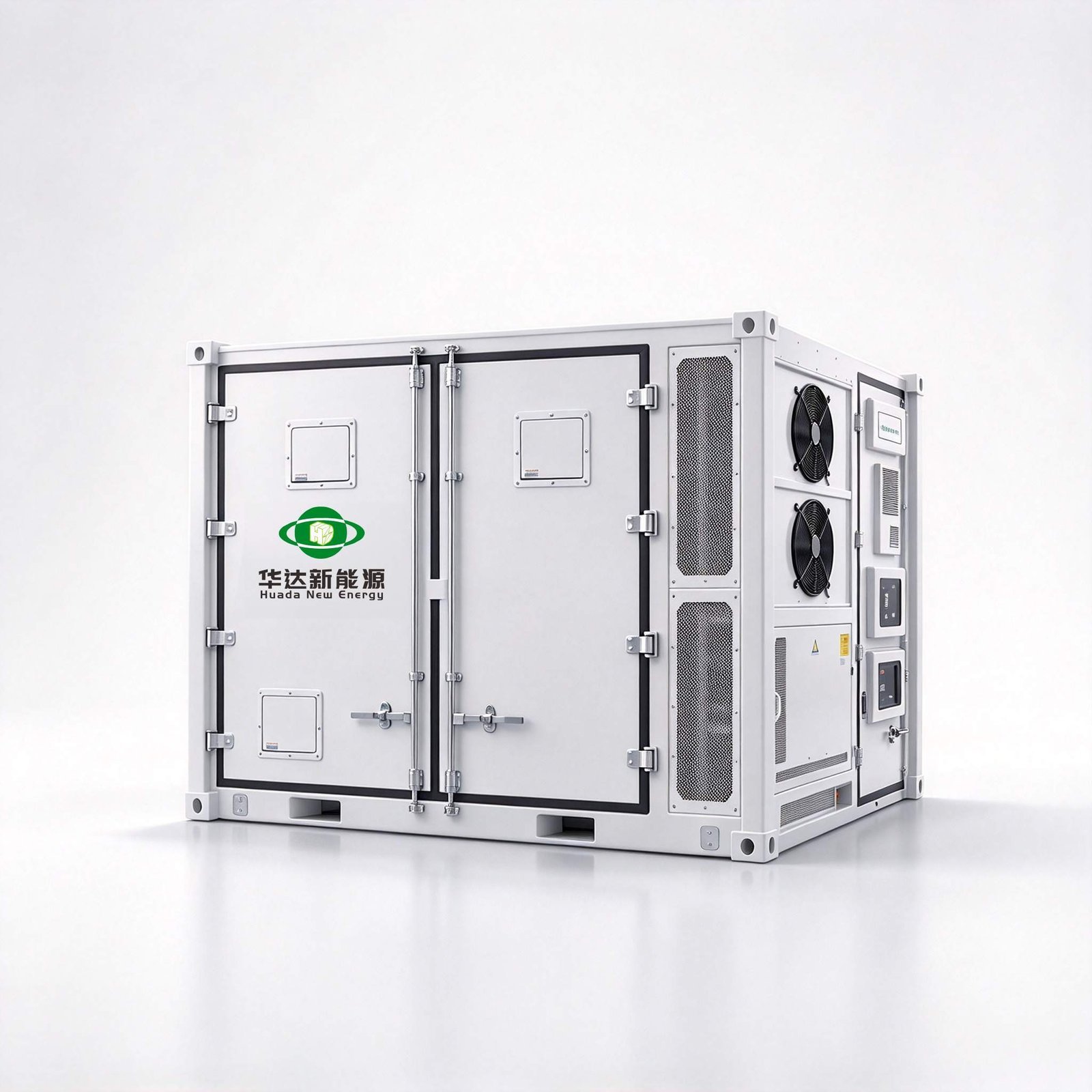
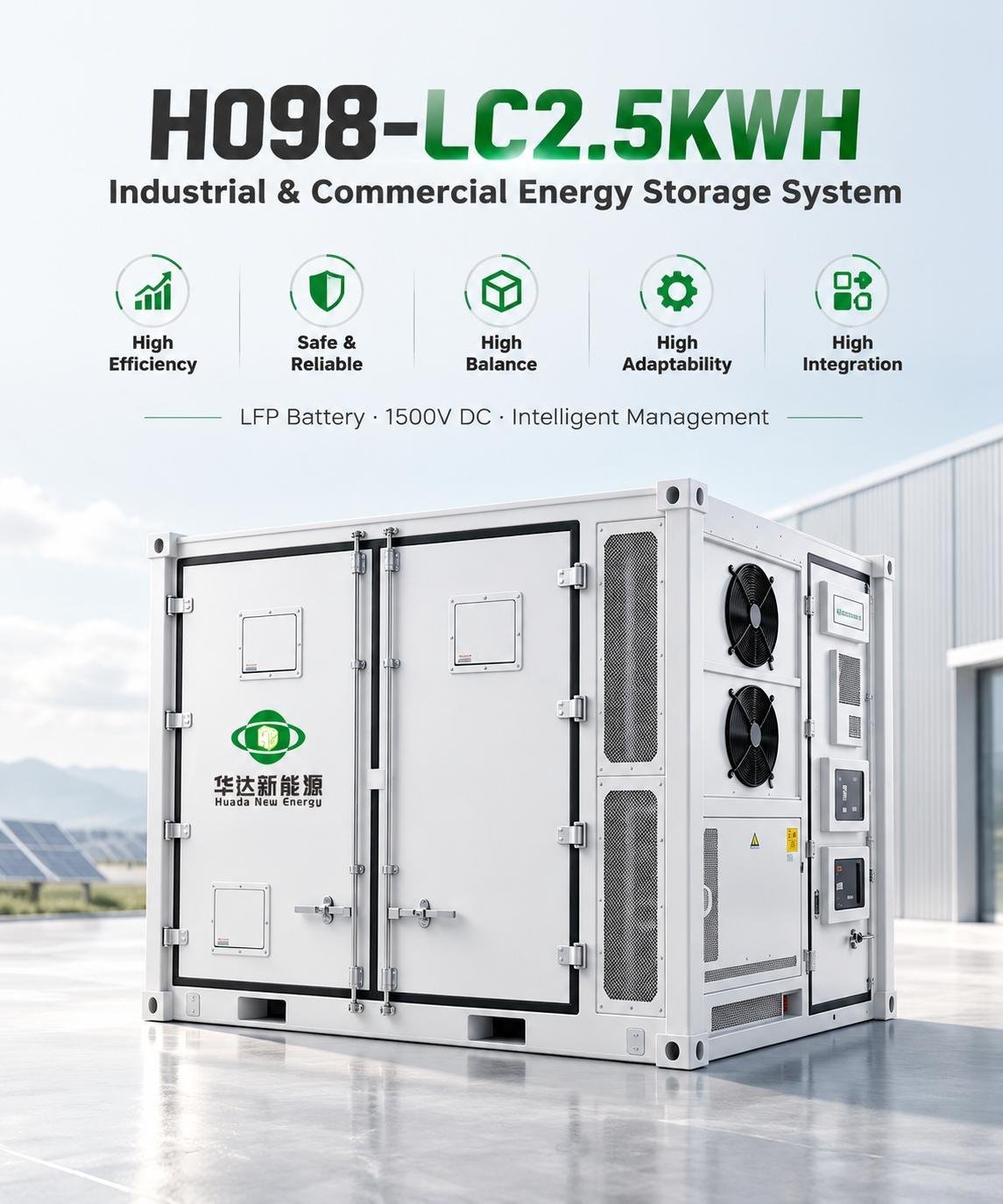
What Is the H098-LC2.5KWH 2.5MWh Containerized BESS?
The H098-LC2.5KWH is a 2,507kWh liquid-cooled containerized BESS on a 1500V DC platform, sized for 2–4 hour duty cycles in commercial, industrial and utility-scale projects. It uses LFP/314Ah cells in a 6P416S configuration, giving a rated 1,331.2V battery bank with a 1,164.8–1,497.6V operating window.
The whole system ships as one pre-tested 10.26-ft enclosure measuring 3,420 × 2,438 × 2,896 mm at 22,500 kg. With a maximum discharge rate of 0.5P, it is built for peak shaving, renewable firming and backup duty rather than sub-second frequency response.
Protection is layered rather than single-point. Cluster-level isolation keeps a fault inside one battery cluster, active ventilation is triggered by flammable-gas detection, and fire suppression combines aerosol units, smoke and temperature detectors and a dry pipe sprinkler, with a deflagration panel available as an option. On the controls side the container speaks Modbus TCP, IEC 61850 and IEC 104 over Ethernet.
Why Certification Now Gates BESS Orders
Certification has stopped being a paperwork step and has become a gating item: fire codes, grid codes and customs authorities increasingly want documented test data before a container is energised, or even cleared. Four developments explain the shift.
UL 9540A is the reference for large-scale fire testing. UL Solutions describes UL 9540A as the only consensus standard explicitly cited in NFPA 855 for large-scale fire testing, and the only US and Canadian national standard for ESS fire-safety test methods (UL Solutions, 2026).
NFPA 855 keeps tightening. The 2026 edition of NFPA 855 introduces Annex G.11, which sets expectations for large-scale fire testing — including how a fire could spread from one BESS to another and what role active fire protection plays (UL Solutions, 2026).
IEC 62933-5-2 has been refreshed. IEC 62933-5-2:2025 specifies safety requirements for grid-integrated electrochemical energy storage systems across the entire life cycle, from design through to end-of-service management (IEC, 2025).
The EU battery file is already live. Under Regulation (EU) 2023/1542, the carbon footprint declaration applies from 18 February 2026 for rechargeable industrial batteries with a capacity above 2 kWh, except those with exclusively external storage (European Commission).
For a buyer the consequence is practical: a container that lands without its documentation can sit at port or on site for weeks, and that idle time is rarely in the EPC contract.
Certification Map: What Each Standard Covers
Each entry in the H098-LC2.5KWH compliance list covers a different layer of the system, and confusing them is the most common sourcing mistake. IEC 62619 is about the battery, IEC 62477-1 is about the power conversion equipment, and IEC 62933 is about the system as a grid-connected asset.
| Standard | Layer it covers | What it proves | What to request from the supplier |
|---|---|---|---|
| IEC 62619:2022 | Cells and battery packs | Safe operation under abuse — overcharge, external short circuit, drop, thermal abuse — plus thermal runaway propagation at pack level | Test report naming the exact cell model and capacity (314Ah, not a generic “LFP”) |
| IEC 62477-1 | Power conversion equipment | Electrical, thermal and mechanical safety of the converter; an LVD reference standard for CE marking in the EU | Report covering the PCS rating and the 1500V DC interface |
| IEC 61000-6-2 & -6-4 | Electromagnetic compatibility | Immunity in industrial environments and emission limits, so comms stay stable beside inverters and switchgear | EMC test report; check whether your grid operator wants a local variant |
| IEC 62933 (incl. IEC 62933-5-2) | Grid-integrated system | System-level safety: subsystem interaction, gas detection, ventilation, fire and explosion protection, life-cycle scope | System safety assessment or certificate, plus the installation and maintenance documentation |
| UL 9540A | Fire propagation | Measured heat release rate, gas composition and spread behaviour at cell, module, unit and installation level | The full report: lab name, edition (5th or 6th), highest level reached, cell model |
| UN38.3 | Transport | Lithium battery transport qualification (T1–T8) under the UN Manual of Tests and Criteria | Test summary per shipped container — freight forwarders ask for it before booking |
One nuance worth repeating: UL 9540A is a test method, not a product certificate. Its output is a report of measured fire behaviour, which then feeds a UL 9540 evaluation, an NFPA 855 review or an authority-having-jurisdiction (AHJ) decision on spacing. A supplier that only says “UL 9540A compliant” without a report number has not given you evidence.
Key Specifications and What They Mean in a Tender
Specification sheets are read twice in a project: once by the engineer sizing the plant, and once by the reviewer checking the compliance file. These are the values that matter in both readings.
| Item | H098-LC2.5KWH | Why it matters in the compliance file |
|---|---|---|
| Battery capacity (DC side, BOL) | 2,507kWh | Nameplate figure used in grid applications and in the carbon footprint declaration |
| Cell type / configuration | LFP 314Ah, 6P416S | Every safety report is cell-specific; the model on the report must match the build |
| Rated voltage | 1,331.2V (1500V DC platform) | Drives insulation coordination, PCS selection and the applicable voltage directive |
| Voltage range | 1,164.8–1,497.6V | Sets the PCS operating window and protection thresholds |
| Max P-rate / duration | 0.5P, 2–4 hours | Determines which grid services the asset can be registered for |
| Container size / weight | 3,420 × 2,438 × 2,896 mm, 22,500 kg | Foundation design, transport permits and crane class on site |
| Temperature control | Liquid cooling | Supports cell temperature consistency, which protects capacity and cycle life |
| IP level / anti-corrosion | IP54, C4 (C5 optional) | Evidence for coastal, desert or chemically aggressive sites |
| Operating temperature | −25 °C to 50 °C (de-rating above 45 °C) | Must be reconciled with the local climate record in the design basis |
| Max altitude | 3,000 m | Derating and insulation checks for high-altitude sites |
| Fire suppression | Aerosol, smoke and temperature detection, gas-detected ventilation, dry pipe sprinkler; optional deflagration panel | The physical measures the AHJ will want to see alongside the UL 9540A data |
| Communication | Ethernet: Modbus TCP, IEC 61850, IEC 104 | Grid-code compliance often names the protocol the operator must see |

Real-World Applications
Factory peak shaving
A 2,507kWh block at 0.5P delivers roughly 1.25MW for two hours, which is the shape most demand-charge profiles actually need. The container shifts load into cheaper tariff hours, trims the monthly peak and takes pressure off an overloaded transformer.
Renewable firming for solar plants
For a PV site with a midday surplus and an evening price peak, the H098-LC2.5KWH absorbs the excess and releases it when the tariff is higher. Cluster-level isolation matters here: with daily deep cycling, thermal consistency across the 416S string is what keeps capacity predictable.
Industrial park backup power
Parks with continuous process loads need ride-through, not just arbitrage. The −25 °C to 50 °C operating window, IP54 enclosure and C4 coating let the same unit serve a coastal park and an inland one without a different bill of materials.
Grid-side and utility capacity
Where a utility needs modular capacity rather than one large block, the standard shipping envelope and hoisting points mean containers can be added later. Modbus TCP, IEC 61850 and IEC 104 cover the protocols most operators specify for SCADA integration.
Liquid Cooling vs Air Cooling: Why It Appears in the Safety File
Thermal management is not just an efficiency choice — it is part of the safety case. Liquid cooling holds every cell closer to its target temperature than forced air can, and uniform cell temperature is what keeps a long series string balanced over years of daily cycling.
| Aspect | Liquid cooling (H098-LC2.5KWH) | Air cooling |
|---|---|---|
| Temperature control | Coolant loop with cell-level control; supports high consistency across the system | Forced ambient air; wider cell-to-cell spread is inherent to the method |
| High-temperature behaviour | De-rating management above 45 °C | Typically de-rates earlier in hot climates |
| Enclosure implications | Sealed design supports IP54 | Needs filtered air paths, which compete with dust and water ingress protection |
| Noise and auxiliary load | Pump and chiller load, lower air movement | Continuous fan operation, higher acoustic signature |
| Maintenance profile | Coolant concentration and loop integrity checks | Fan and filter replacement |
| Documentation to request | FAT report with cell temperature spread at rated power | Same — and compare the numbers, not the adjectives |
The honest caveat: liquid cooling adds a coolant loop that must be maintained, and for a lightly cycled site in a mild climate air cooling can remain the lower-cost answer. The reason most 2MWh-plus projects still specify liquid cooling is consistency and code compliance, not fashion.
How to Verify a BESS Compliance File
Before you sign, run this checklist against the exact model you are buying:
- Match the cell, not the chemistry. A report for 280Ah cells does not cover a 314Ah build. Check cell model and capacity on every page.
- Match the model number. The H098-LC2.5KWH on the report must be the H098-LC2.5KWH in the contract, including the 1500V configuration.
- Ask which UL 9540A level was reached, and whether it was cell, module, unit or installation level — installation level is the one that informs spacing.
- Confirm the standard editions. IEC 62619:2022 and IEC 62933-5-2:2025 are the current references; older editions may not satisfy a 2026 AHJ.
- Request the UN38.3 test summary per container before freight is booked, not after.
- Check regional add-ons. EU projects need the Regulation (EU) 2023/1542 carbon footprint declaration; North American projects need the NFPA 855 and UL path; other markets may name local grid codes.
- Ask for the FAT report with serial numbers. Factory acceptance testing is where a documented design becomes a documented unit.
- Confirm IP and corrosion class against the site — C4 is the default, C5 is optional and should be specified up front for coastal or industrial atmospheres.
Frequently Asked Questions
Is UL 9540A a certificate?
No — UL 9540A is a test method, not a product certificate. It evaluates thermal runaway fire propagation at cell, module, unit and installation level and produces measured data on heat release, gas composition and spread. That report is then used inside a UL 9540 evaluation or an NFPA 855 review to justify spacing, ventilation and suppression.
Which standards does the H098-LC2.5KWH comply with?
The published compliance list is IEC 62619, IEC 62933, IEC 62477-1, IEC 61000-6-2&4, UL 9540A and UN38.3. hudanewenergy notes that specifications follow the documents shipped with each unit, and that certifications can be provided on request to meet specific regional grid and project requirements — so confirm the exact set for your target market during RFQ.
What is the difference between IEC 62619 and IEC 62933?
IEC 62619 tests the battery itself — cells and packs under abuse conditions including thermal runaway propagation. IEC 62933 addresses the grid-integrated energy storage system as a whole, with IEC 62933-5-2 covering safety requirements for electrochemical systems across the life cycle. A compliant battery does not by itself make a compliant system.
Can a 2.5MWh container run in hot or high-altitude sites?
The H098-LC2.5KWH operates from −25 °C to 50 °C with de-rating management above 45 °C, and up to 3,000 m altitude. Verify the site’s extreme temperature record and elevation against those limits during design, because de-rating reduces usable power exactly when a hot site needs it most.
How long does installation and commissioning take?
Battery racks, liquid cooling, fire suppression and EMS integration are pre-installed and factory tested, so site work is a prepared foundation, cable connection and grid tie. hudanewenergy states commissioning takes days rather than months; the actual schedule depends on foundation readiness, grid connection approval and local acceptance testing.
Can hudanewenergy certify to our local grid code?
Project-specific certification can be provided on request to meet regional grid and project requirements, and OEM/ODM covers capacity, container layout, communication protocols and branding. MOQ is one unit. Share your target market and grid operator early so the right test plan is built into the schedule rather than added afterwards.
About hudanewenergy
hudanewenergy is the energy storage brand of Huizhou Huada Technology, manufacturing LiFePO4 batteries and integrated storage systems from portable power stations and lead-acid replacement batteries through golf cart packs, home storage, C&I cabinets and containerized BESS. Every H098-LC2.5KWH unit completes full-function FAT testing before shipment, with cell and module batch records kept on file.
Explore the H098-LC2.5KWH 2.5MWh containerized BESS for full specifications, compare the 1MW/3MWh containerized system for longer duration, or read our 1MW/3MWh containerized BESS buyer guide and 500kWh containerized BESS guide for smaller footprints. For sites below 1MWh, see the 315kWh cabinet ESS. Send your site location, transformer capacity and load profile to sales@huadaenergy.com for a compliance file and quotation.
Last updated: 21 October 2026
Sources
- UL Solutions, UL 9540A test method (levels, editions, relationship to NFPA 855 and the 2026 edition Annex G.11), 2026
- IEC, IEC 62619:2022 (Edition 2.0, May 2022) — safety requirements for secondary lithium cells and batteries for industrial applications
- IEC, IEC 62933-5-2:2025 — safety requirements for grid-integrated EES systems, electrochemical-based
- European Commission, Regulation (EU) 2023/1542 — carbon footprint declaration applies from 18 February 2026 for rechargeable industrial batteries above 2 kWh
- hudanewenergy H098-LC2.5KWH product specification and compliance list
Image credits
- Product and internal views: hudanewenergy product page images
- Solar farm: Pexels, photo 33537433, Pexels License
- Industrial park warehouse: Pexels, photo 17641131, Pexels License
- Shipping containers: Pexels, photo 16244327, Pexels License
- Compliance map and UL 9540A test levels: original diagrams drawn by hudanewenergy