A 12V 100Ah LiFePO4 battery is a drop-in lithium replacement for a 12V lead-acid battery, and 2026 is the year the economics of that swap tip for many buyers. Lead — 60–70% of a lead-acid battery’s production cost — has been climbing, while lithium iron phosphate pack prices keep falling. This market analysis explains what is changing, what the numbers mean, and how to qualify a supplier. All figures come from verifiable public sources. The product referenced throughout is the huadaenergy 12V 100Ah LiFePO4 battery — 1,280Wh, 8,000+ cycles, UN38.3 and CE certified.

What Is a 12V 100Ah LiFePO4 Battery?
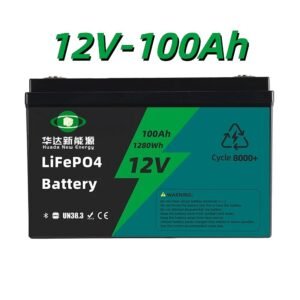
A 12V 100Ah LiFePO4 battery combines four 3.2V 100Ah lithium iron phosphate cells in series (a 4S1P configuration) with a built-in battery management system, delivering 12.8V nominal and 1,280Wh of energy in the same footprint as a Group 31 lead-acid battery. The huadaenergy version uses grade-A prismatic LFP cells with ≤35mΩ internal resistance, an integrated BMS with cell balancing and Bluetooth monitoring, and an IP55-rated casing with standard M8 terminals.
Because the voltage plateau (12.8V nominal, 10.0V cut-off, 14.0–14.6V charge) matches what most 12V charging systems expect, it works as a drop-in lead-acid replacement for RVs, boats, solar systems, off-grid cabins and telecom standby — usually with only a charging-profile check. For a deeper parameter walkthrough of this model, see our 12V 100Ah LiFePO4 battery specs guide.
Why the 2026 Market Is Shifting Toward LiFePO4
Two price curves crossed in 2025–2026, and they explain why the 12V replacement segment is growing so fast.
Lead is getting more expensive. Lead is 60–70% of a lead-acid battery’s production cost, and LME three-month lead traded in a $1,900–2,600 per tonne band through 2025, touching a 12-week high near $1,999/t in May 2026 before settling back around $1,910/t in August 2026 (LME data; SO OK Trading, 2026; Thi Truong Hang Hoa, 2026). Industry analysis forecasts LME lead averaging $2,200–2,800/t in 2026 — a 5–15% rise over 2025 — as mine supply stays tight and recycled-lead collection faces tighter environmental rules (CHISEN Battery, 2026). For importers, that means firmer lead-acid price quotes for 2026 tenders.
Lithium pack prices keep falling. BloombergNEF’s 2025 Battery Price Survey put average lithium-ion pack prices at $108/kWh, with LFP packs at just $81/kWh — the lowest on record (BloombergNEF, 2025). Falling cell costs flow straight into 12V drop-in products.
The global 12V LiFePO4 battery market is estimated at $3.41 billion in 2025 and projected to reach $11.52 billion by 2032, an 18.96% CAGR, with the 100–200Ah capacity segment holding a 48% share and RV applications the largest single use case (PW Consulting, 2026). An independent forecast puts the market at $3.55 billion in 2026 growing to $8.48 billion by 2034 at 11.5% CAGR (Energy Resources Insights, 2026). Estimates differ, but the direction is clear: LFP is taking the 12V deep-cycle slot lead-acid has held for decades.
Key Specifications and What They Mean
The table below lists the published specifications of the huadaenergy 12V 100Ah LiFePO4 battery as stated on the product page, and what each means in practice.
| Item | Value | What It Means for Buyers |
|---|---|---|
| Nominal voltage / energy | 12.8V / 1,280Wh (100Ah) | Drop-in match for 12V lead-acid systems; same usable energy class |
| Configuration | 4S1P, grade-A prismatic LFP, ≤35mΩ | Low internal resistance keeps voltage stable under load |
| Cycle life | 8,000+ cycles @0.2C to 80% capacity | Years of daily deep cycling; the core of the TCO advantage |
| Discharge | 100A continuous, 200A pulse (<3s) | Runs inverters, pumps and winches without voltage sag |
| Charging | 0.2C CC to 14.6V then CV; 0–45°C | Works with most lithium-ready chargers; verify the 14.0–14.6V profile |
| Temperature | Discharge −20°C to 60°C | Seasonal use in hot climates and cold storage |
| Self-discharge | ≤3.5% per month at 25°C | Ready after long storage between seasons |
| Weight / size | ≈10 kg; 330×172×215 mm | About half the weight of an equivalent lead-acid battery |
| Protection / terminal | IP55 casing, built-in BMS, M8 | Dust- and jet-water-resistant for engine rooms and outdoor bays |
| Certification | UN38.3, CE | Shippable by air and sea; compliant for EU market entry |
A note on method: the 8,000-cycle figure is rated at 0.2C charge/discharge until capacity falls to 80%. At higher C-rates or deeper depths, real-world life will differ — ask for the test conditions behind any cycle-life claim before comparing quotes.
Real-World Applications
The 12V slot is the most common format in mobile and off-grid power, so the shift shows up first in four applications.
RV and camper vans
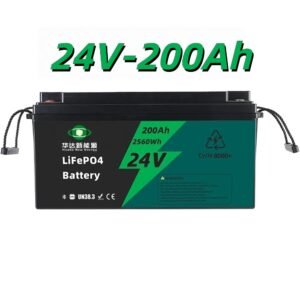
RV applications represent the largest single share of the 12V LiFePO4 market — about 33% of value in 2025 (PW Consulting, 2026). A 12V 100Ah LiFePO4 battery cuts weight to roughly half of lead-acid while delivering about twice the usable energy per cycle, since lead-acid is typically limited to about 50% depth of discharge. For fleet upfitters and dealers, that is now the main selling point of lithium factory-fit options — and buyers running 24V systems can step up to the 24V 100Ah LiFePO4 battery from the same factory.

Marine and fishing boats
IP55 sealing, no acid leakage and Bluetooth monitoring make the swap into a house-battery bay straightforward. Marine buyers in North America and Europe — the premium segments of this market — are converting fastest as boatbuilders adopt LFP as standard equipment (Energy Resources Insights, 2026).
Solar storage and off-grid homes
For 12V and 24V solar kits in Africa, Southeast Asia and Latin America, one 12V 100Ah LiFePO4 battery stores 1,024Wh of usable energy per cycle at 80% depth of discharge. Installers who once quoted two parallel lead-acid batteries to shield them from deep discharge can now quote a single lithium unit — or double it with the 12V 200Ah LiFePO4 battery

Telecom and UPS standby
Low self-discharge (≤3.5% per month at 25°C) and long float life keep standby banks ready between outages — a growing segment as telecom operators expand in grid-unstable regions.
12V 100Ah LiFePO4 vs Lead-Acid: The Cost Math
Over a typical service life, the cost per usable kilowatt-hour is where LiFePO4 pulls ahead. Using the published specs and stated assumptions: one huadaenergy 12V 100Ah LiFePO4 battery at 80% depth of discharge delivers about 1.02 kWh per cycle; 8,000 cycles yield roughly 8.2 MWh of lifetime throughput. A same-size lead-acid deep-cycle battery, cycled at 50% depth for 500–1,500 cycles, delivers roughly 0.3–1.0 MWh (assumptions — actual lead-acid life varies with chemistry, temperature and maintenance). Even before counting weight and maintenance, the throughput gap is measured in multiples, not percentages.
| Item | Huada 12V 100Ah LiFePO4 | Lead-acid (same size) |
|---|---|---|
| Cycle life (to 80% capacity) | 8,000+ (0.2C, product page) | Typically 500–1,500 |
| Usable energy per cycle | ~1.02 kWh (80% depth) | ~0.64 kWh (50% depth) |
| Lifetime throughput | ~8.2 MWh (estimate) | ~0.3–1.0 MWh (assumption) |
| Weight | ≈10 kg | ≈20 kg+ |
| Maintenance | None — fully sealed | Regular checks and topping-up (flooded types) |
| 2026 price trend | Falling with LFP cell costs (BNEF 2025: $81/kWh LFP packs) | Rising with lead costs (forecast +5–15%, CHISEN 2026) |
Two caveats keep this comparison honest. The up-front price of lithium remains higher in most markets, so compare cost per usable kilowatt-hour over service life rather than sticker price. And lithium needs a lithium-appropriate charge profile — the swap is drop-in in fit, not in settings.
Certifications Explained: UN38.3, CE and IP55
Certification is now a procurement gate, not a formality — and it is where low-cost suppliers most often fall short. The huadaenergy 12V 100Ah LiFePO4 battery carries UN38.3 and CE as listed on the product page, and its IP55 rating follows the IEC 60529 ingress-protection standard. Here is what each covers, and what it does not.
- UN38.3 is the UN Manual of Tests and Criteria (Section 38.3, tests T.1–T.8) that lithium batteries must pass before transport by air or sea — a shipping requirement under Class 9 dangerous-goods rules. Without it, cargo can be refused by freight forwarders and airlines. It is not a performance or safety-of-use certificate.
- CE marking declares conformity with applicable EU directives, and since 18 August 2024 the EU Battery Regulation (2023/1542) has applied in full. The timeline matters: battery labels face an 18 August 2026 deadline, industrial batteries above 2kWh require a QR code and digital battery passport from 18 February 2027, and LMT batteries face a carbon-footprint declaration from 18 August 2028 (European Commission, Regulation (EU) 2023/1542). This 1,280Wh battery sits below the 2kWh passport threshold — but if you plan to place larger industrial packs on the EU market, build the passport requirement into sourcing now.
- IP55 (IEC 60529) means dust-protected and resistant to low-pressure water jets — appropriate for RV battery bays, engine rooms and outdoor cabinets, though it is not submersible.
Qualifying a supplier: ask for the actual UN38.3 test summary and the CE declaration of conformity — not just the logos on the label. A factory that produces both on request, with matching model numbers, is a far safer sourcing partner than one that shows only marketing marks.
How to Choose the Right 12V 100Ah LiFePO4 Battery
With hundreds of near-identical listings online, five checks separate reliable suppliers from risky ones:
- Verified certifications — demand the UN38.3 test summary and CE declaration of conformity, matching the exact model you buy.
- Cycle-life test conditions — 8,000+ cycles at 0.2C is meaningful only with a stated depth of discharge and end-of-life capacity; insist on the datasheet.
- BMS capability — confirm continuous and pulse current ratings (100A / 200A pulse under 3 seconds) against your inverter’s surge load.
- Charging compatibility — verify your charger or solar controller supports a 14.0–14.6V absorption profile; most modern ones do.
- OEM/ODM support — for distributors, check whether the factory can customize labels, casings and Bluetooth parameters, so one supplier can serve several product lines.
Frequently Asked Questions
How long does a 12V 100Ah LiFePO4 battery last?
Rated at 8,000+ cycles at 0.2C until capacity drops to 80%, a battery cycled once daily would exceed 20 years in cycle terms; calendar life, charging habits and temperature usually limit service life first. Expect many years of daily deep cycling — far beyond the 500–1,500 cycles of lead-acid.
Can I replace my lead-acid battery with a LiFePO4 battery without changing my charger?
In most cases yes, but verify the charging profile. LiFePO4 needs about 14.0–14.6V with a proper absorption phase, and most modern chargers and MPPT controllers have a lithium mode. Avoid chargers with automatic desulphation modes, which can exceed safe voltages.
How many 12V 100Ah LiFePO4 batteries can I connect in parallel or in series?
The huadaenergy 12V 100Ah battery is parallel-ready for cabins and off-grid homes. For series connections beyond 12V — for example 24V or 48V banks — use batteries designed and matched for that configuration, and confirm the supported topology before ordering.
Is a 12V 100Ah LiFePO4 battery suitable for marine use?
Yes. The IP55 casing resists water jets and dust, there is no acid to leak, and Bluetooth monitoring lets you check state of charge from the helm. It is a house-battery upgrade for sailing and fishing boats; for engine-starting duty, confirm cranking requirements separately.
What certifications should I require when importing 12V LiFePO4 batteries?
At minimum, UN38.3 for transport and CE for the EU market, backed by the test summaries and declaration of conformity. Depending on destination, ask about additional requirements — for example North American product-safety standards — before committing to an order.
How much does a 12V 100Ah LiFePO4 battery cost in 2026?
Prices vary by region and volume, but the direction is downward: average LFP pack prices fell to $81/kWh in 2025 (BloombergNEF). Compare cost per usable kWh over service life rather than sticker prices — and request a current quote, since cell prices move quarterly.
About huadaenergy
huadaenergy (Huizhou Huada Technology Co., Ltd.) manufactures LiFePO4 batteries and integrated energy-storage systems in Huizhou, Guangdong, China, serving distributors, OEMs and project buyers in more than 40 countries. The product range spans 12V/24V drop-in replacement batteries, golf-cart lithium batteries, portable power stations, home energy storage, and commercial and industrial containerized BESS from 215kWh to 3MWh. For stamped datasheets, OEM/ODM customization or a 2026 quotation for the 12V 100Ah LiFePO4 battery, contact the huadaenergy team.
Last updated: 2026-11-12. Market figures are third-party estimates provided for reference; actual pricing and availability vary by region and order volume.