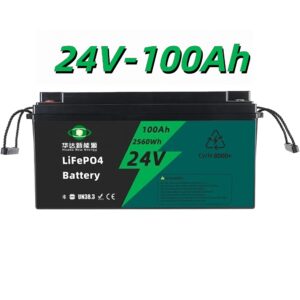
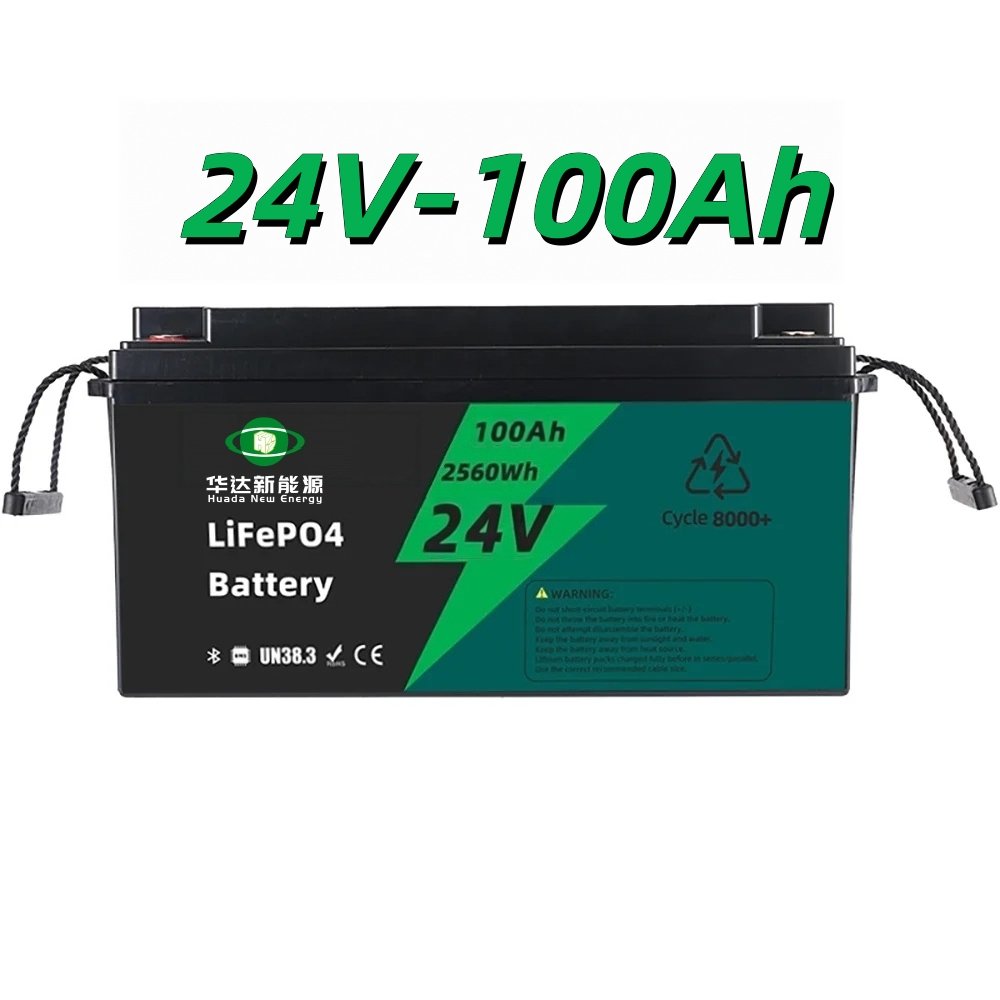
The 24V 100Ah LiFePO4 battery is a direct lead-acid replacement that stores 2,560Wh of energy in a 20 kg, IP55-rated case, and it earns its keep in exactly four kinds of places: camper vans and RVs, small boats, off-grid cabins and backup-power cabinets. In the United States alone, 342,220 new RVs were shipped in 2025, up 2.5% on 2024 (RVIA, 2026) — this guide walks through where the huadaenergy 24V 100Ah unit fits, how to size it for each scenario, and what to check before ordering.
Last updated: 2026-10-26
What Is a 24V 100Ah LiFePO4 Battery?
A 24V 100Ah LiFePO4 battery is an eight-cell lithium iron phosphate pack (8S1P) that delivers 25.6V nominal and 2,560Wh of energy, managed by a built-in battery management system (BMS). The huadaenergy 24V 100Ah unit uses the same mounting dimensions and M8 terminal layout as conventional 24V lead-acid batteries, so it drops into existing battery boxes, cables and brackets without modification.
Because the LiFePO4 discharge curve stays flat across most of the capacity, inverters and DC loads see stable voltage until the pack is nearly empty — unlike lead-acid, whose voltage sags as charge falls. The sealed, spill-proof case needs no watering or equalisation, and its IP55 rating against dust and water jets is what makes the outdoor and marine scenarios below practical.
Real-World Scenarios for a 24V 100Ah LiFePO4 Battery
A 24V 100Ah LiFePO4 battery fits systems that need 1–2.5kWh per day, weigh sensitivity matters, and maintenance visits are difficult or impossible. These scenarios cover most orders huadaenergy sees for this model.
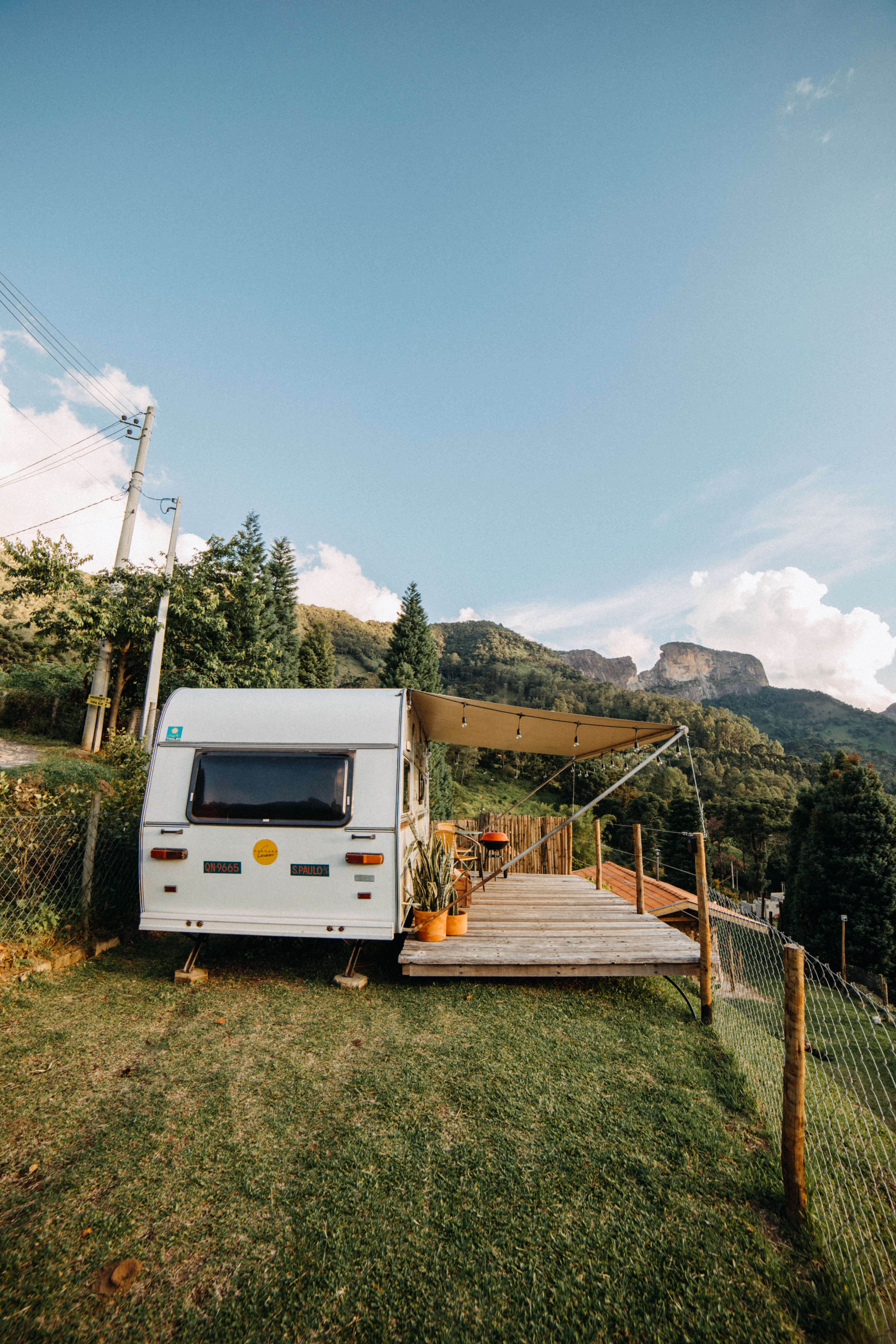
RVs and camper vans
In a camper, the house battery runs lighting, a 12V compressor fridge, water pump and a small inverter — typically 1.5–2.5kWh per day for a couple travelling off-grid. One 24V 100Ah unit covers that with margin, and its 20 kg weight saves roughly 40 kg of payload compared with an equivalent lead-acid bank. With 100A continuous discharge, the pack supports a 2,000W inverter; with 2,000+ cycles at 80% depth of discharge, it outlives several generations of lead-acid batteries in the same compartment.
Small boats and sailboats
Marine house banks punish batteries with humidity, heel angles and long standby. The sealed IP55 case tolerates spray and damp bilges, the ≤3.5% monthly self-discharge keeps the pack healthy between weekend trips, and there is no acid to top up at a marina. One 24V 100Ah battery runs navigation instruments, cabin lights, an autopilot and a fridge at anchor; two in parallel double the endurance for liveaboards.
Off-grid cabins and cottages
Cabins without grid power usually pair a 1–3kWp solar array with a 24V battery bank. Because the 24V 100Ah unit supports parallel expansion to 200Ah and beyond, owners can start with one battery and add more as budgets allow, keeping the same charger and wiring. Charging is specified between 0°C and 45°C, so in cold climates the batteries belong indoors, with the BMS blocking charge below freezing.
Telecom and monitoring backup
Remote telecom repeaters, weather stations and CCTV sites need uninterrupted DC power in unattended enclosures. The IP55 enclosure, −20°C to 60°C discharge window and maintenance-free chemistry suit outdoor cabinets, where a site visit just to top up lead-acid cells is the main operating cost. Low self-discharge keeps the pack ready through long standby periods.
Key Specifications of the huadaenergy 24V 100Ah Battery
The huadaenergy 24V 100Ah battery is a 25.6V, 2,560Wh LiFePO4 pack rated for 2,000 cycles at 0.2C discharge while retaining 80% of capacity, with 100A continuous discharge and an IP55 enclosure. The table below translates each specification into a buying decision.
| Item | 24V 100Ah spec | What it means in practice |
|---|---|---|
| Nominal voltage / capacity | 25.6V, 100Ah (8S1P) | Runs 24V inverters and DC busbars directly |
| Energy | 2,560Wh | About one day of essential loads in an RV or cabin |
| Cycle life | 2,000 cycles @ 0.2C to 80% capacity | Several times the service life of typical lead-acid banks |
| Self-discharge | ≤3.5% per month at 25°C | Survives seasonal storage without a float charger |
| Discharge | 100A continuous; 200A pulse (<3s) | Supports a 2,000W-class inverter and motor start surges |
| Charging | 50A standard, 100A max; 0–45°C | Full charge in about 2 hours at the higher rate |
| Discharge temperature | −20°C to 60°C | Works in winter conditions; charge only above 0°C |
| Ingress protection | IP55 | Dust-protected and jet-water resistant for outdoor cabinets |
| Construction | Sealed plastic case, M8 terminals, ~20 kg | Drop-in replacement, one-hand portability |
| Expansion | Up to 4 in series; parallel to 200Ah+ | Scales from 2.5kWh to 10kWh-plus systems |
Specifications follow the documents shipped with each unit; labels, packaging, parameters and connectors can be customised for OEM / ODM programmes.
24V LiFePO4 vs Lead-Acid in the Same Scenarios
Across all four scenarios, the LiFePO4 pack replaces a lead-acid bank that is three times heavier, needs regular maintenance and lasts a fraction as long — industry-typical flooded deep-cycle lead-acid ratings sit around 500–1,500 cycles versus 2,000 cycles specified here (industry-typical figures; huadaenergy product comparison, 2026). The weight difference is the most visible one in mobile applications:
Lifetime throughput changes the economics as well: one 24V 100Ah LiFePO4 pack cycled 2,000 times to 80% depth of discharge delivers roughly 4 MWh of usable energy, while a lead-acid bank limited to 50% depth of discharge delivers far less usable energy per rated kWh. With average lithium-ion pack prices at a record-low US$108/kWh in 2025 (BloombergNEF Battery Price Survey, 2025), the replacement usually pays for itself within one battery life cycle — based on assumptions about cycle frequency and energy cost, which vary by user.
How to Size and Configure a 24V 100Ah System
The right configuration falls out of three numbers: daily consumption, inverter size and charge source. Check this list before ordering:
- Add up daily consumption — fridge, lights, pump and inverter loads; 1–2.5kWh per day matches one battery.
- Check the inverter — 100A continuous discharge supports about 2,000W at 24V; larger inverters need parallel batteries.
- Match the charger profile — set lithium mode (max charge voltage 29.2V) on the solar controller or charger; charge only between 0°C and 45°C.
- Plan the layout — M8 terminals and a 522 × 238 × 218 mm, 20 kg case fit most existing lead-acid trays.
- Decide the expansion path — up to 4 units in series (to 96V) or several in parallel (to 200Ah+); use the same hardware batch in one string.
- Confirm certifications — CE and UN38.3 transport compliance come standard; ask for test reports with the quote.
Frequently Asked Questions
Can a 24V 100Ah LiFePO4 battery directly replace my lead-acid batteries?
Yes. The huadaenergy 24V 100Ah unit keeps the same mounting dimensions and M8 terminal configuration as conventional 24V lead-acid batteries, so it drops into the existing box and cabling. Set the charger to a lithium profile (29.2V maximum) instead of the lead-acid absorption voltage.
How long will a 24V 100Ah battery run a fridge and lights?
A 12V compressor fridge typically uses 1–1.5kWh per day and LED lighting adds 0.2–0.5kWh, so one 2,560Wh battery covers a full day with headroom. At 80% depth of discharge the usable energy is about 2kWh per cycle.
How many cycles does the battery last?
The specification rates the pack for 2,000 cycles at 0.2C discharge while retaining 80% of capacity. At one cycle per day that is more than five years of daily cycling, with calendar life extending further at lighter duty.
Can I connect several 24V 100Ah batteries together?
Yes. Up to four units can be connected in series to reach 96V, and multiple units can be paralleled to reach 200Ah, 300Ah and beyond. Keep cables equal in length and buy the same hardware batch for one string.
Is the battery safe on a boat?
The LiFePO4 chemistry is thermally stable and the sealed, IP55-rated case is spill-proof, so there is no acid to maintain in a damp environment. The BMS protects against over-charge, over-discharge, over-current, short circuit and temperature faults.
What certifications and customisation are available?
The battery ships with CE certification and UN38.3 transport compliance. huadaenergy supports OEM and ODM programmes covering labels, packaging, battery parameters and connector types for distributors and installers.
About huadaenergy
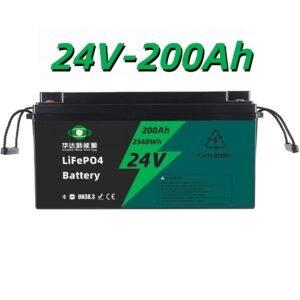
huadaenergy manufactures LiFePO4 batteries across 12V, 24V, 36.4V (golf cart) and 51.2V platforms, including drop-in lead-acid replacements, home storage, portable power stations, commercial cabinets and containerised ESS. Every pack is built from Grade-A cells and passes capacity, cycle, insulation and BMS function testing before shipment. Compare the 12V 100Ah LiFePO4 battery, the higher-capacity 24V 200Ah model and the 12V 200Ah variant, read the 51.2V golf cart battery guide, or contact the huadaenergy team for datasheets and OEM pricing on the 24V 100Ah LiFePO4 battery.
Last updated: 2026-10-26