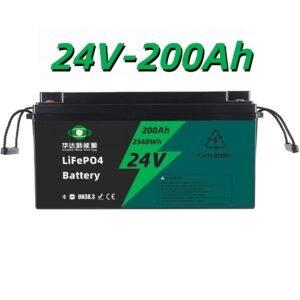
A 24V 200Ah LiFePO4 battery replaces a 24V lead-acid bank with 5,120Wh of nameplate energy in a 38 kg sealed case, roughly 1.8 times the usable energy of the same lead-acid bank at about one third of the weight. For off-grid solar systems, RV and marine house power, UPS backup and 24V golf carts, it is the format where LFP delivers the clearest upgrade over AGM and flooded lead-acid. This guide explains what the pack is, how its specifications translate into real performance, where it beats lead-acid on cost, and what to check before you buy — figures come from the manufacturer datasheet or cited public sources.
What Is a 24V 200Ah LiFePO4 Battery?
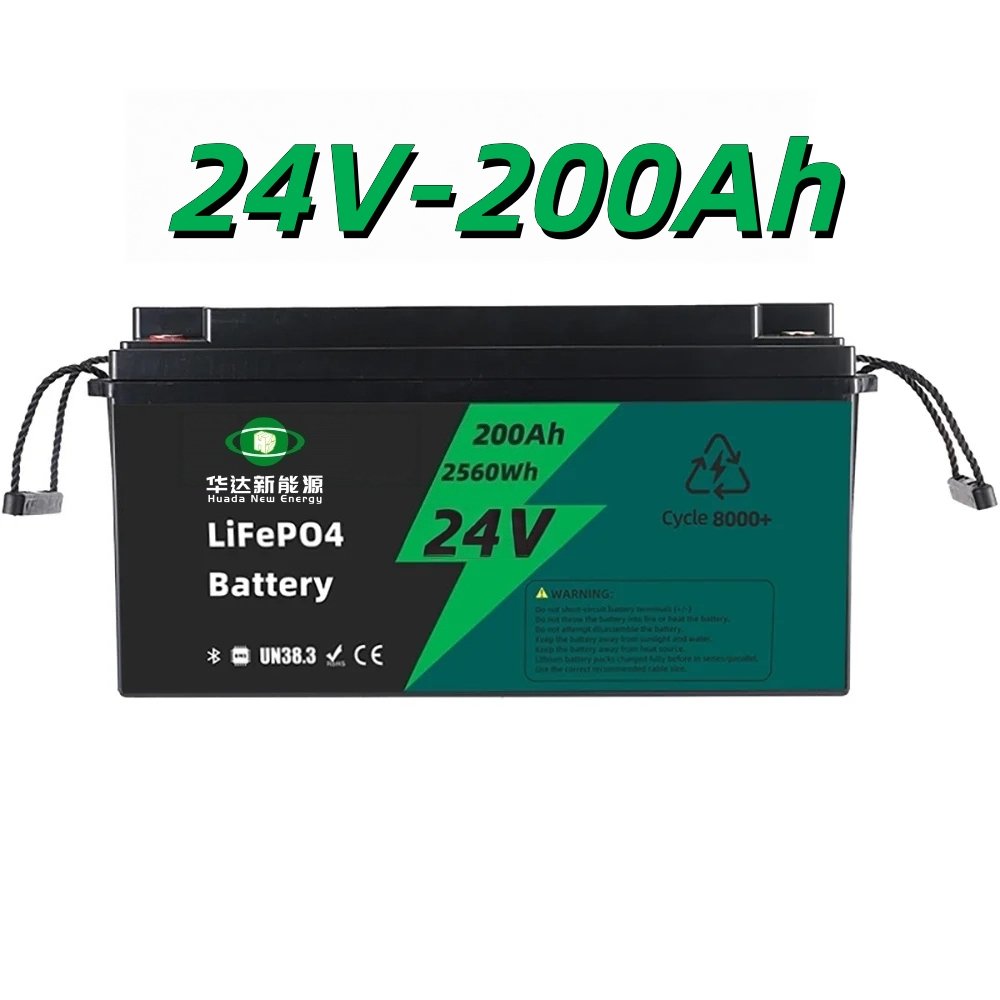
A 24V 200Ah LiFePO4 battery is a 25.6-volt lithium iron phosphate pack storing 200Ah of charge, equal to 5,120Wh of energy, with an integrated BMS in a sealed case sized like a conventional 24V lead-acid battery. The chemistry — LiFePO4, often written LFP — is chosen for its thermal stability and long cycle life, and the 24V class sits between 12V systems (small RVs and boats) and 48V systems (whole-home storage and larger inverters).
How the 8S1P Cell Layout Works
The huadaenergy pack uses eight 206Ah prismatic LFP cells in series (8S1P). Eight cells in series multiply the cell voltage — about 3.2V nominal per cell — to 25.6V, while the single parallel path keeps 200Ah of capacity. Because there is no parallel grouping, each series connection is monitored and balanced individually by the BMS, which also enforces over-charge, over-discharge, over-current, short-circuit and temperature protection, including blocking charge below 0°C.
Why Replace Lead-Acid Now: Three Numbers Behind the Shift
Three verified numbers explain why buyers are converting 24V lead-acid banks now. First, lithium pack prices keep falling: BloombergNEF’s annual survey put the global average lithium-ion pack price at $108/kWh in 2025, an 8% year-on-year drop, with a further decline to about $105/kWh forecast for 2026 (BloombergNEF, 2025). Second, the replacement market has already voted: LFP chemistry accounted for roughly 75% of the lead-acid replacement battery market by chemistry type in 2025, with stationary and telecom applications taking about 40% of total demand (PW Consulting, 2026). Third, compliance is tightening: under EU Regulation 2023/1542, a carbon footprint declaration applies to rechargeable industrial batteries above 2 kWh from 18 February 2026, and the digital battery passport follows from 18 February 2027 — so EU-bound buyers should ask suppliers for compliant documentation now (EUR-Lex, 2026).

Key Specifications and What They Mean
The table below lists the datasheet values for the huadaenergy 24V 200Ah LiFePO4 battery, followed by the three specifications that matter most in daily operation.
| Parameter | Datasheet value | What it means for the buyer |
|---|---|---|
| Nominal voltage | 25.6V | Direct replacement for two 12V lead-acid batteries in series |
| Nominal capacity | 200Ah | 5,120Wh of nameplate energy per unit |
| Internal resistance | ≤35mΩ | Low voltage sag under heavy inverter loads |
| Cycle life | 2,000 cycles at 0.2C to 80% capacity | Full cycles before capacity fades to 80% |
| Self-discharge | ≤3.5% per month at 25°C | Holds charge through seasonal storage |
| Standard / max charge current | 100A / 200A | Fast recharge from large solar arrays |
| Continuous discharge | 200A | Runs a 5kW-class 24V inverter at full load |
| Pulse discharge | 400A (<3s) | Covers motor and compressor start-up surges |
| Discharge cut-off | 20.0V | BMS-enforced lower limit |
| Charge / discharge temperature | 0–45°C / −20–60°C | No charging below freezing without preheat |
| Water & dust resistance | IP55 | Protected against dust and water jets |
| Cell format | LFP 206Ah prismatic, 8S1P | Eight cells in series, individually balanced |
| Dimensions (L×W×H) | 520 × 245 × 220 mm | Matches a common 24V lead-acid footprint |
| Weight | approx. 38 kg | One-person install vs 110–120 kg of AGM |
| Terminal | M8 | Accepts standard lead-acid cable lugs |
Reading the Cycle-Life Number Correctly
The rated 2,000 cycles is measured at 0.2C — a 40A charge and discharge rate — until capacity falls to 80% of nominal. Real installations that cycle the battery part-way each day, rather than fully, accumulate calendar life faster than cycle count: a system using 40% depth of discharge daily can expect several more years beyond the full-cycle rating. Compare cycle-life figures only at matched test conditions (rate and end-of-life threshold); the datasheet number, not a marketing headline, should drive the comparison.
LFP vs Lead-Acid: Where the 24V 200Ah Format Wins
Against a like-for-like lead-acid bank — two 12V 200Ah AGM batteries in series — the 24V 200Ah LiFePO4 battery wins on usable energy, weight, and lifetime throughput, and it does so without any maintenance.
| Factor | 24V lead-acid (2 × 12V 200Ah AGM) | huadaenergy 24V 200Ah LiFePO4 |
|---|---|---|
| Nameplate energy | 5,120Wh | 5,120Wh |
| Usable energy per cycle | ~2,560Wh (50% recommended DoD) | ~4,600Wh (about 90% usable) |
| Weight (typical) | ~110–120 kg (55–60 kg per 12V unit) | ~38 kg |
| Cycle life (typical published) | 500–1,500 cycles at 50% DoD | 2,000 cycles at 0.2C to 80% |
| Lifetime throughput (assumptions below) | ~1.3–3.8 MWh | ~9.2 MWh |
| Maintenance | Watering/equalisation (flooded); ventilation; terminal checks | None — sealed, no watering, no equalisation |
| Charge efficiency | ~80–85% | ~95%+ (less solar wasted as heat) |
| Self-discharge | Higher, rises with temperature and age | ≤3.5% per month at 25°C |
Assumptions: lead-acid figures use typical published AGM weights and cycle ratings at 50% DoD; LiFePO4 throughput = 2,000 cycles × ~4.6 kWh usable. Actual results vary with climate, load profile and charging practice.
Ten-Year Cost Maths (Based on Stated Assumptions)
The lifetime-energy view is the fairest comparison: multiply rated cycles by usable energy per cycle. On the assumptions in the table, the LFP pack delivers roughly 2.5 to 7 times the total energy of the lead-acid bank before either reaches end of life — which is why, despite a higher purchase price, lithium usually wins on cost per delivered kWh in systems that cycle daily. Lead-acid still holds an advantage in low-cycling standby roles where the battery rarely moves and upfront capital dominates — a nuance also noted in recent market analysis (PW Consulting, 2026). UPS and telecom replacement batteries, for context, are typically swapped every three to five years (Win Market Research, 2026); a 24V 200Ah LiFePO4 battery is designed to outlast several of those replacement cycles.
Real-World Applications
Off-Grid Solar and Cabins
A single 24V 200Ah LiFePO4 battery stores roughly a full day of household electricity for lighting, refrigeration, a water pump and electronics. In a location with five peak sun hours, a 1.2–1.5kW array replaces a full 5.12kWh charge in one good day. Because the pack accepts 100A standard charge current, it can absorb a full day’s surplus without throttling — something small lead-acid banks cannot do without extended absorption time. When daily consumption grows past 5kWh, two units in parallel give 400Ah, or you can step up to a purpose-built residential system such as the 15kWh home energy storage battery.
RV and Marine House Power
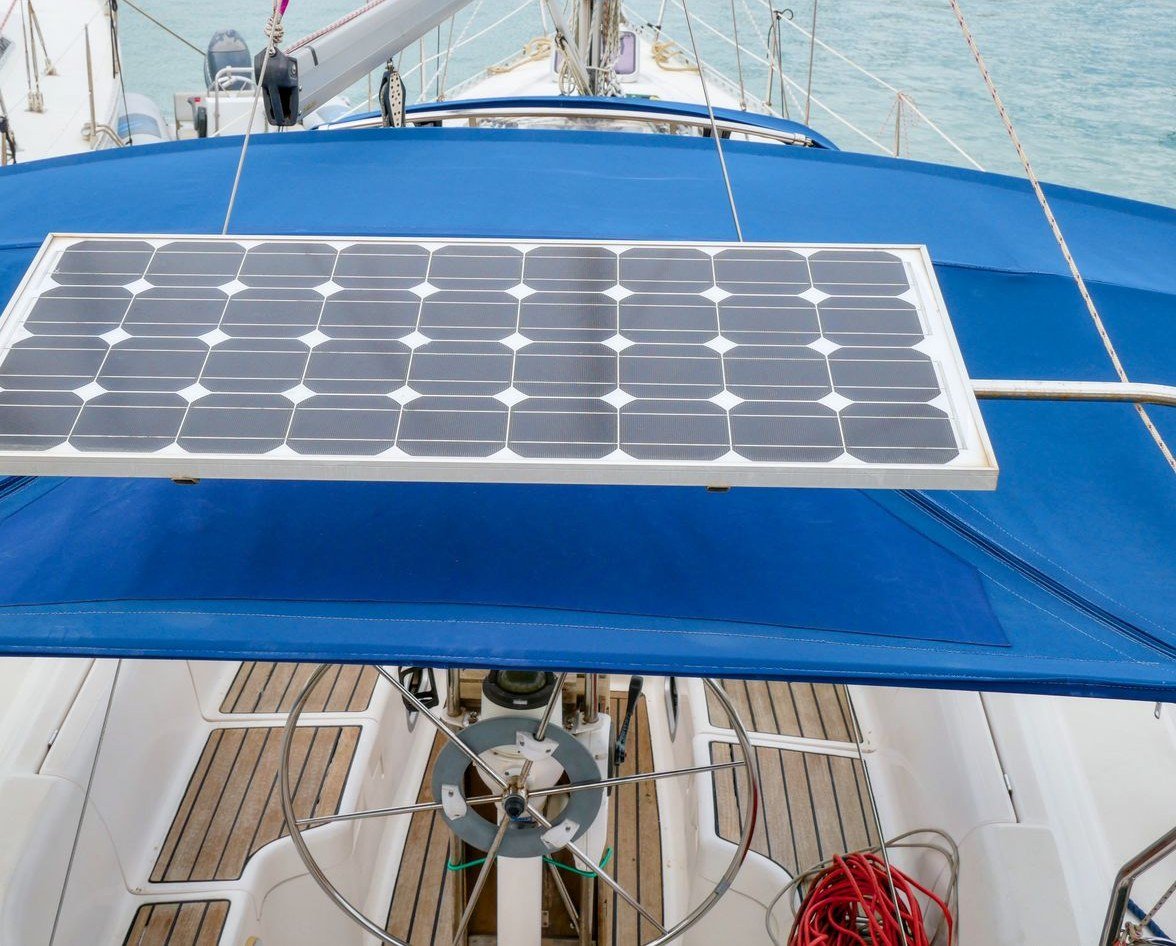
In recreational vehicles and sailing yachts, weight and volume are the budget. Swapping ~120 kg of AGM for one 38 kg LFP pack frees payload and space, and the higher usable capacity roughly doubles runtime between charges. The sealed case mounts in living compartments without acid-fume ventilation, and the IP55 rating shrugs off bilge humidity and road spray.
Telecom and UPS Backup
Remote telecom sites and small UPS rooms need banks that survive years of float with occasional deep discharges. The 24V class is standard in many legacy DC plants, and the pack’s low self-discharge and sealed, maintenance-free construction remove the watering and equalisation visits that dominate lead-acid operating cost at unmanned sites. For larger always-on loads, the same platform scales in parallel or moves to cabinet-class systems such as the 315kWh battery energy storage system.

Golf Carts and Light Electric Vehicles
Golf carts and similar light EVs are intensive cycling duty — one or two full discharge cycles per day. For carts wired as 24V systems, the 200Ah format extends daily range materially; for 48V carts, huadaenergy builds dedicated traction packs such as the 51.2V 105Ah golf cart battery. Lighter weight also reduces chassis wear on suspension and tyres.
How to Choose the Right 24V 200Ah LiFePO4 Battery
Use this checklist before committing to any 24V 200Ah LiFePO4 battery supplier:
- Match the charger. Confirm your charger or solar controller offers a lithium (CC/CV) profile within the datasheet’s 28.0V maximum charging voltage, and avoid chargers with lead-acid equalisation modes.
- Check current headroom. Add up your inverter’s peak draw: 200A continuous and 400A pulse (under 3 seconds) covers a 5kW-class 24V inverter, but not larger loads without a second parallel unit.
- Plan the expansion path. Up to four packs can be connected in series (to 96V); run parallel units from the same batch and same state of charge at first connection.
- Mind the temperature window. Charging is specified from 0°C to 45°C; if the battery lives where mornings freeze, either place it indoors or add a heating/low-temperature-charge lockout feature.
- Verify transport and compliance documents. Ask for the UN38.3 test summary for shipping, and for EU-bound industrial-battery projects, confirm carbon-footprint documentation under Regulation (EU) 2023/1542.
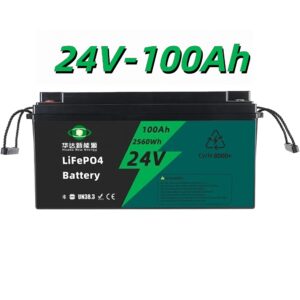
- Confirm the drop-in fit. The pack’s 520 × 245 × 220 mm case and M8 terminals follow the common 24V lead-acid layout — measure your tray before ordering the smaller 24V 100Ah LiFePO4 battery if capacity allows, or this 200Ah model when runtime matters.
- Series vs parallel vs higher voltage. If your system is still 12V, two 12V 200Ah LiFePO4 batteries in series may be simpler; if you are designing new, compare against the 24V 200Ah format for the same energy with fewer connections.
Frequently Asked Questions
Can a 24V 200Ah LiFePO4 battery directly replace my lead-acid bank?
Yes. The pack follows the common 24V lead-acid case dimensions and M8 terminal layout, so it drops into the existing tray and cables. You should still switch the charger or solar controller to a lithium charge profile and disable any equalisation stage.
How long will a 24V 200Ah LiFePO4 battery last?
The datasheet rates 2,000 full cycles at 0.2C until capacity reaches 80%. Daily-partial-cycle use stretches calendar life well beyond the cycle rating; seasonal self-discharge of ≤3.5% per month means the pack also survives long idle periods without damage.
How many solar panels do I need to charge it?
A 5,120Wh pack needs about 1.2–1.5kW of panel capacity to refill in one day with five peak sun hours. Smaller arrays simply take two days.
Can I connect two in parallel or four in series?
Yes. The pack supports series connection up to four units (96V total) and parallel connection for more capacity. Use batteries from the same batch, equalise their state of charge before first connection, and follow the balancing sequence in the manual.
What charger do I need?
Use a constant-current/constant-voltage (CC/CV) lithium charger with an absorption voltage at or below the datasheet’s 28.0V maximum, a standard charging rate of 0.2C (40A), and no equalisation stage. The pack accepts up to 200A of charging current, so most MPPT solar controllers and correctly configured 24V chargers can recharge it quickly.
Does it work below freezing?
Discharging is rated from −20°C to 60°C, but charging is only specified from 0°C to 45°C. The BMS blocks charge below freezing to prevent lithium plating; if the installation sees sub-zero mornings, plan for indoor mounting or a low-temperature charging solution.
About huadaenergy
huadaenergy manufactures LiFePO4 batteries across 12V, 24V, 38.4V and 51.2V platforms, including drop-in lead-acid replacements, home storage, portable power stations, golf cart traction packs, commercial cabinets and containerised ESS. Every pack is built from Grade-A cells and passes capacity, cycle, insulation and BMS function testing before shipment, and OEM/ODM programmes cover labels, packaging, battery parameters and connector types for distributors and installers. Review the full specifications on the 24V 200Ah LiFePO4 battery product page, compare the 24V 100Ah model, or contact the huadaenergy team for datasheets, samples and OEM pricing.
Last updated: 2026-10-26