The 1MW/3MWh containerized BESS is a fully integrated battery energy storage system that stores 3,153.9 kWh of LiFePO4 energy and delivers 1 MW of continuous power — roughly three hours of rated output — from a single standard 40ft container. For factory owners, EPC contractors and distributors sizing a mid-scale storage project in 2026, this guide explains what the specification means, why the 3MWh class is growing fastest, and how it compares with diesel generation, lead-acid banks and smaller cabinet systems.
Last updated: 17 October 2026
What Is a 1MW/3MWh Containerized BESS?
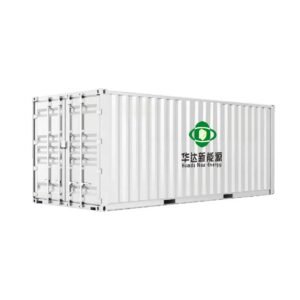
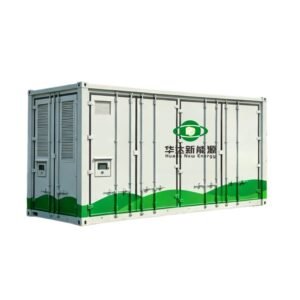
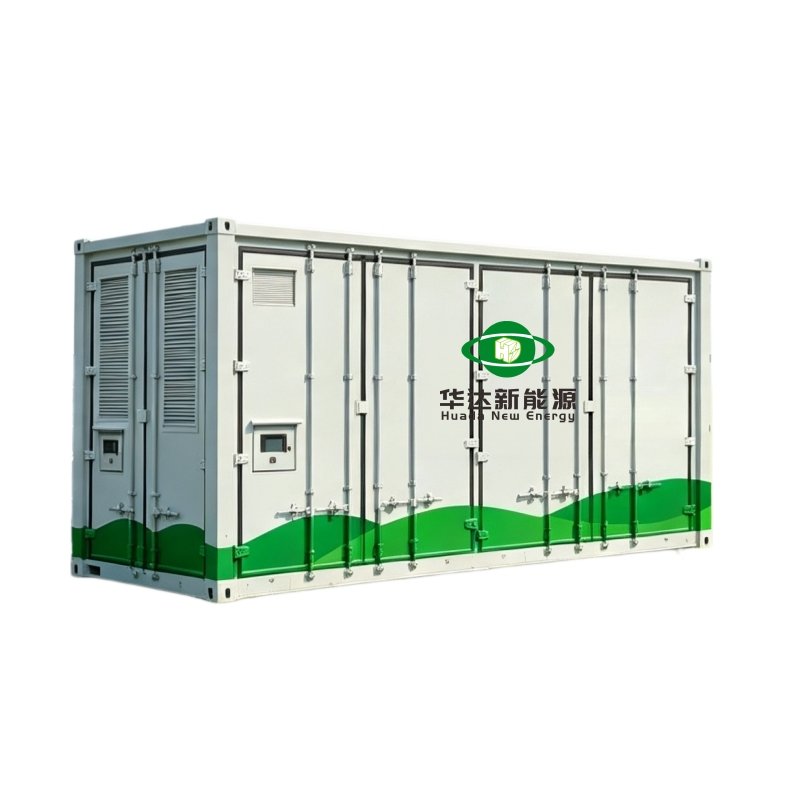
A 1MW/3MWh containerized BESS is a complete storage power plant — battery clusters, BMS, PCS, liquid-cooling thermal management, fire suppression and monitoring — pre-assembled and factory-tested inside one standard 40ft shipping container.
The Huada Energy H098 1MW/3MWh containerized energy storage system uses a 4082Ah / 768V LiFePO4 battery bank rated at 3153.9 kWh. Because every component is installed and commissioned in the factory, site work is limited to landing the container on a concrete pad and connecting the AC cables — no on-site battery assembly, no multi-month construction schedule.
Two numbers define the product class. The 1 MW power rating means the system can discharge at up to 1 MW continuously (1.1 MW peak), and the 3,153.9 kWh capacity means a full charge can supply that rated output for a little over three hours. At a 400V AC output (−20% to +15% tolerance, 1444A rated current), it connects directly to standard industrial distribution — no custom transformer is required for most C&I sites.
Why 3MWh-Class Containers Are Scaling So Fast in 2026
Battery storage is growing faster than any other power technology, and containerized systems are the format driving most of that growth at utility and industrial scale.
According to the IEA Global Energy Review 2026, 108 GW of new battery storage was installed worldwide in 2025, 40% more than in 2024, with around 80% of new capacity being utility-scale and LiFePO4 chemistry accounting for roughly 90% of deployments. BloombergNEF counted 112 GW / 307 GWh of additions in 2025 and forecasts 158 GW / 459 GWh for 2026 (Energy Storage Market Outlook H1 2026).
Cost is the underlying driver. BNEF’s Energy Storage Systems Cost Survey 2025 put the global average turnkey BESS price at $117/kWh, down 31% year-on-year, and stationary-storage battery pack prices at $70/kWh, down 45%. The benchmark levelized cost of storage for a four-hour project fell 27% to $78/MWh — the lowest since BNEF began tracking in 2009.
Two trends in that data matter directly to buyers considering a 3MWh container:
- Durations are lengthening. The IEA notes that while most projects still cluster around two hours, four-hour-plus systems are increasingly common as PV penetration rises. A 3.15-hour system at 1 MW sits exactly in the band where evening peak shifting works for industrial loads.
- LFP has become the default chemistry. At roughly 90% of 2025 deployments (IEA, 2026), LiFePO4’s cycle life and thermal stability are no longer a differentiator against NMC — they are the baseline a serious supplier must meet.
Key Specifications and What They Mean
The table below lists the H098 1MW/3MWh system’s published specifications and explains why each one matters at procurement stage. All values come from the official product page.
| Parameter | Value | What It Means for Buyers |
|---|---|---|
| Battery capacity | 3,153.9 kWh (4082Ah / 768V LiFePO4) | About 3 hours of rated discharge; covers an afternoon-to-evening peak window |
| Rated / peak power | 1 MW / 1.1 MW | Runs a 1 MW load continuously; 10% headroom for motor starts and surges |
| AC output | 400V (−20% to +15%), 1444A rated | Direct connection to standard industrial LV distribution |
| Thermal management | Liquid cooling | Uniform pack temperature, slower capacity decay, longer cycle life than air-cooled racks |
| Enclosure | 40ft container, 12192 × 2438 × 2896 mm, 32,000 kg | Ships as standard cargo; lands on a concrete pad without a dedicated building |
| Certifications | UL 9540A, CE, IEC 62933, UN38.3, MSDS, RoHS 2.0 | Accepted documentation set for most export markets and insurers |
| Monitoring | 4G remote monitoring, EMS cloud platform | Dispatch, fault alarms and performance data visible without on-site staff |
| Deployment | Factory pre-assembled and tested, plug & play | Site work is cabling and commissioning, not construction |
Liquid cooling deserves specific attention. In a 3MWh-class bank, air cooling struggles to keep cell temperatures uniform across the container; temperature spread accelerates capacity fade and forces conservative charge limits. The H098’s liquid-cooling loop holds pack temperatures consistent, which the manufacturer states reduces battery decay and extends system cycle life — the difference between a bank that still delivers rated energy in year eight and one that does not.
Where a 3MWh Container Beats the Alternatives
A 1MW/3MWh containerized BESS outperforms diesel generation, lead-acid banks and multi-cabinet builds on running cost, footprint and management overhead — but each comparison depends on your load profile.
vs. Diesel Generation
A BESS does not replace a genset outright; it changes how the genset is used. In a hybrid setup, the container covers normal load and peak periods while diesel runs only as backup — cutting fuel burn, running hours and maintenance intervals. The IEA’s data underlines the direction of travel: battery additions in 2025 exceeded the largest-ever annual capacity additions for natural gas plants (IEA Global Energy Review 2026).
Illustrative cost check (based on assumptions, not a quote): assume diesel generation costs $0.30/kWh in fuel and maintenance, off-peak grid charging costs $0.08/kWh, and a modern LFP system achieves ~90% round-trip efficiency (a figure Ember research in December 2025 associated with current LFP assets). Stored energy then costs roughly $0.09/kWh delivered, so every MWh shifted from diesel to battery avoids on the order of $200 in operating spend. Actual savings depend on local fuel prices, tariffs and cycling — model your own numbers before committing.
vs. Lead-Acid Banks
Lead-acid remains cheaper to buy per kWh, but at 3MWh scale the lifetime math usually reverses. A LiFePO4 bank tolerates deep daily cycling for several thousand cycles, while lead-acid requires oversizing (typically 2× capacity for the same usable energy), vented battery rooms, and replacement every few years under daily cycling. For a system expected to cycle every day for a decade, LFP in a managed container is normally the lower total-cost option.
vs. Multiple Smaller Cabinets
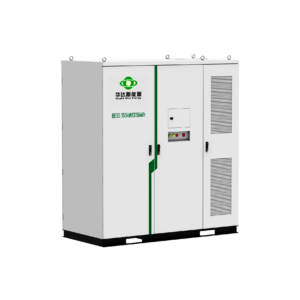
Stacking 300–500 kWh cabinets to reach 3MWh multiplies enclosures, cable runs, BMS integration points and failure surfaces. One 40ft container with a single integrated BMS/EMS is simpler to permit, faster to commission and easier to monitor. Cabinet systems keep their place below roughly 500 kWh, or where indoor space and step-by-step expansion matter more than simplicity — see the 150kW/315kWh cabinet ESS and 100kW/215kWh cabinet BESS for that segment.
| Factor | 1MW/3MWh Container | Diesel Genset | Lead-Acid Bank | Multiple Cabinets |
|---|---|---|---|---|
| Daily cycling cost | Low (off-peak charging) | High (fuel) | Moderate–high (replacement) | Low |
| Cycle life | Several thousand LFP cycles | Engine-hour limited | Short under deep cycling | Several thousand LFP cycles |
| Footprint per MWh | One 40ft unit | Multiple gensets + fuel storage | Large battery rooms | Many enclosures |
| Maintenance | Remote monitoring, scheduled checks | Fuel logistics, engine service | Watering, cell checks | Multiple systems to service |
| Emissions on site | None at point of use | Exhaust + noise | None at point of use | None at point of use |
How to Choose the Right 3MWh Containerized BESS
Choosing a 3MWh container comes down to five checks that separate systems that will run for a decade from systems that will disappoint in year two:
- Match power to load, not just energy. Confirm your daytime peak stays under the rated 1 MW (1.1 MW peak), and size the container for the peak window you actually need to cover — 3,153.9 kWh supports about three hours at full rating.
- Verify the certification set for your market. UL 9540A (thermal-runaway test data), CE, IEC 62933 and UN38.3 (transport) are the documents insurers and authorities most often request.
- Ask for liquid cooling at this size. For 3MWh in one container, confirm the thermal design and the specified temperature-uniformity figures, not just “air or liquid” as a checkbox.
- Confirm factory testing and deployment scope. The H098 ships pre-assembled and fully tested; your site scope should be limited to the pad, AC cabling and commissioning.
- Check the supplier’s scaling path. Huada Energy builds the same containerized series at 500kWh, 1MWh, 2MWh and 3MWh (500kW/500kWh, 500kW/1MWh, 1MW/2MWh), plus OEM/ODM customization for EPCs and distributors — useful if your next project needs a different ratio.
Frequently Asked Questions
How much energy does a 1MW/3MWh containerized BESS actually store?
The H098 system stores a rated 3,153.9 kWh, delivered from a 4082Ah / 768V LiFePO4 battery bank. At the rated 1 MW output, a full charge supplies roughly three hours of continuous power; at a lighter 500 kW load, more than six hours.
How long can it run a factory during a grid outage?
It depends on the load: at 1 MW the container runs for about three hours, and proportionally longer at reduced load. Many sites combine the BESS with existing diesel gensets so the battery covers immediate transfer while generators start, then takes over again to cut fuel use.
What certifications should a 3MWh containerized BESS have for export projects?
Look at minimum for UL 9540A, CE, IEC 62933, UN38.3 and RoHS documentation — the exact set the H098 carries. UL 9540A test data is the document most insurers and authorities having jurisdiction ask for when approving large lithium battery installations.
Why is liquid cooling important in a 3MWh battery container?
Liquid cooling keeps cell temperatures uniform across a large battery bank, which slows capacity fade and allows consistent charge and discharge limits. In air-cooled containers of this size, temperature spread between packs is the main factor that shortens usable system life.
Can the system work together with solar and existing diesel generators?
Yes. The container is designed for hybrid topologies: PV charges the bank, the grid charges it at off-peak tariffs, and diesel gensets remain as backup with sharply reduced running hours. The EMS automates charging and dispatch and reports to a cloud platform over 4G.
How long does installation take on site?
Because the system is pre-assembled and factory-tested, on-site work is mainly civil preparation, cable connection and commissioning — a matter of days rather than the months required to build a storage plant from separate components. Exact timelines depend on site conditions and grid connection procedures.
About Huada Energy
Huada Energy (Huizhou Huada New Energy Technology) manufactures LiFePO4 energy storage products spanning home batteries, portable power stations, golf cart batteries, cabinet systems and containerized BESS from 500kWh to 3MWh. Container systems ship pre-assembled, factory-tested and certified to UL 9540A, CE and IEC 62933, with OEM/ODM support for EPC contractors and distributors worldwide. To size a system for your project or request a quotation, contact the Huada Energy team or compare the 1MW/3MWh containerized BESS product page directly.