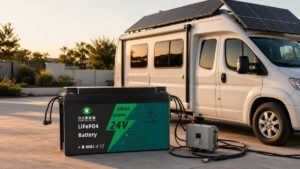
A 12V 100Ah LiFePO4 battery is a drop-in lithium replacement for the lead-acid house battery in an RV, boat or off-grid kit, and in 2026 the buying question has shifted from “does it fit” to “can I verify what is inside and how it was tested.” RVIA’s guidance now expects lithium batteries in member-built RVs to be third-party listed, while US RV shipments fell through the first three quarters of 2026. This article explains what the rules require, what the huadaenergy 12V 100Ah delivers, which documents to request, and why buying from the source factory changes the conversation.
What Is a 12V 100Ah LiFePO4 Battery?
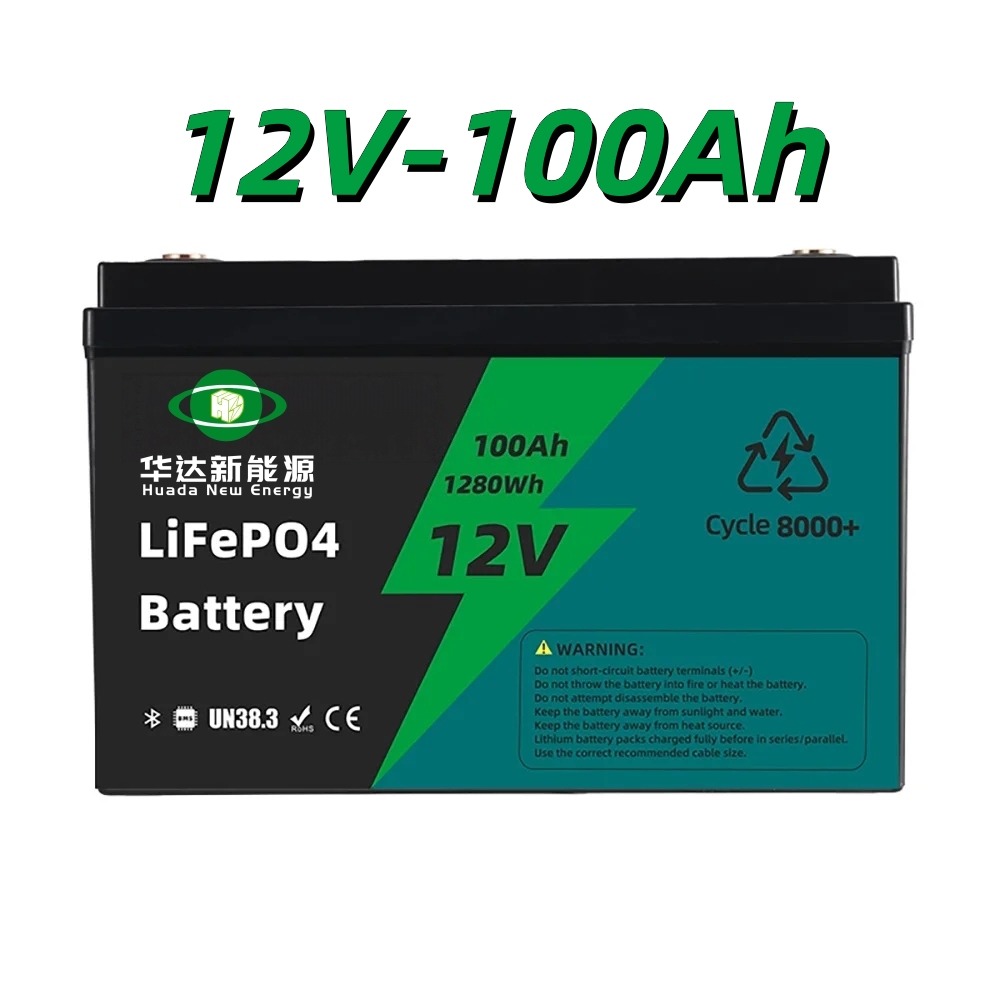
A 12V 100Ah LiFePO4 battery is four 3.2V lithium iron phosphate cells in series (4S1P) with a built-in battery management system, giving 12.8V nominal and 1,280Wh in a case the same size as a Group 31 lead-acid battery.
Same Box, Different Chemistry
The huadaenergy unit uses grade-A prismatic LFP cells at or below 35mΩ, an integrated BMS with cell balancing and Bluetooth monitoring, and an IP55 casing with M8 terminals. It drops into a 12V battery bay without structural change; the main check is a lithium-compatible charger. Full configuration is on the huadaenergy 12V 100Ah LiFePO4 product page.
Why Listing Rules and a Softer RV Market Both Favour Verified Batteries
Two 2026 developments push RV and marine buyers toward documented lithium packs: a clearer third-party listing expectation, and a slower RV market that makes buyers scrutinise value over impulse upgrades.
The Listing Requirement Is Specific
NFPA 1192, the standard on recreational vehicles, does not detail battery wiring itself. It defers AC systems to NFPA 70 and DC systems to ANSI/RVIA LV. RVIA component guidance calls for rechargeable lithium battery systems to be listed to UL 1973 or UL 2054, and does not treat a CE self-declaration as equivalent. A UN38.3 certificate covers transport safety, not product listing. These requirements bind RVIA members; a private owner is not regulated the same way, but the benchmark matters because insurance and warranty claims often reference recognised standards.
The Market Is Cooling, So Value Gets Examined
RVIA reported 23,320 wholesale RV shipments in September 2026, down 9.2 percent year on year, with 230,508 units through three quarters, down 13.7 percent. Its quarterly forecast still projects 349,300 units for 2026, up 3.7 percent on 2025’s 337,000. RVIA also says 28 million Americans intend to RV this winter, up 33 percent, and 8.1 million US households own an RV (RVIA, 2026). Softer shipments and steady use mean owners keep vehicles longer and upgrade the battery instead of replacing the rig – which makes verified cycle life and documentation more valuable than a low headline price.
What the 12V 100Ah Actually Delivers
Four numbers explain the switch: usable energy, cycle life, weight and self-discharge, tied together by built-in protection.
The Short Version of the Specs
| Item | huadaenergy 12V 100Ah | Use in practice |
|---|---|---|
| Nominal / energy | 12.8V / 1,280Wh (100Ah) | Matches a 12V lead-acid bay and its voltage window |
| Cycle life | 8,000+ cycles at 0.2C to 80% capacity | Years of daily deep cycling, subject to test conditions |
| Discharge | 100A continuous, 200A pulse under 3s | Runs inverters, pumps and fridges without voltage sag |
| Charging | 0 to 45 C, lithium profile | Check the existing converter before swapping |
| Weight | about 10 kg | Roughly half an equivalent lead-acid battery |
| Self-discharge | at or below 3.5% per month at 25 C | Survives seasonal storage between trips |
| Protection | IP55 case, BMS, M8, Bluetooth | Dust and jet-water resistance, cell balancing, state of charge on a phone |
Why the Numbers Beat the Chemistry Argument
Lead-acid is typically limited to about half its rated capacity in deep-cycle use and rated for 500 to 1,500 cycles; this LFP pack is rated at 8,000+ cycles to 80% capacity and can be discharged deeply without sulfation. The practical difference is more usable energy per trip and fewer replacements over the vehicle’s life. The 8,000+ figure is measured at 0.2C, so higher currents or extreme temperatures change real-world life.
Where This Battery Earns Its Keep
A 12V 100Ah LiFePO4 battery suits four deep-cycle jobs: RV house banks, boat and marine auxiliary power, small off-grid solar systems and telecom or UPS standby.
RV and Camper Vans
Half the weight of lead-acid matters in a rear bay, and deeper usable capacity means a fridge and lights last through a night off-grid. Dealers fitting lithium as standard increasingly treat listing as part of supplier qualification. If a build needs more runtime, the 12V 200Ah LiFePO4 battery doubles capacity in the same 12V architecture.

Marine and Off-Grid Solar
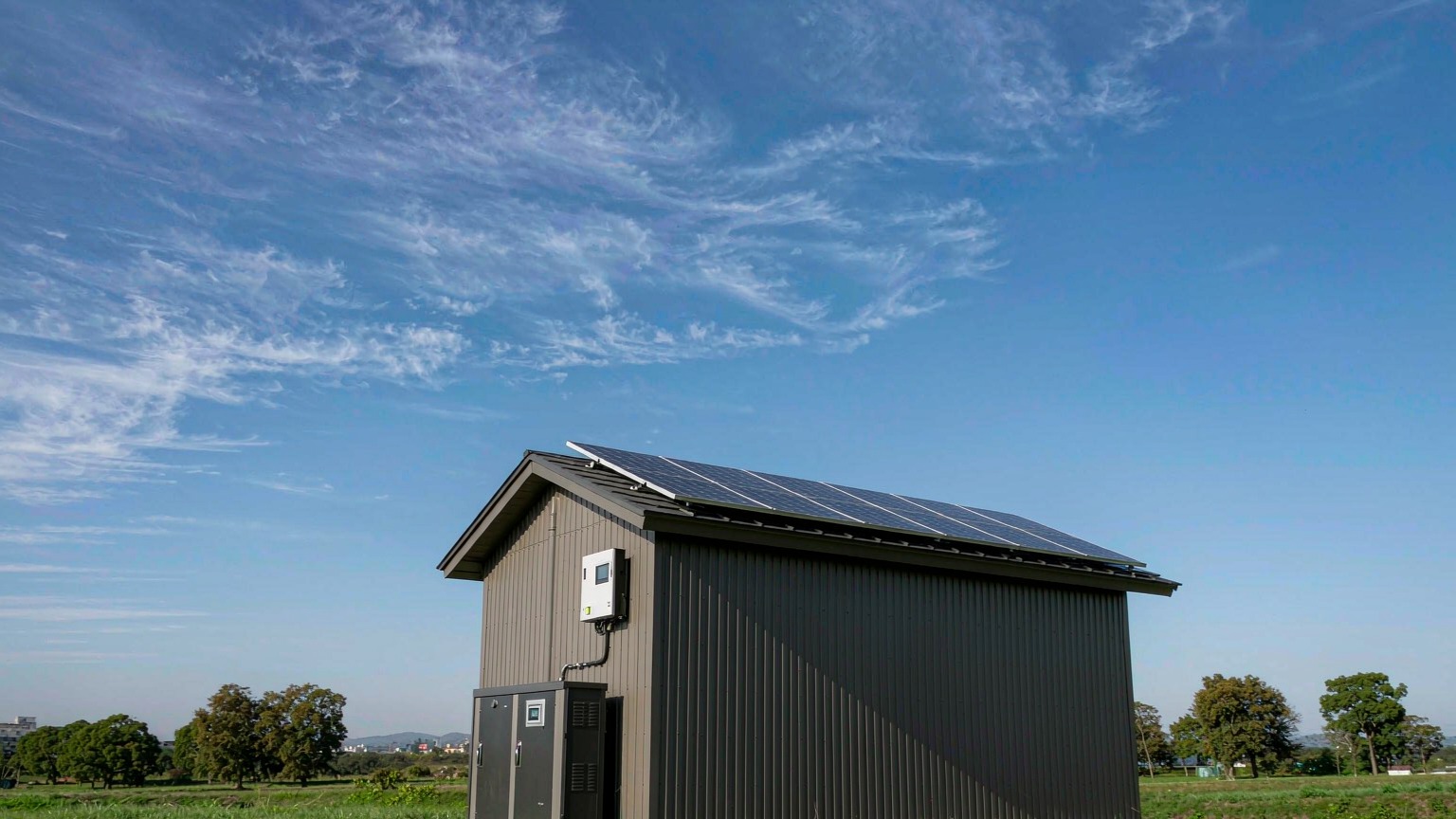
No acid leakage, IP55 sealing and Bluetooth state-of-charge make the swap straightforward in a boat’s battery compartment or a cabin. For a 12V solar kit storing daytime surplus for evening loads, one unit covers the basics; a 24V array can use the 24V 100Ah LiFePO4 battery from the same line.
Telecom and Standby
Low self-discharge and no maintenance suit an occasionally visited site; the sealed pack needs no topping-up or venting in enclosed cabinets.
Certifications Explained: What a Buyer Can Actually Verify
The huadaenergy 12V 100Ah product page lists UN38.3 and CE, and a UL 1973 test report is on file for model HD12100-12; a buyer should treat a test report as evidence of testing, not as a product listing.
Document Versus Claim
The report is TSZ25JW026A01-01, issued 2025-11-27 by Shenzhen Tiansu Calibration and Testing Co., Ltd to ANSI/CAN/UL-1973:2022, covering model HD12100-12 rated 12.8V, 100Ah, 1,280Wh. Its conclusion states the samples passed. It is a test report on those samples, not a UL listing; a listing needs verifying with the issuing agency. UN38.3 is the transport test carriers expect; CE is a manufacturer’s declaration for EU rules. Each answers a different question, and none replaces a listing an RVIA-member build may require.
What to Request Before Ordering
Ask for the report number, issue date, applicant, tested model and scope, then check they match the SKU you are buying. For a fleet or tender, agree in writing which documents ship with the goods. The 12.8V 150Ah portable DC LiFePO4 pack follows the same documentation discipline.
Fire Safety Beyond the Cell: A Note on Passive Protection
Passive fire barriers are a growing topic in battery safety, but a coating is a supplementary layer and does not replace cell-level testing or system-level fire tests.
Why the Topic Keeps Returning
UL 9540A Edition 6, published in 2026, has pushed installers toward installation-scale fire testing and clearer enclosure design. In that context, a fire-resistant coating is discussed as one more control layer for battery compartments. A coating from a materials partner is not a certification held by the battery maker, and it does not turn a pack into a listed system.
What the Material Data Actually Says
Tests on a fire-resistant coating co-developed with materials partners report that a 2.5mm coated steel plate withstood 800-850 C for 30 minutes without burn-through, with a peak back-face temperature of 154.8 C, below the 300 C criterion (CTI report YJ2025060240). Adhesion was class 0 under GB/T 31586-2015 (EMT02R000171C01); RoHS screening reported 256 mg/kg lead against a 1,000 mg/kg limit (A2260349272101001C). These reports were commissioned by the material developers, apply only to the tested samples and are for internal reference; huadaenergy is an early adopter of the material in storage, not the patent holder. Request documents relevant to your own project rather than treating a material sheet as a system certificate.
LiFePO4 vs Lead-Acid: The Honest Comparison
For a deep-cycle 12V application, an LFP pack costs more upfront and delivers more usable energy, lighter weight and far more cycles; lead-acid still wins on purchase price where budgets are tight and duty is light.
Decision Table
| Factor | 12V 100Ah LiFePO4 | Lead-acid, same size |
|---|---|---|
| Upfront price | Higher | Lower |
| Usable energy | Deep discharge to 80% DOD | Limited by voltage sag and sulfation |
| Weight | about 10 kg | about 20 kg or more |
| Cycle life | 8,000+ rated at 0.2C | typically 500 – 1,500 |
| Maintenance | Sealed, none | Periodic checks and topping-up |
| Charging | Needs a lithium profile | Works with standard lead-acid chargers |
When Lead-Acid Still Makes Sense
If the battery is rarely cycled, the vehicle is sold quickly, or the charger cannot be changed, lead-acid may be the simpler buy. If the pack is cycled daily in a lightweight RV or boat, or expected to last several seasons, lithium changes the total cost even though the invoice is larger.
How to Choose the Right 12V Pack
Choose by matching capacity, current, charging and documentation to the actual application, then verify the paperwork against the exact model you will receive.
A Short Checklist
- Measure the bay and confirm M8 terminals and cable lengths fit.
- Add up peak loads: 100A continuous, 200A pulse under 3s.
- Confirm the charger or converter supports a 14.0-14.6V lithium profile.
- Decide whether 1,280Wh covers a typical night, or whether 200Ah fits better.
- Ask for dated test reports tied to the SKU, and check your market’s listing rules.
- Confirm cold-weather charging if the vehicle is used below freezing.
Documentation Is Part of the Product
A datasheet without a model number, report date and applicant is hard to use in a tender. As the source factory, huadaenergy can align the pack, BMS parameters, casing and markings with a customer’s specification, so a project file matches the unit shipped.
Frequently Asked Questions
Does a 12V 100Ah LiFePO4 battery fit my existing RV battery box?
Usually yes. The pack uses the same footprint as a Group 31 lead-acid battery and standard M8 terminals, so most 12V bays accept it unchanged. Check the bay dimensions and confirm your charger has a lithium-compatible profile before fitting.
Do I need a UL listing to install this battery in an RV?
RVIA guidance expects lithium batteries in member-built RVs to be listed to UL 1973 or UL 2054 by a third party, and CE alone is not equivalent. The huadaenergy 12V 100Ah has a UL 1973 test report for model HD12100-12, but a test report is not a listing; verify the current listing status with the issuing agency.
How long will a 12V 100Ah LiFePO4 battery run my fridge?
The pack stores 1,280Wh. At 80% usable depth that is about 1,024Wh before losses, so a 60W fridge would in theory run roughly 17 hours, a 40W unit closer to 25. Real runtime depends on compressor duty cycle, temperature and inverter efficiency.
Can I charge it with my existing solar controller?
Only if the controller has a lithium or LiFePO4 profile, typically a 14.0-14.6V absorption setting for a 12V pack. Charging is specified from 0 C to 45 C, so a heated enclosure is needed below freezing. Many RV converters can be reconfigured for lithium use.
What do the 8,000 cycles actually mean?
It is a rating, not a promise. The 8,000+ figure is measured at 0.2C charge and discharge until capacity falls to 80%, as stated on the product page. Higher currents, deep discharge and high temperature shorten real service life; ask for the test conditions when comparing quotes.
Can huadaenergy customise the battery for my brand or project?
Yes. As the source factory, huadaenergy supports OEM and ODM work on casing, labels, BMS parameters, communication and capacity, and can develop a configuration around a customer’s application rather than a fixed catalogue.
About huadaenergy
Factory-Direct, With Room to Customise
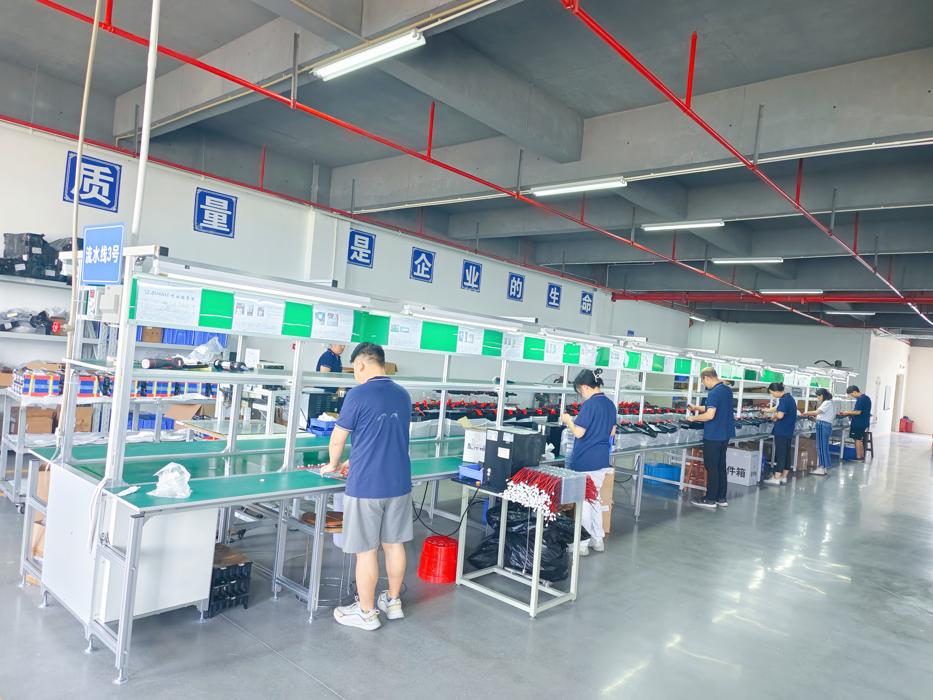
huadaenergy makes portable power stations, LiFePO4 batteries, home storage and containerized systems in Huizhou, with cell and batch traceability and full-function testing before shipment. We are the source factory, not a trading middleman: OEM and ODM work, custom system design and development to customer requirements are part of the job. For a datasheet, document pack or quotation, see the 12V 100Ah product page or contact sales@huadaenergy.com / +86 138 2316 3795. Last updated: 2026-11-28