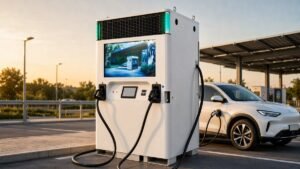
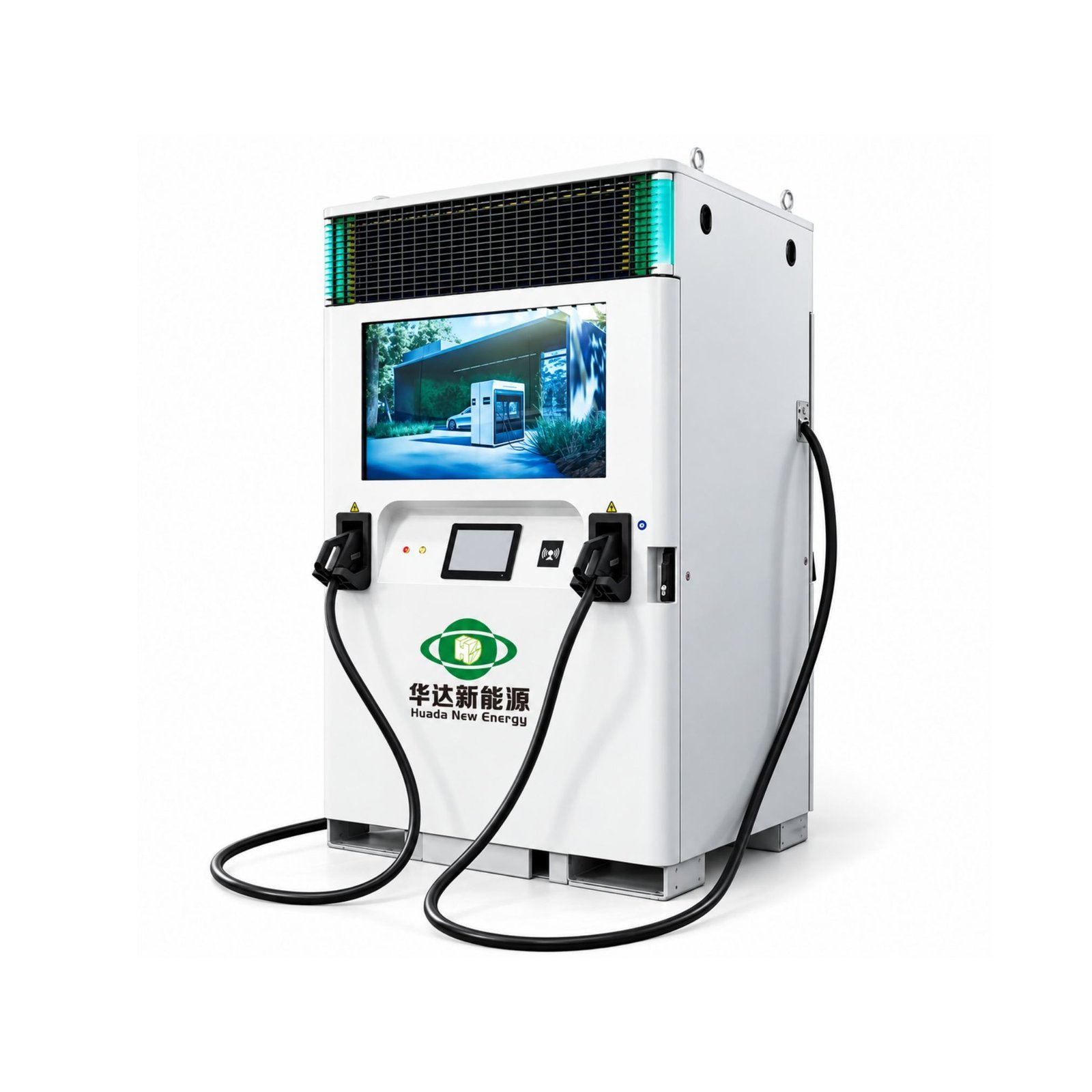
A battery-buffered off-grid EV charging station puts a large battery between the grid and the charger, so a site can deliver 120 kW DC fast charging without waiting years for a grid upgrade. The huadaenergy H096 integrates 193 kWh of LiFePO4 storage, a 120 kW rated DC output (180 kW peak), dual charging guns and liquid cooling in a single IP55 cabinet. This article explains why battery-buffered charging became a mainstream 2026 strategy, where this station fits, and what buyers should verify before ordering.
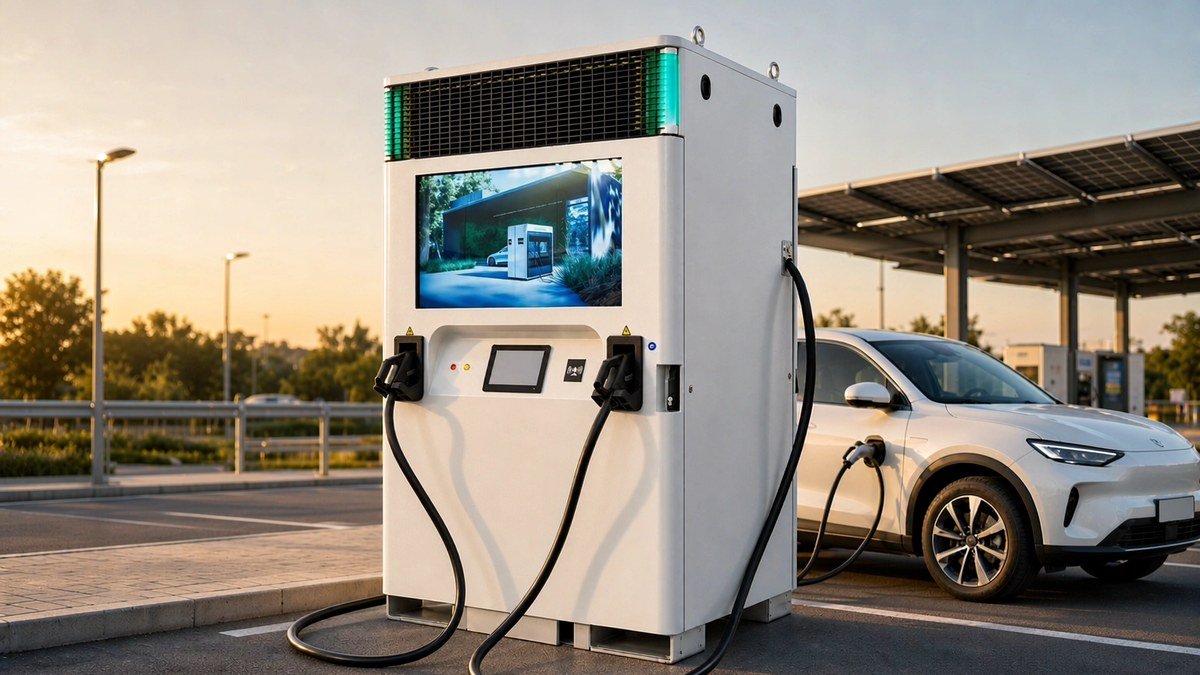
What Is a Battery-Buffered Off-Grid EV Charging Station?
A battery-buffered off-grid EV charging station is a self-contained fast-charging unit that stores energy in an onboard battery and delivers it to vehicles at high power, independent of a continuous grid supply. The huadaenergy H096 holds 193 kWh in a 614.4 V LiFePO4 pack and outputs 120 kW rated DC power, up to 180 kW peak, through two guns. It can run with no grid connection at all, or draw up to 60 kW from a 380 Vac supply during off-peak hours and discharge during peak periods.
The principle is straightforward: the battery absorbs a small, steady input and releases it as a short, powerful burst. That decoupling is what lets a site offer fast charging where the local network was never designed for it. See the H096 product page for the full specification.
Why Battery-Buffered Charging Became a 2026 Mainstream Strategy
Battery-buffered charging moved from a niche concept to a mainstream deployment strategy in 2026 because grid capacity, not charger supply, is now the binding constraint on EV infrastructure. GlobalData’s Strategic Intelligence: Electric Vehicles in Power (2026) identifies battery-buffered hubs as a key emerging model: on-site storage draws steadily from the grid and delivers high-power bursts to vehicles, helping operators avoid costly network upgrades and cut demand charges.
The scale of the shift is documented. The IEA Global EV Outlook 2026 reports that the global public charging stock passed 7 million points at the end of 2025 after nearly 1.8 million additions in the year, a rise of more than 33%; fast and ultra-fast chargers grew from about 1.5 million to 2.2 million. The same IEA analysis notes that limited substation capacity and network reinforcement can delay charging depots by several years, and that a 7 kW post and a 400 kW hub are effectively different businesses with different timelines.
For operators, the practical consequence is that deployment speed has become a product feature. A 193 kWh buffer such as the H096 lets a site charge vehicles at 120 kW while limiting its own grid draw, turning a multi-year interconnection problem into a container-sized delivery. For sites with a solid grid supply, huadaenergy also offers grid-tied CCS2 DC fast chargers from 60 kW to 240 kW.
What the H096 Delivers: Key Capabilities and What They Mean
The H096’s value lies in a short list of capabilities that map directly to operator pain points: high output, dual-vehicle service, wide voltage compatibility, and freedom from a heavy grid connection.
| Capability | Value | What it means for the buyer |
|---|---|---|
| Onboard storage | 193 kWh LiFePO4, 614.4 V (480–700.8 V) | Buffers peak grid draw; LiFePO4 is valued for thermal stability and long cycle life. |
| DC fast output | 120 kW rated, up to 180 kW peak | Enables 20–30 minute top-ups for typical passenger EVs. |
| Dual guns | Two guns, 7 m cables | Serve two vehicles at once, improving site throughput. |
| Voltage / current | DC 200–1000 V, 0–250 A | Covers a broad range of today’s EV platforms. |
| Recharging | 60 kW AC (380 Vac, 3P+N+PE) or DC gun-to-gun | Charge from the grid off-peak, or refill where no grid exists. |
| Cooling / protection | Intelligent liquid cooling; IP55 | Stable high-power operation; resistance to dust and water jets. |
| Operating range | −30 °C to +50 °C; up to 3000 m altitude | Suits hot climates, cold regions and high-altitude sites. |
| Connectivity | 4G remote monitoring; LAN / CAN / RS485 | Remote status, control and fleet integration. |
Figures are the manufacturer’s published specifications for the H096; confirm the exact configuration for your market in the quotation.
Where the H096 Fits: Real-World Applications
Battery-buffered stations are most valuable where grid capacity is scarce, expensive or slow to obtain, and where charging demand arrives in short, high-power bursts.
Tourist Areas and Highway Rest Stops
Remote scenic sites and rest areas often have weak distribution networks but strong weekend demand. A 193 kWh buffer lets the station deliver multiple fast-charging sessions while recharging slowly in the background, avoiding a new substation.
Fleet Depots and Logistics Parks
Depot vehicles return on predictable schedules and charge in windows. The H096’s dual guns and 120 kW output support two vehicles at once, while the battery limits the depot’s simultaneous peak draw — exactly the demand-charge problem GlobalData highlights.
Temporary Events and Emergency Charging
Because it needs no permanent grid connection, the unit can be placed at exhibitions, construction sites or roadside-assembly points and moved later. Its 1340 × 1100 × 2280 mm cabinet, 1600 kg weight and standard hoisting rings support crane handling.
How It Compares: Battery-Buffered Station vs Conventional Grid-Tied Charger
A conventional grid-tied fast charger depends on a connection sized for its full peak power, while a battery-buffered station separates peak charging power from grid draw.
| Factor | Conventional grid-tied charger | Battery-buffered H096 |
|---|---|---|
| Grid connection | Often requires upgrade for high peak power | Can operate off-grid; grid input limited to 60 kW where available |
| Deployment time | Tied to utility reinforcement schedules | Delivered as a single cabinet, no civil works assumed |
| Demand charges | Full peak load hits the meter | Battery absorbs peaks; charge off-peak, discharge on-peak |
| Site flexibility | Fixed to the connection point | Relocatable; gun standard customizable (GB/T, CCS2, Type 2) |
Chart: indicative peak-power profile (assumptions — illustrative, not a performance guarantee).
Certifications and Compliance: What Buyers Should Confirm
The H096 product page lists the station as certified to GB/T 36276, GB/T 34131, GB/T 34120 and GB/T 34133, and lists UN 38.3 and CE in its certification summary. Buyers should match these to their destination market before ordering.
| Standard / mark | What it covers | Buyer note |
|---|---|---|
| GB/T 36276 | Lithium-ion batteries for power energy storage | China national standard for the storage battery. |
| GB/T 34131 | Battery management system for energy storage | Covers the BMS. |
| GB/T 34120 / 34133 | Power conversion equipment for energy storage | Covers converter equipment and testing. |
| UN 38.3 | Transport safety testing for lithium batteries | Relevant to shipping; test summary on request. |
| CE | EU conformity marking | Confirm the directives and declarations applicable to your installation. |
Certifications are as listed on the product page. Request the current test reports and certificates for your model and market, and confirm charging-gun standard and communication protocols in writing.
How to Choose the Right Off-Grid Charging Configuration
Start from the charging profile, then size the battery and grid input around it.
- Estimate sessions per day. Multiply expected vehicles by energy per session to size the usable battery; the H096’s 193 kWh buffer suits a handful of fast top-ups per day.
- Set the grid cap. If a 60 kW supply is available, off-peak recharging reduces demand charges; if not, plan DC gun-to-gun refilling.
- Match connectors. Specify GB/T, CCS2, Type 2 or other gun standards before production.
- Check environment. Confirm temperature range, altitude and IP55 against the site.
- Confirm compliance. Align certificates and protocols with the destination market.
As a source factory, huadaenergy supports OEM/ODM, custom system design and development against customer requirements — from cabinet branding and output configuration to communication protocols.
About huadaenergy
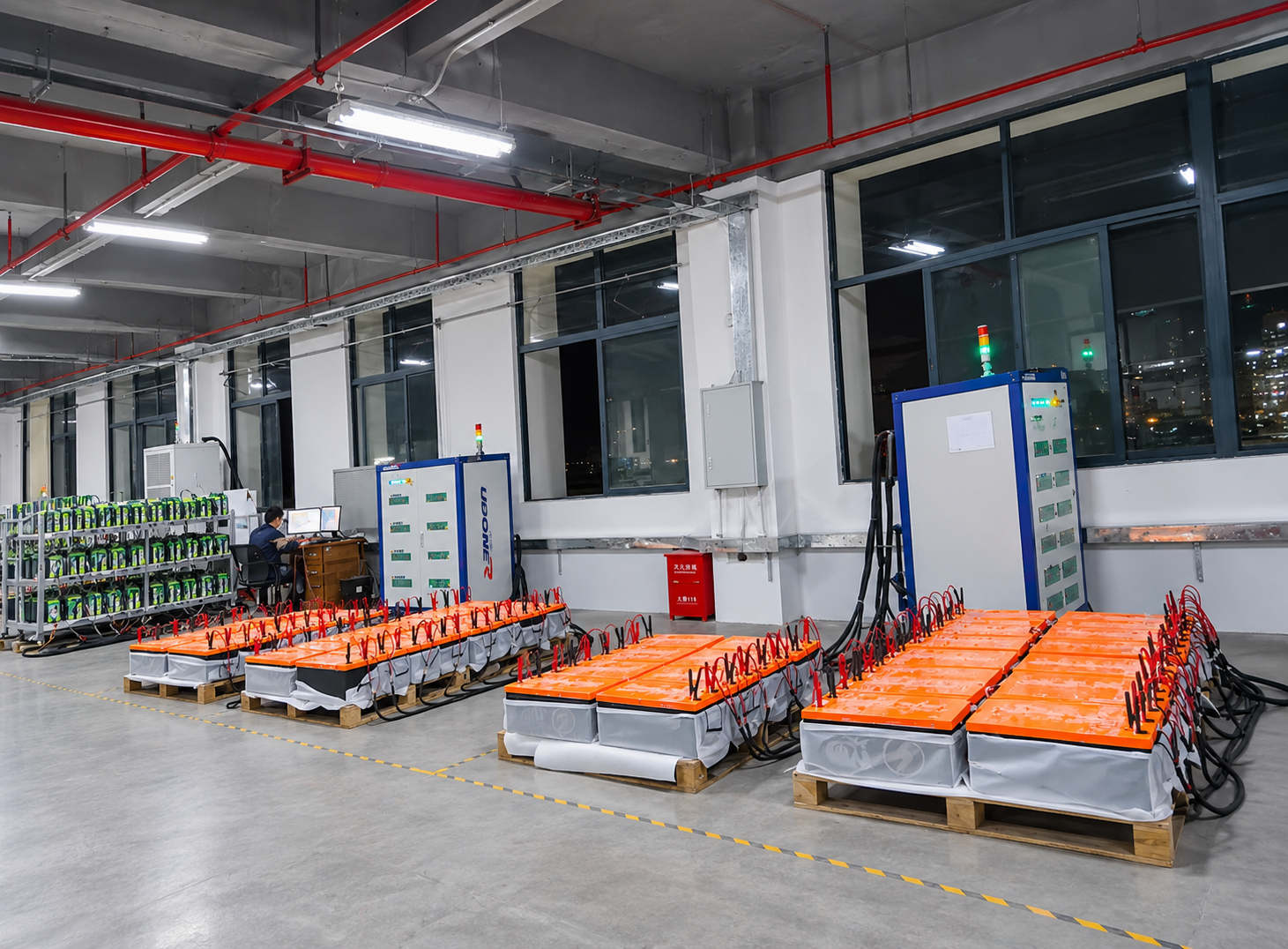
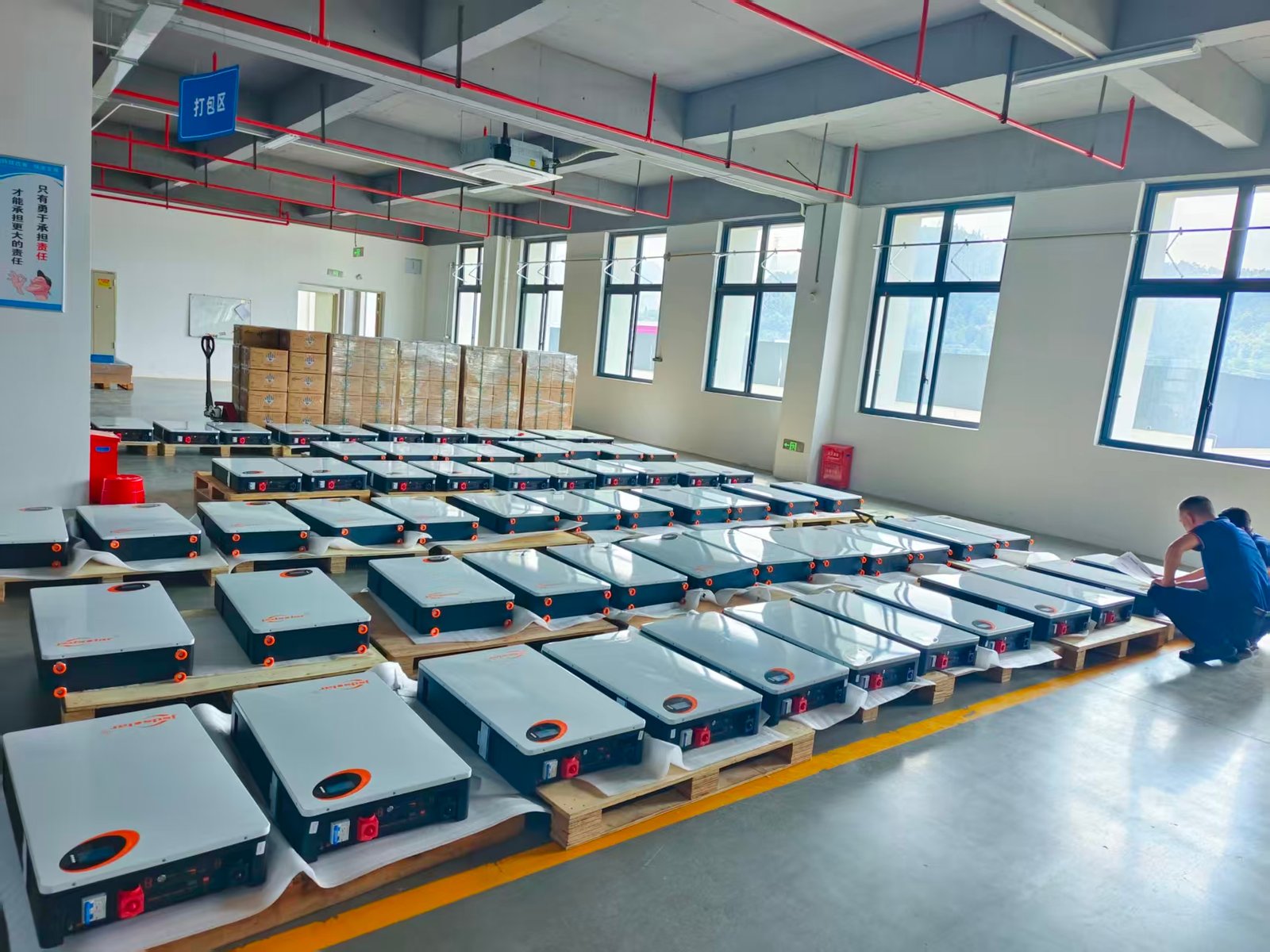
huadaenergy is a source manufacturer of lithium energy-storage products, with in-house production and testing lines covering portable power stations, residential storage, commercial and industrial ESS, and EV charging systems. The workshop images below show the cell test racks and finished storage units used in production and quality inspection.
Whether you need a standard H096 or a project-specific configuration, our engineering team can develop a system around your site, brand and market. Contact huadaenergy for a quotation or explore commercial energy storage solutions.
Frequently Asked Questions
Can the H096 charging station operate without a grid connection?
Yes. The H096 carries a 193 kWh LiFePO4 battery and delivers 120 kW rated DC output without a grid upgrade. Where grid power exists, it recharges at up to 60 kW from 380 Vac; where it does not, DC gun-to-gun refilling keeps the station in service.
How many vehicles can it charge at once, and how fast?
Two vehicles can charge simultaneously through dual guns with 7 m cables. With 120 kW rated output (180 kW peak) and a DC 200–1000 V, 0–250 A range, a typical 30–60 kWh passenger EV session takes roughly 20–30 minutes, depending on the vehicle’s onboard limits.
What is battery-buffered charging and why does it matter?
Battery-buffered charging places storage between the grid and the charger so the site draws power steadily and delivers short high-power bursts. GlobalData’s 2026 analysis identifies it as a way to avoid expensive grid upgrades and cut demand charges at constrained sites.
Which charging connectors and protocols are supported?
The charging gun standard is customizable — GB/T, CCS2, Type 2 and others — along with cabinet branding, output configuration and communication protocols (LAN, CAN, RS485, 4G). Confirm your market’s requirements before ordering.
What certifications does the H096 hold?
The product page lists GB/T 36276, GB/T 34131, GB/T 34120 and GB/T 34133, with UN 38.3 and CE in its certification summary. Request the current reports and confirm applicability to your destination market.
Does huadaenergy support OEM/ODM and custom development?
Yes. As a source factory, huadaenergy offers OEM/ODM manufacturing, custom system design and development against customer requirements, backed by in-house production and testing lines.
Last updated: 2026-11-19