H098 1MW/3MWh gecontaineriseerde BESS-voordelen uitgelegd
A 1MW/3MWh gecontaineriseerde BESS delivers one megawatt of power for more than three hours from a single standard 40ft container, and the huadaenergy H098-3MWh packs exactly that: 3,153.9 kWh of LiFePO4 storage, a 1 MW PCS with 1.1 MW peak output, liquid-cooling thermal management, fire suppression and 4G cloud monitoring, factory-assembled and tested before shipment. This guide explains what the published specifications mean in practice, where the system pays back, why liquid cooling matters at the 3MWh class, and which certifications – UL 9540A, CE, IEC 62933, UN38.3, MSDS and RoHS 2.0 – to verify before you import.
Last updated: 2026-11-03
What Is the H098 1MW/3MWh Containerized BESS?
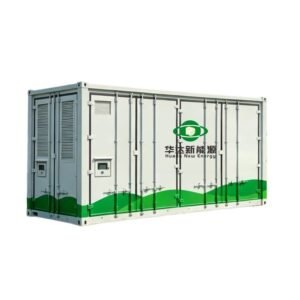
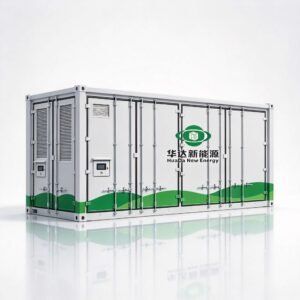
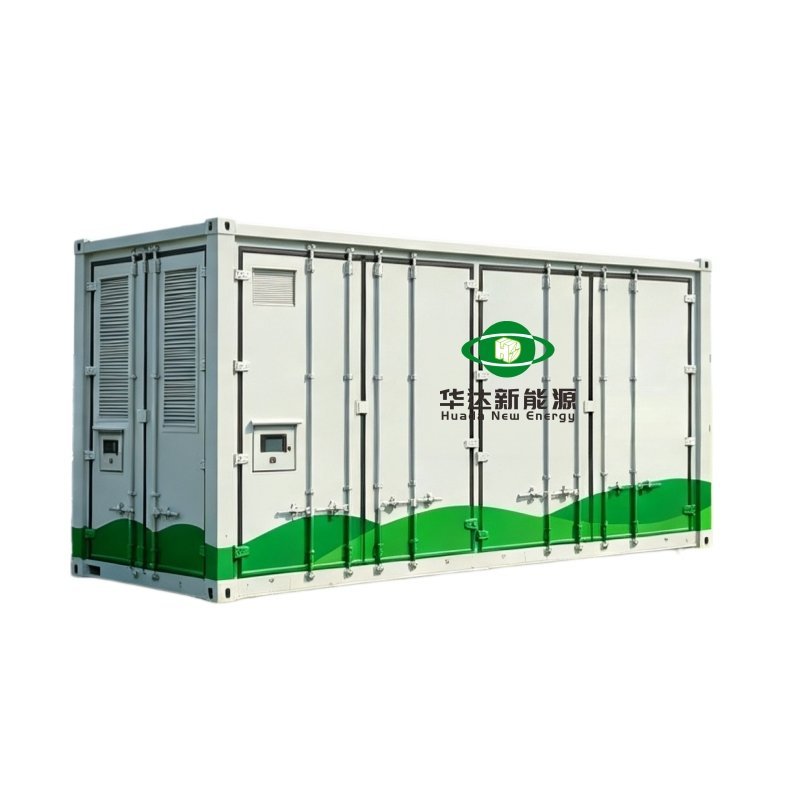
The H098 1MW/3MWh containerized BESS is a fully integrated outdoor battery energy storage plant that combines a 3,153.9 kWh LiFePO4 battery bank, a battery management system (BMS), a power conversion system (PCS), liquid-cooling thermal management, fire suppression and 4G remote monitoring inside one standard 40ft ISO container. Because every component is installed and commissioned at the factory, on-site work is reduced to foundation preparation, cable connection and grid tie – no indoor battery room, no rack-by-rack assembly.
Wat zit er in de container?
Open the doors of the H098-3MWh and you find five functional blocks working together:
- LiFePO4 battery clusters: a 4,480Ah / 704V battery bank rated 3,153.9 kWh, built from lithium iron phosphate cells chosen for thermal stability and long service life.
- PCS: rated 1 MW with 1.1 MW peak capability, converting the DC battery bank into 400V three-phase AC output (-20% to +15%) at a rated current of 1,444A.
- BMS and fire suppression: real-time battery monitoring with multi-layer protection, integrated with the container fire protection system.
- Liquid-cooling thermal management: keeps temperature consistent across all battery packs to reduce decay and extend cycle life.
- EMS and cloud platform: decides when to charge, when to discharge and when to hold reserve, reporting operating data over 4G for remote monitoring.
The container sits at the centre of the site power system: ground-mount or rooftop PV feeds it, the grid charges the bank through the electricity meter at off-peak tariff, and existing diesel gensets stay as backup while the BESS cuts their running hours. Factory and mall loads are served around the clock, and the EMS reports everything to the cloud. Buyers comparing capacity tiers can step down to the 500kW/1MWh containerized ESS of de 1MW/2MWh gecontaineriseerde ESS – all four sizes (500kWh / 1MWh / 2MWh / 3MWh) share the same architecture, and multiple containers can be combined for larger projects.
Why Is Demand for 3MWh-Class Containerized Storage Growing?
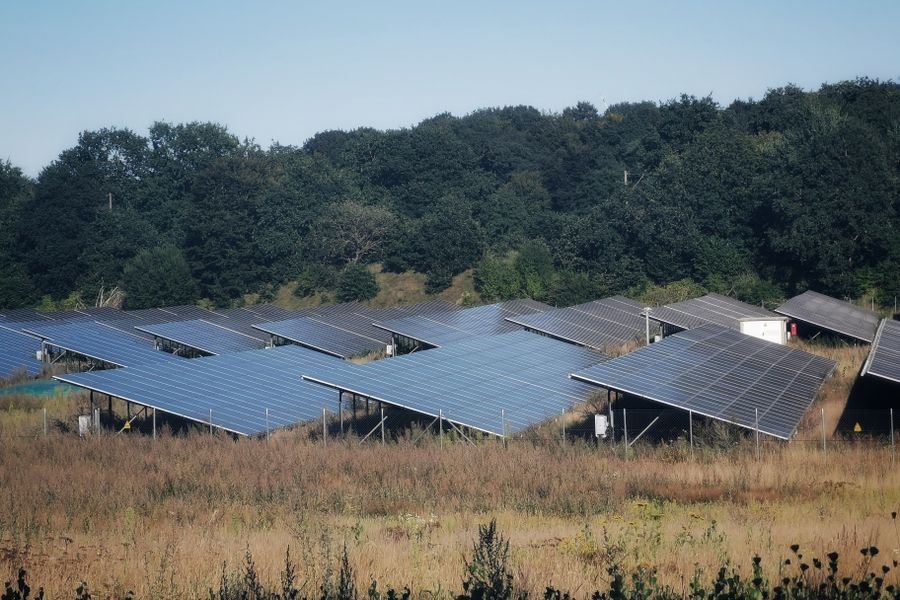
Demand is growing because grid-scale storage is scaling faster than any other power technology: BloombergNEF expects 188 GW / 535 GWh of new energy storage to be deployed worldwide in 2026, up 45 percent from the record 112 GW / 307 GWh installed in 2025 (BloombergNEF Energy Storage Market Outlook, October 2026).
Three facts from that outlook matter for buyers planning multi-megawatt projects. First, the growth is sustained, not a spike: BNEF forecasts 209 GW / 638 GWh in 2027 and roughly 3.1 TW / 11.1 TWh of cumulative capacity by 2036 – about ten times the 2025 installed base. Second, the growth is broad: China, the United States and Australia account for about 62 percent of 2026 additions, while India adds more than 6 GW and markets such as Spain, the UAE, Chile and Japan accelerate from 2027. Third, the chemistry is settled for now: BNEF expects LFP to remain the dominant battery technology for utility-scale storage over the next decade, which is exactly the chemistry inside the H098-3MWh. Cost momentum supports the trend: stationary storage packs averaged USD 70/kWh in 2025, down 45 percent year on year (BloombergNEF Battery Price Survey, December 2025), and the IEA counted roughly 108 GW of battery storage added globally in 2025, up 40 percent (IEA, Global Energy Review 2026).
Belangrijkste specificaties en wat ze betekenen
The published specification of the H098-3MWh reads as follows, and each row carries a practical consequence for siting, permitting and grid connection.
| Item | H098-3MWh Specification | Wat het betekent voor kopers |
|---|---|---|
| Batterijcapaciteit | 3,153.9 kWh (4,480Ah / 704V LiFePO4) | About 3.15 hours of discharge at rated 1 MW – the duration range most peak-shaving and solar-firming tenders ask for |
| Nominaal / piekvermogen | 1 MW / 1,1 MW | The 1.1 MW peak covers motor-start surges and short load excursions without tripping |
| AC-uitgang | 400V (-20% to +15%), 1,444A rated | Connects to a standard industrial low-voltage switchboard via a 1,600A-class breaker and matching transformer |
| Thermisch beheer | Vloeistofkoeling | Uniform battery-pack temperature, lower decay and longer system cycle life (as published by huadaenergy) |
| Container | 40ft, 12,192 x 2,438 x 2,896 mm, 32,000 kg | Any crane, truck or port that handles shipping containers can handle it; plan the foundation for 32 tonnes |
| Bewaking | 4G-op afstand monitoring | EMS charge/discharge decisions and cloud reporting without a permanent on-site control room |
| Certificering | UL 9540A, CE, IEC 62933, UN38.3, MSDS, RoHS 2.0 | Covers system safety testing, EU market access, system design standards, transport and substance compliance (see below) |
The capacity math is worth doing once: 4,480Ah multiplied by 704V equals 3,153,920Wh, which is why the system is rated 3,153.9 kWh. Dividing rated power by capacity gives a duration of about 3.15 hours at 1 MW, and dividing capacity by the container volume of roughly 86 cubic metres gives an energy density of about 37 kWh per cubic metre – dense enough that one 40ft unit replaces an indoor battery room of several times that floor area.
Certifications Explained: UL 9540A, CE, IEC 62933 and UN38.3
The H098-3MWh is listed on the huadaenergy product page with UL 9540A, CE, IEC 62933, UN38.3, MSDS and RoHS 2.0, and each document answers a different buyer question – fire safety, market access, system design, transport, handling and restricted substances.
| Certification / Document | Wat dekt het? | Why Buyers Ask for It |
|---|---|---|
| UL 9540A | Test method evaluating thermal-runaway fire propagation at cell, module and unit level | The data set most US authorities having jurisdiction (AHJ), insurers and permitting processes request for ESS installations |
| CE | EU market access; under EU Battery Regulation 2023/1542, batteries require CE conformity since 2024-08-18, with a digital battery passport for industrial batteries above 2 kWh from 2027-02-18 | Confirms the system can be placed on the EU market and is on the regulatory timeline buyers now audit |
| IEC 62933 | The IEC series for electrical energy storage systems, including safety requirements for grid-integrated ESS (IEC 62933-5-2) | The design standard referenced in utility and EPC technical specifications worldwide |
| UN38.3 | Transport safety Tests T.1 to T.8 under the UN Manual of Tests and Criteria; lithium batteries ship as Class 9 dangerous goods | Required before the containerized system can be legally shipped by sea, air or road |
| MSDS | Material safety data sheet for the cells, covering composition, hazards and emergency handling | Needed by freight forwarders, port authorities and site HSE teams |
| RoHS 2.0 (2011/65/EU) | Restriction of hazardous substances in electrical equipment | Confirms restricted substances are controlled to EU limits |
These items are listed on the product page; certificate numbers and report copies are provided with a quotation. Ask every supplier for the same six items – one that cannot produce them is asking you to absorb the permitting and insurance risk.
Where Does a 3MWh Containerized BESS Pay Back?
A 3,153.9 kWh containerized BESS pays back fastest where electricity is expensive, solar generation is curtailed, or diesel generators run long hours – the three scenarios below are the published use cases for the H098-3MWh.
Factory Peak Shaving and Load Shifting
In markets with a meaningful gap between off-peak and peak tariffs, the container charges at night and discharges through the afternoon peak. The economics depend on local tariffs, so the following is an illustrative calculation based on assumptions, not a promise: assume 80 percent of the 3,153.9 kWh is cycled daily (about 2,523 kWh), a tariff spread of USD 0.15/kWh, and a turnkey system cost at the BloombergNEF 2025 survey average of USD 117/kWh (about USD 369,000 for this capacity). At roughly USD 378 per day, annual savings are about USD 138,000, which corresponds to a simple payback of about 2.7 years before incentives, degradation and balance-of-plant costs. Actual results vary by market.
Solar and Wind Firming
Where PV or wind generation is curtailed at midday, the container absorbs the surplus and releases it into the evening. At 3,153.9 kWh per cycle, one H098-3MWh shifts up to about 3.1 MWh of surplus generation per day, and the EMS automates the charge and discharge windows.
Diesel-Hybrid Microgrids
In off-grid and weak-grid industrial sites, existing diesel gensets keep running as backup while the BESS covers daily loads – cutting generator running hours, fuel burn and maintenance intervals, and bridging the site while generators start. The published topology for the H098-3MWh was designed around exactly this PV-plus-grid-plus-genset arrangement, and the EMS coordinates all three sources automatically.
Why Liquid Cooling Matters at the 3MWh Class
At the 3MWh class, liquid cooling keeps battery-pack temperatures more uniform than air cooling, which lowers decay and extends system cycle life – the reason huadaenergy specifies it as standard on the H098-3MWh. The physics is simple: a 40ft container dissipates significant heat at a 1 MW charge and discharge rate, and air moving through dense racks warms up along the way, leaving packs at the airflow end hotter than packs at the intake. Liquid cooling carries that heat to an external exchanger with far less spread across the bank, so the BMS rarely throttles individual clusters, the full capacity stays usable, and slower chemical decay protects the revenue the container was bought to earn. Treat cooling architecture as a lifecycle-cost question, not a comfort feature: at multi-megawatt scale, temperature spread is one of the main determinants of how long the bank delivers its rated capacity.
Hoe u de juiste gecontaineriseerde BESS van 3MWh kiest
Choosing the right unit is mostly about matching five project parameters to the datasheet before comparing prices.
- Duration requirement: if your peak window runs three to four hours, a 1 MW / 3.15-hour unit matches; shorter windows can step down to the 500kW/1MWh or 2MWh tier.
- Site and logistics: a 40ft, 32-tonne container needs crane access and a rated foundation – confirm both before ordering.
- Grid connection: check that your connection point accepts 400V AC at 1,444A or plan a step-up transformer from day one.
- Permitting and insurance: list the certifications your AHJ or insurer expects (for example UL 9540A data in the US, IEC 62933-based design in IEC markets) and request the reports, not just the logos.
- Expansion path: if loads will grow, confirm the EMS supports paralleling additional containers – huadaenergy covers this in its article on EMS flexible power dispatch for parallel containers, and smaller sites can start at the 2.5MWh container tier.
Veelgestelde vragen
Hoeveel kost een gecontaineriseerd BESS van 1MW/3MWh?
Using the BloombergNEF 2025 cost survey average of USD 117/kWh turnkey, a 3,153.9 kWh system lands around USD 369,000 before shipping, duties and grid connection works. Actual quotations vary with certification scope, PCS configuration and destination market, so treat that figure as a budgeting baseline.
Welke certificeringen moet ik controleren voordat ik een 3MWh-container importeer?
Ask for the six items published for the H098-3MWh: UL 9540A test data, CE conformity, IEC 62933-based design, UN38.3 transport test report, MSDS and RoHS 2.0. The first four map to fire safety, EU market access, system design and legal shipping; without them, permitting and freight can stall.
Kan de H098-3MWh werken met zonne-energie en een dieselgenerator?
Yes. The published topology connects PV, the grid and diesel gensets to the container, which serves site loads while the EMS decides when to charge, discharge or hold reserve, reporting to the cloud over 4G.
Hoe lang duurt de installatie?
The system arrives pre-assembled and fully factory-tested, so on-site work is limited to foundations, cable connection and grid tie. Your EPC’s programme determines the calendar time; the container itself is designed for plug-and-play commissioning.
What cycle life can I expect from the H098-3MWh?
huadaenergy does not publish a specific cycle-life figure for this model on the product page; it specifies liquid cooling precisely because uniform pack temperature lowers decay and extends cycle life. Request the warranty schedule and cycle-life definition (depth of discharge and end-of-life capacity) with your quotation.
Can several H098 containers be connected in parallel?
Yes – the H098 series (500kWh / 1MWh / 2MWh / 3MWh) shares one architecture and multiple containers can be combined at project scale, with the EMS balancing state of charge across units. huadaenergy documents the balancing logic in its article on flexible power dispatch for parallel cabinet and container fleets.
Over huadaenergy
huadaenergy (Huada New Energy) manufactures the H098 containerized ESS series in 500kWh, 1MWh, 2MWh and 3MWh capacities, with OEM/ODM customization of power and capacity for EPC contractors, distributors and project developers. Systems are pre-assembled and factory-tested before shipment, backed by remote monitoring and technical support through the warranty period. To request a quotation with the full certification package, or to size a system for your tariff and load profile, visit the 1MW/3MWh containerized energy storage system product page.