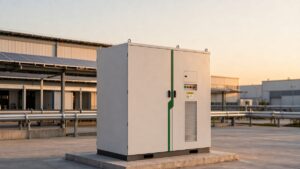
A 215kWh cabinet BESS is the practical size for a factory or charging site that needs to cut peak demand without waiting years for a grid connection. The huadaenergy H098-215kWh puts 215 kWh of LiFePO4, a 100 kW PCS, a 120 kW solar MPPT, air cooling and the EMS in one IP55 cabinet that arrives factory-tested. That matters in 2026: the IEA reported roughly 3,000 GW of generation and storage projects waiting in interconnection queues, while BloombergNEF lifted its 2026 deployment forecast to 188 GW/535 GWh. This guide covers what the cabinet does, what its certification files actually say, where it pays back, and what to confirm before you order.
What Is a 215kWh Cabinet BESS?
A 215kWh cabinet BESS is one outdoor enclosure holding lithium cells, a BMS, a PCS and an EMS, ready to connect solar, grid and site loads. The buyer gets a factory-tested unit; site work is a pad, cabling and a grid tie.
The One-Cabinet Architecture
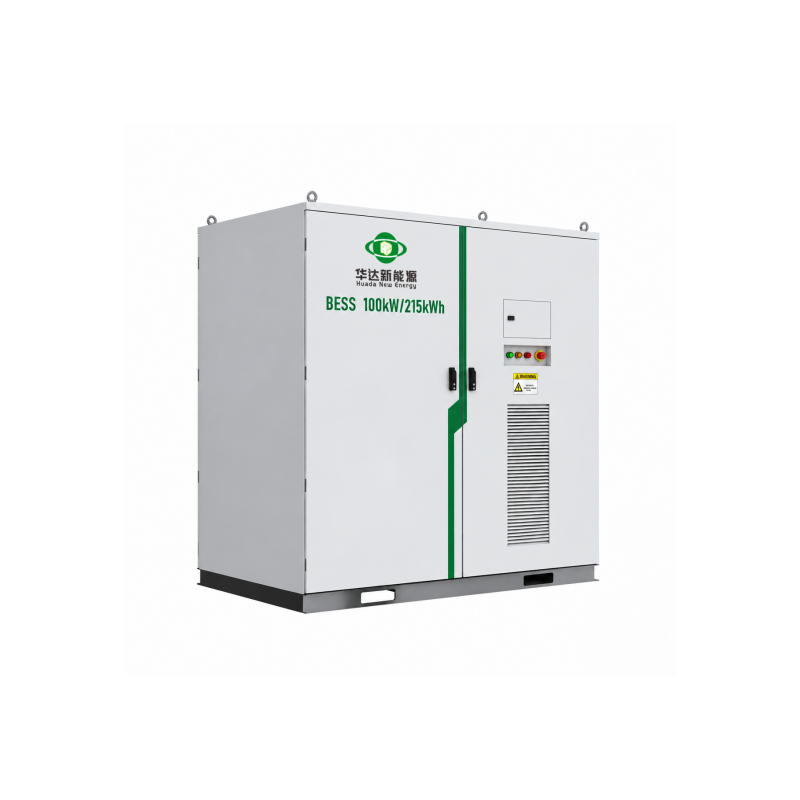
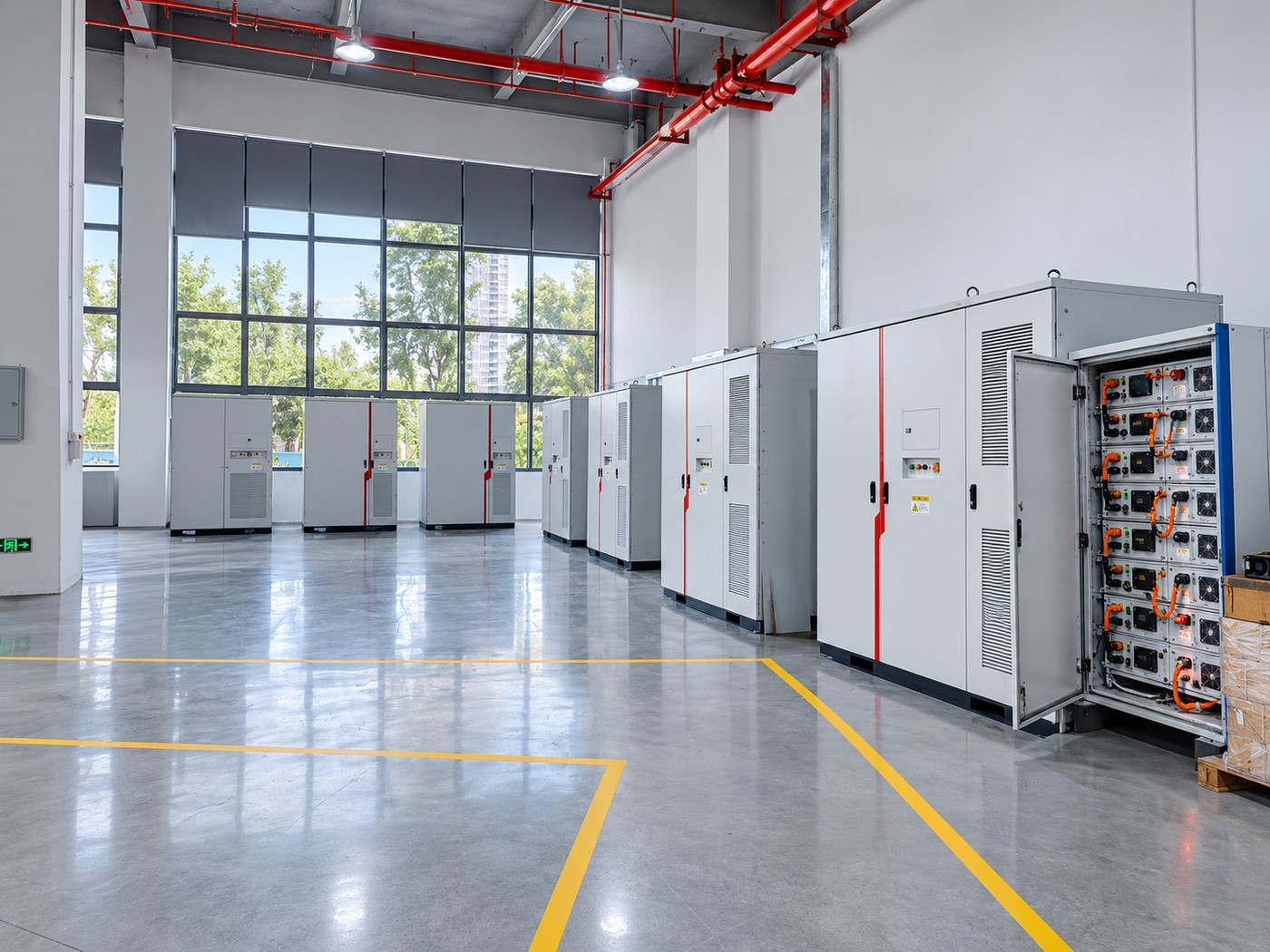
Inside the H098-215kWh, a 768 V DC LiFePO4 battery at 280 Ah feeds a 100 kW bidirectional PCS with 3P+N+PE, 400 V output. The built-in MPPT takes rooftop solar directly, so no separate PV inverter is needed. The EMS picks when to charge from cheap grid power or surplus solar and when to discharge. RS485 or CAN handles local communication, while a cloud platform carries alarms and data.
Where It Sits in the H098 Range
The H098 platform spans 50 to 315 kWh in five steps. The 215 kWh model holds power at 100 kW, giving just over two hours of full discharge — a middle step for sites whose peak lasts a shift. The 315 kWh cabinet suits heavier demand; the 50 and 100 kWh models fit smaller loads.
Why Grid Queues Make On-Site Storage a 2026 Priority
Grid interconnection has become the binding constraint on new energy projects, which is why a behind-the-meter 215kWh cabinet BESS is moving from optional to routine for commercial buyers. A cabinet on your own site does not need a new substation to start saving money.
The Interconnection Bottleneck
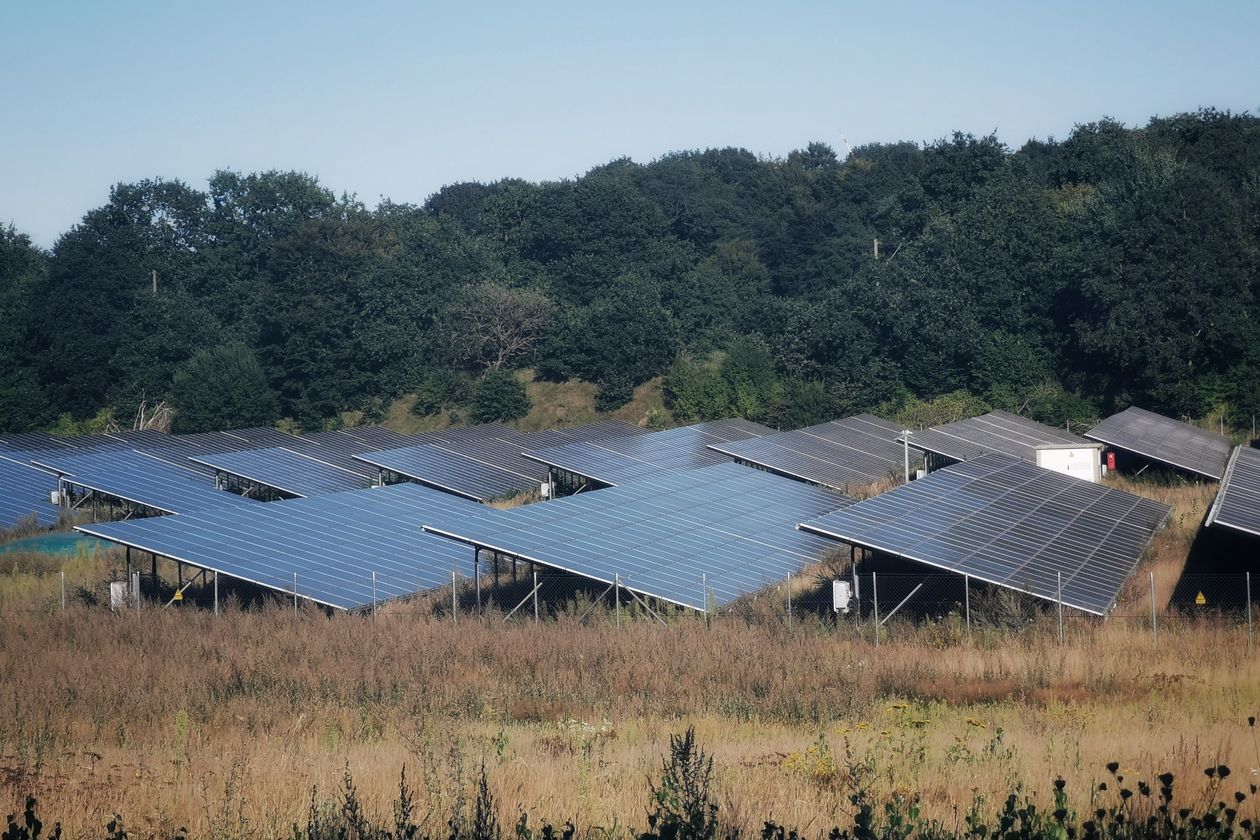
The IEA’s Renewables 2026 report, published 6 November 2026, put about 3,000 GW of wind, solar, battery and hybrid capacity in connection queues worldwide — roughly 60 percent more than a year earlier and about a third of existing global capacity. Storage and hybrid projects supplied about 60 percent of the increase, and the report forecasts nearly 4,800 GW of renewable additions for 2026–2031. When a new feed-in cannot be energised quickly, behind-the-meter storage becomes the faster route.
What BNEF’s 2026 Forecast Adds
BloombergNEF’s Energy Storage Market Outlook H2 2026, released 22 October 2026, raised the 2026 forecast to 188 GW/535 GWh, about 45 percent above 2025. It flagged supply-chain localisation, solar-plus-storage co-location and a sharp lithium price rise between October 2025 and May 2026. Data-centre storage was projected to grow from 0.5 GW in 2025 to 4.9 GW in 2026. For mid-size buyers, lead time and price risk now count as much as cell cost.
Spécifications clés et leur signification
The H098-215kWh delivers 215 kWh at 768 V DC through a 100 kW PCS, giving a little over two hours at rated output with room for up to 120 kW of direct PV. The table below uses the values published on the product page.
Power, Runtime and Footprint
| Article | H098-215kWh | Ce que cela signifie sur site |
|---|---|---|
| Énergie nominale | 215 kWh (280 Ah, 768 V DC) | About two hours of support at 100 kW |
| PCS output | 100 kW, 138 A, 3P+N+PE / 400 V | Sized for a mid-size factory peak |
| Entrée PV | Up to 120 kW, 850 V max, MPPT 200–950 V | Rooftop solar connects without another inverter |
| Enceinte | IP55, 1910 × 1297 × 2414 mm, 2850 kg | Under 2.5 m²; ground-mounted outdoors |
| Température | Charge 0–50 °C ; décharge −20–55 °C | Suits unconditioned plant yards |
| Communication | RS485 / CAN plus cloud monitoring | Fits an existing SCADA or EMS |
Solar Input, Cooling and Protection
Air cooling removes the coolant loop, top-ups and leak risk of liquid systems, at the cost of slightly less uniform temperatures under sustained high load — often the deciding factor for a site without a maintenance team. The MPPT takes up to 120 kW of PV at 200–950 V, so PV and off-peak grid charging run in parallel. Check values against your stamped datasheet.
Certifications: What the Documents Cover
Certification files on record for the 215 kWh platform cover battery safety, EMC, low-voltage equipment and RoHS, but they should be read as test evidence on named samples rather than a blanket approval of every configuration. Asking for the right document early avoids tender delays later.
Safety and EMC Test Reports on File
| Document | Reference / date | Champ d'application |
|---|---|---|
| IEC 63056:2020 safety test report | KS2506S2694B, 18 Jul 2025; revised KS2506S2694BX1, 17 Jan 2026 | 215 kWh LFP cabinet, model LEM-215KWH-LFP, 768 V / 280 Ah |
| Low Voltage Directive verification | KS2506S2695SC, Directive 2014/35/EU | IEC 62477-1:2022 and EN 62477-1:2012+A11+A1+A12 |
| EMC test report | KS2506S2696E, 18 Jul 2025, result PASS | EN IEC 61000-6-1/-2/-3/-4 |
| Verification of conformity | KS2506S2697SC | IEC 62933-5-2:2020 with IEC TS 62933-5-1:2017 |
| RoHS declaration and report | DTI2025EE040711C; CNAS report DTI2025EE040711D, 23 Dec 2025 | EU 2011/65/EU and (EU) 2015/863 |
| SIRIM / MyHIJAU | Listed on the product page | Malaysian market listing; request current mark approval |
The reports name Huizhou Huada as manufacturer and a Malaysian partner as applicant, and cover only samples tested. The product page also lists IEC 62933-2-1:2017, EN 61000-6, UN38.3, MSDS and RoHS 2.0. For tenders, ask for the current stamped set and confirm which entity should hold each document. A test report is not a product listing, and no UL 9540 listing is claimed.
What Buyers Should Verify at Quotation
Request report numbers, dates, model designations and UN38.3 documents for the shipped unit. If your authority needs a local mark or system-level listing, say so at enquiry so the factory can quote the right test package.
Fire Safety: A Passive Layer Behind the Cabinet
A fire-resistant coating is a passive back-up layer, not a substitute for system-level fire testing, and 2026 raised what North American approvers expect to see. It belongs in a stack that starts at the cell, not at the top of a specification sheet.
Why 2026 Raised the Bar
ANSI/CAN/UL 9540A edition six was published 13 March 2026, and NFPA 855:2026 aligned by making large-scale fire testing routine for many non-residential sites. AHJs and insurers use it for spacing and permits. A coating slows heat transfer to steel; it does not produce the propagation data those reviews require.
What the Coating Tests Show
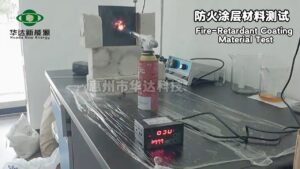
huadaenergy is a pioneer in applying a newly developed fire-resistant coating to energy storage systems. The material is jointly developed by Hunan Yinsuo Technology and Changsha TopMaterial, with research roots at the State Key Laboratory of Powder Metallurgy, Central South University — an application first, not a claim to the material patent. Material test files report that a 2.5 mm coated steel plate withstood an 800–850 °C burner for 30 minutes without burn-through, with a peak back-face temperature of 154.8 °C below the 300 °C limit (YJ2025060240); cross-cut adhesion reached grade 0 under GB/T 31586-2015 (EMT02R000171C01); RoHS screening found 256 mg/kg lead against a 1000 mg/kg limit (A2260349272101001C); and an SDS follows REACH 2020/878 (XG26165519). The reports were issued to the material developers, cover only tested samples, are for internal reference, and are not huadaenergy certificates.
Applications dans le monde réel
A 215kWh cabinet BESS earns its place where demand charges, rooftop solar or an unreliable grid make the timing of electricity expensive. The same cabinet serves different loads depending on how the EMS is configured.
Factories and Workshops
A plant with a sharp 100 kW peak for two hours can charge overnight and discharge through the peak window, flattening energy cost and billed demand. Production lines keep running through short outages, with no diesel delay. Full-function testing and batch traceability matter more here than brochure figures.
Places de recharge pour véhicules électriques
Fast chargers create steep, short grid spikes. A cabinet on site absorbs them, cutting connection capacity needs while chargers stay available — often the difference between a viable and a stalled project. See the CCS2 DC fast charger range for paired equipment.
Solar-Heavy Sites and Weak Grids
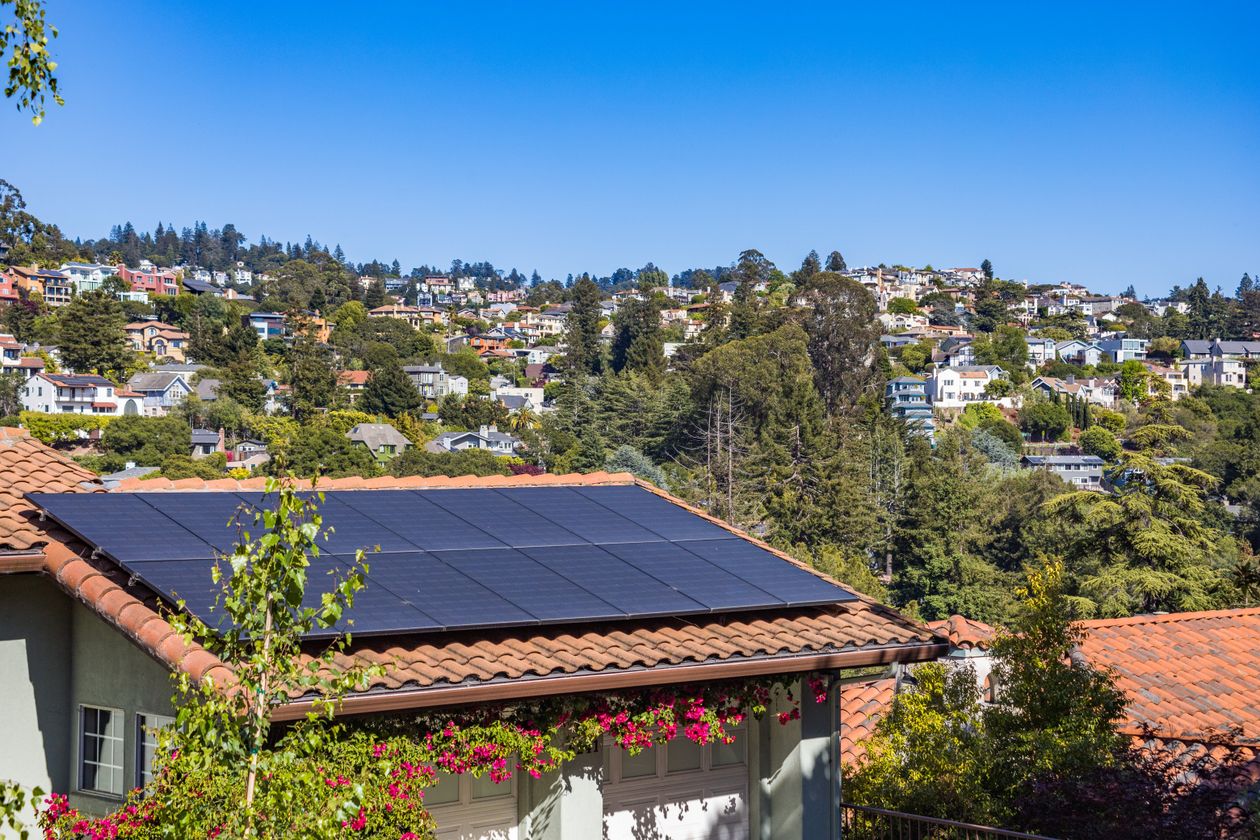
When rooftops generate more than the site uses, the MPPT takes surplus and the EMS stores it for the evening peak. Remote towers use the same cabinet as a buffer on unstable supply. Multi-cabinet dispatch logic is covered in the flexible power dispatch article.

Cabinet BESS vs Alternatives
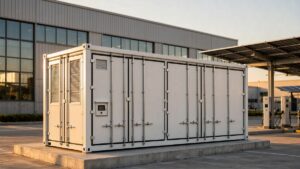
For a site with under 2.5 m² to spare and no dedicated O&M team, a 215kWh cabinet BESS is simpler than a container and more useful than a grid-only connection. The comparison below is indicative, not a quote.
Versus Grid-Only Supply
The product page’s example uses a 0.85 USD/kWh peak-valley spread and 330 operating days: one full 215 kWh cycle a day shifts about 71 MWh a year, roughly 60,300 USD of arbitrage value before demand savings. Those are assumptions, not a return commitment. The 500 kWh container fits when shifted energy exceeds one cabinet.
Versus a Containerized System
| Choice | 215 kWh cabinet | 500 kWh–2 MWh container |
|---|---|---|
| Space | Under 2.5 m², ground-set | 20–40 ft footprint and lifting |
| Installation | Pad, cables, grid tie | Civil works, crane, commissioning |
| Thermal design | Air cooling, no coolant loop | Liquid cooling at higher energy density |
| Scaling route | Add cabinets or move up the H098 range | Sized for utility-scale durations |
Larger containerised systems follow the same sizing logic; the choice turns on land, duration and maintenance.
How to Choose and Configure
Choose a 215kWh cabinet BESS by matching three numbers: your peak load, your tariff spread and your available PV roof area. Capacity alone does not decide whether a project works.
Five Checks Before Ordering
- Peak profile: confirm the kW peak and how many hours it lasts; 100 kW for about two hours is the cabinet’s window.
- Tariff structure: check both the energy spread and any demand charge, since the two are saved differently.
- PV plan: confirm roof area and DC voltage so the 200–950 V MPPT window is used properly.
- Site conditions: verify the pad, access for a 2850 kg unit, ambient range and local fire requirements.
- Documents: request the report numbers, current dates and market-specific marks before tender submission.
OEM, ODM and Custom System Design
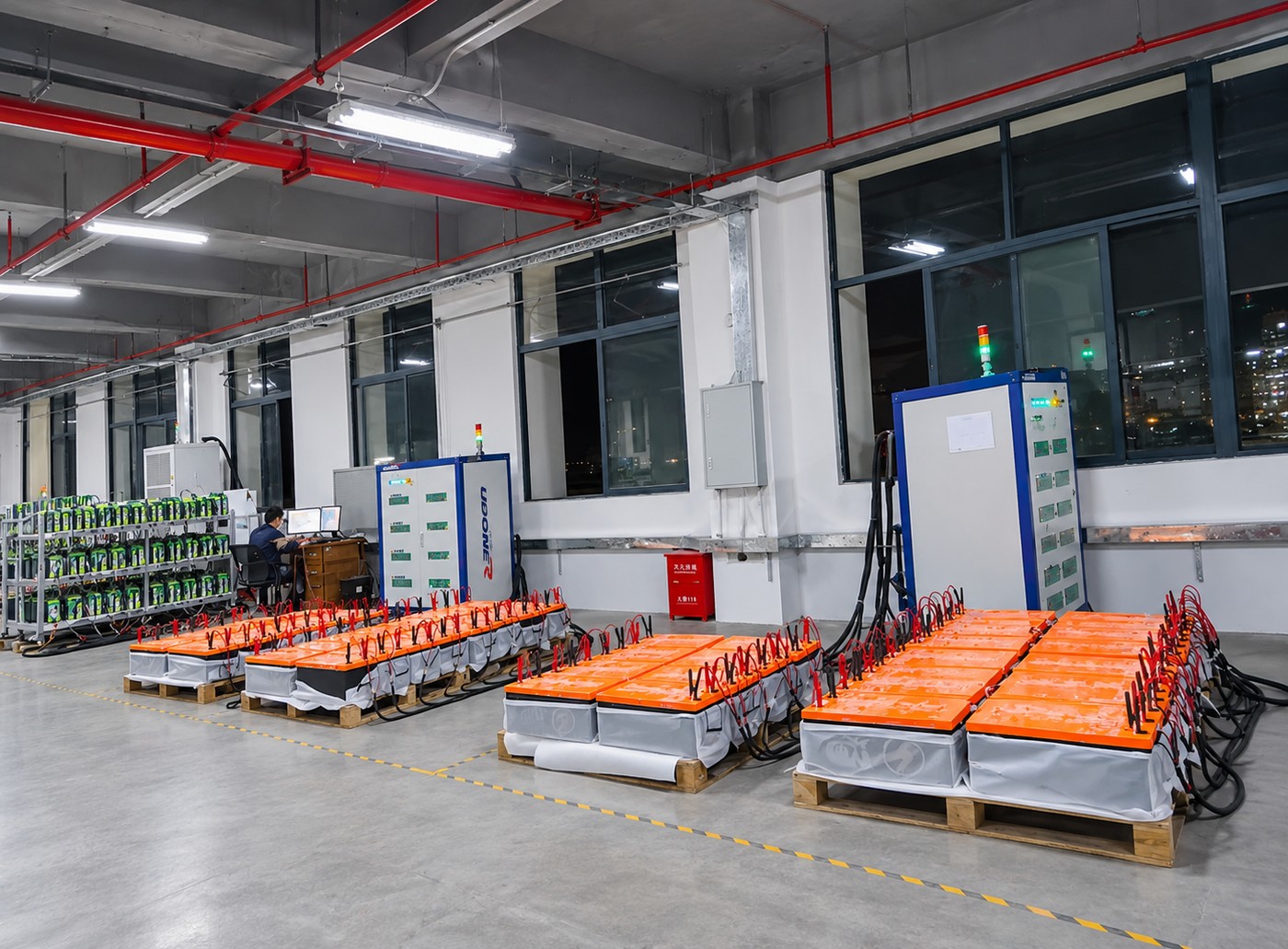
huadaenergy is the source factory for the H098 range: capacity, appearance, communication protocol and control logic can be built to a distributor’s or EPC’s specification. Production follows the confirmed configuration with batch records, full-function testing and reinforced export packing. Engineering can adapt the EMS to local tariffs or dispatch rules — send the site data for a proposed configuration.
Questions fréquemment posées
Que peut alimenter un BESS en armoire de 215 kWh ?
À sa puissance nominale de 100 kW, l'armoire assure environ deux heures d'une charge de 100 kW, ou plus longtemps à charge réduite. L'autonomie réelle dépend de la profondeur de décharge, de la température et du profil de charge.
Le solaire en toiture peut-il se raccorder directement ?
Oui. Le MPPT intégré accepte jusqu'à 120 kW de PV à un maximum de 850 V, avec une plage de fonctionnement de 200–950 V, donc un onduleur PV séparé n'est pas nécessaire.
Le H098-215kWh est-il refroidi par air ou par liquide ?
Air-cooled. There is no coolant loop to top up and no leak risk, which lowers the maintenance threshold for sites without an O&M team.
Quelles certifications détient-elle ?
Test files on record cover IEC 63056:2020, low-voltage and EMC verification, IEC 62933-5-2 and RoHS; the product page also lists IEC 62933-2-1, EN 61000-6, UN38.3, MSDS, RoHS 2.0 and SIRIM MyHIJAU. Request the current stamped documents for your market.
Can I expand capacity later?
Yes. The H098 series spans 50 to 315 kWh, and multiple cabinets can be planned into one site. Start with the load you have and add capacity as consumption grows.
Do you support OEM and ODM orders?
Yes. huadaenergy supports customization of capacity, appearance, communication protocols and control logic, with project-specific system design from the factory.
À propos de huadaenergy
Source Factory and Support
huadaenergy builds the H098 cabinet and container ranges in Huizhou, with cell and module traceability, full-function testing and export packing handled in house. Share your site type, load and target market through the page de contact for a configuration and quotation.
Last updated: 2026-11-24