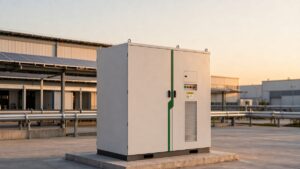
A Armario BESS de 215kWh es el tamaño práctico para una fábrica o un sitio de carga que necesita reducir la demanda pico sin esperar años por una conexión a la red. El huadaenergy H098-215kWh integra 215 kWh de LiFePO4, un PCS de 100 kW, un MPPT solar de 120 kW, refrigeración por aire y el EMS en un solo armario IP55 que llega probado de fábrica. Eso importa en 2026: la IEA informó que aproximadamente 3.000 GW de proyectos de generación y almacenamiento esperan en colas de interconexión, mientras que BloombergNEF elevó su previsión de despliegue para 2026 a 188 GW/535 GWh. Esta guía cubre qué hace el armario, qué dicen realmente sus archivos de certificación, dónde se amortiza y qué confirmar antes de realizar el pedido.
¿Qué es un armario BESS de 215kWh?
Un armario BESS de 215kWh es un recinto exterior que contiene celdas de litio, un BMS, un PCS y un EMS, listo para conectar solar, red y cargas del sitio. El comprador recibe una unidad probada de fábrica; el trabajo en sitio consiste en una base, cableado y una conexión a la red.
La arquitectura de un solo armario
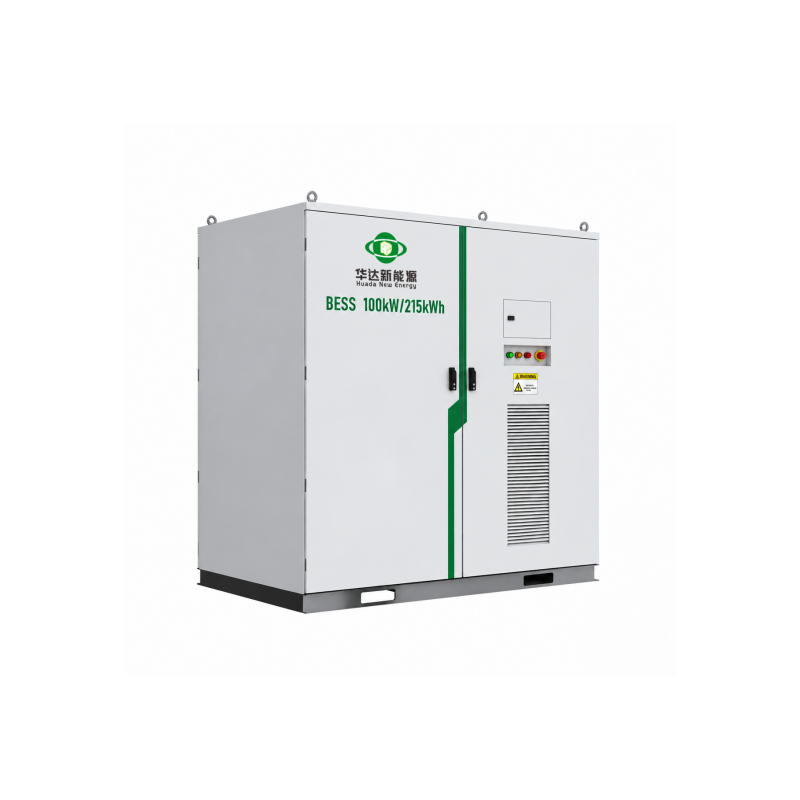
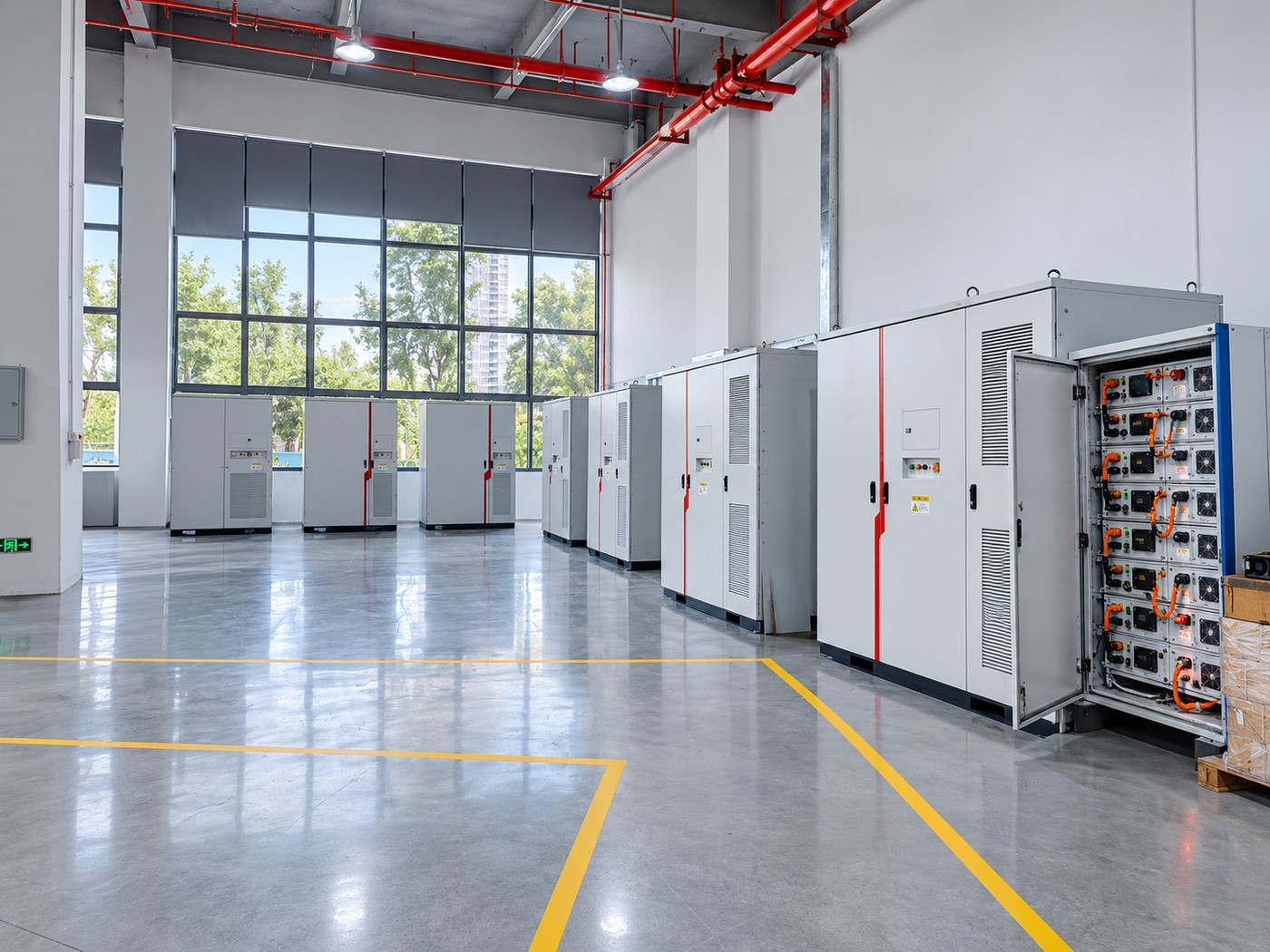
Dentro del H098-215kWh, una batería LiFePO4 de 768 V DC a 280 Ah alimenta un PCS bidireccional de 100 kW con salida 3P+N+PE, 400 V. El MPPT integrado acepta solar de techo directamente, por lo que no se necesita un inversor PV separado. El EMS decide cuándo cargar desde energía de red barata o solar excedente y cuándo descargar. RS485 o CAN gestionan la comunicación local, mientras que una plataforma en la nube transporta alarmas y datos.
Dónde se ubica en la gama H098
La plataforma H098 abarca de 50 a 315 kWh en cinco pasos. El modelo de 215 kWh entrega potencia a 100 kW, lo que da poco más de dos horas de descarga completa — un paso intermedio para sitios cuyo pico dura un turno. El armario de 315 kWh se adapta a demanda más pesada; los modelos de 50 y 100 kWh se ajustan a cargas menores.
Por qué las colas de red hacen del almacenamiento en sitio una prioridad para 2026
La interconexión a la red se ha convertido en la restricción vinculante para los nuevos proyectos de energía, por lo que un armario BESS de 215kWh detrás del medidor está pasando de opcional a rutinario para compradores comerciales. Un armario en su propio sitio no necesita una nueva subestación para empezar a ahorrar dinero.
El cuello de botella de la interconexión
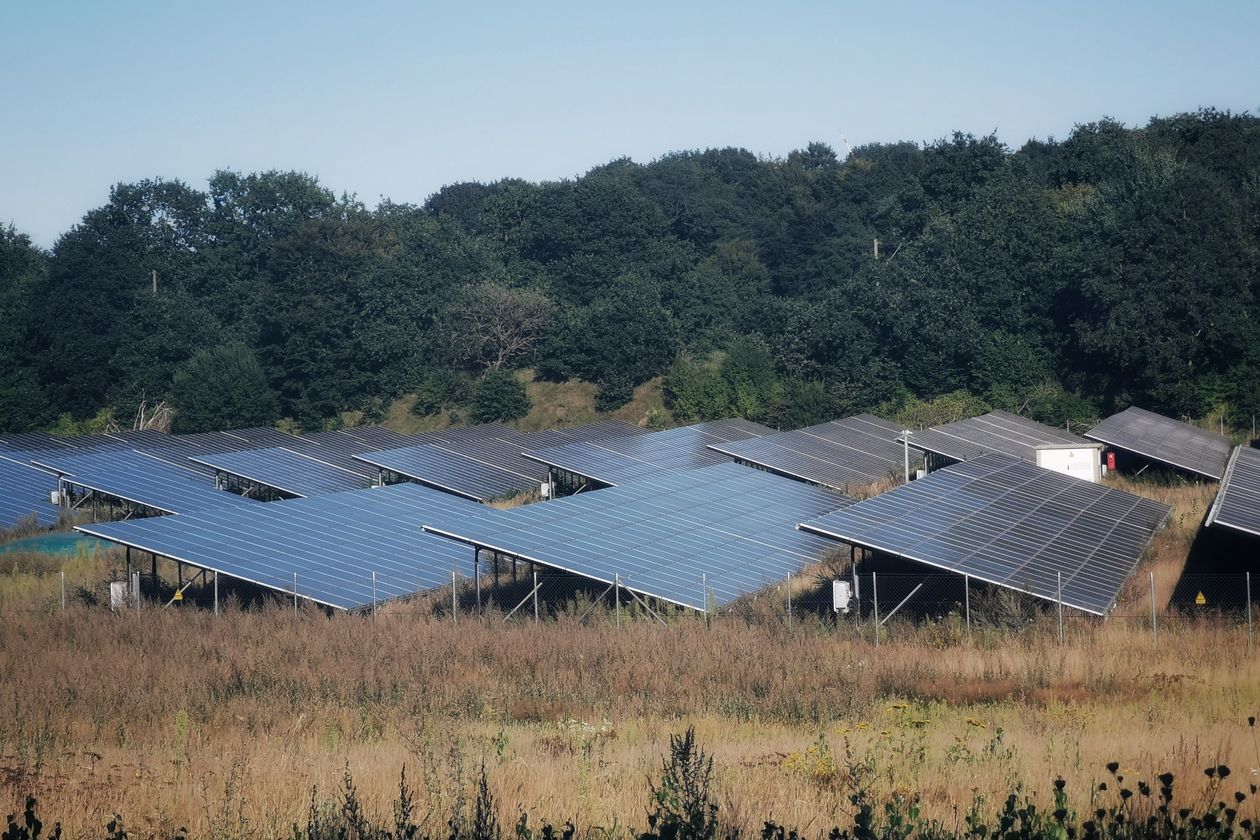
El Renewables 2026 informe de la IEA, publicado el 6 de noviembre de 2026, situó aproximadamente 3.000 GW de capacidad eólica, solar, de baterías e híbrida en colas de conexión a nivel mundial — alrededor de un 60 por ciento más que un año antes y cerca de un tercio de la capacidad global existente. Los proyectos de almacenamiento e híbridos aportaron cerca del 60 por ciento del incremento, y el informe prevé casi 4.800 GW de adiciones renovables para 2026–2031. Cuando una nueva alimentación no puede energizarse rápidamente, el almacenamiento detrás del medidor se convierte en la ruta más rápida.
Qué añade la previsión 2026 de BNEF
El Energy Storage Market Outlook H2 2026, de BloombergNEF, publicado el 22 de octubre de 2026, elevó la previsión para 2026 a 188 GW/535 GWh, aproximadamente un 45 por ciento por encima de 2025. Señaló la localización de la cadena de suministro, la co-ubicación de solar más almacenamiento y un fuerte aumento del precio del litio entre octubre de 2025 y mayo de 2026. Se proyectó que el almacenamiento para centros de datos creciera de 0,5 GW en 2025 a 4,9 GW en 2026. Para los compradores de tamaño medio, el plazo de entrega y el riesgo de precio ahora cuentan tanto como el costo de las celdas.
Especificaciones clave y qué significan
El H098-215kWh entrega 215 kWh a 768 V DC mediante un PCS de 100 kW, lo que da poco más de dos horas a potencia nominal con espacio para hasta 120 kW de PV directo. La tabla siguiente utiliza los valores publicados en la página del producto.
Potencia, autonomía y huella
| Artículo | H098-215 kWh | Qué significa en sitio |
|---|---|---|
| Energía nominal | 215 kWh (280 Ah, 768 V DC) | Aproximadamente dos horas de soporte a 100 kW |
| Salida del PCS | 100 kW, 138 A, 3P+N+PE / 400 V | Dimensionado para el pico de una fábrica mediana |
| Entrada fotovoltaica | Hasta 120 kW, 850 V máx., MPPT 200–950 V | El solar de techo se conecta sin otro inversor |
| Envolvente | IP55, 1910 × 1297 × 2414 mm, 2850 kg | Menos de 2,5 m²; montaje en suelo en exterior |
| Temperatura | Carga 0–50 °C; descarga −20–55 °C | Adecuado para patios de planta sin acondicionamiento |
| Comunicación | RS485 / CAN más monitoreo en la nube | Compatible con un SCADA o EMS existente |
Entrada solar, refrigeración y protección
La refrigeración por aire elimina el circuito de refrigerante, las recargas y el riesgo de fugas de los sistemas líquidos, a costa de temperaturas ligeramente menos uniformes bajo carga alta sostenida — a menudo el factor decisivo para un sitio sin equipo de mantenimiento. El MPPT acepta hasta 120 kW de PV a 200–950 V, por lo que la carga PV y la carga de red en horas valle funcionan en paralelo. Verifique los valores contra su ficha técnica sellada.
Certificaciones: qué cubren los documentos
Los archivos de certificación registrados para la plataforma de 215 kWh cubren seguridad de batería, EMC, equipos de baja tensión y RoHS, pero deben leerse como evidencia de ensayo sobre muestras designadas y no como una aprobación global de cada configuración. Solicitar el documento correcto a tiempo evita retrasos en la licitación posteriormente.
Informes de ensayo de seguridad y EMC en archivo
| Documento | Referencia / fecha | Ámbito de aplicación |
|---|---|---|
| Informe de ensayo de seguridad IEC 63056:2020 | KS2506S2694B, 18 Jul 2025; revised KS2506S2694BX1, 17 Jan 2026 | 215 kWh LFP cabinet, model LEM-215KWH-LFP, 768 V / 280 Ah |
| Low Voltage Directive verification | KS2506S2695SC, Directive 2014/35/EU | IEC 62477-1:2022 and EN 62477-1:2012+A11+A1+A12 |
| EMC test report | KS2506S2696E, 18 Jul 2025, result PASS | EN IEC 61000-6-1/-2/-3/-4 |
| Verification of conformity | KS2506S2697SC | IEC 62933-5-2:2020 with IEC TS 62933-5-1:2017 |
| RoHS declaration and report | DTI2025EE040711C; CNAS report DTI2025EE040711D, 23 Dec 2025 | EU 2011/65/EU and (EU) 2015/863 |
| SIRIM / MyHIJAU | Listed on the product page | Malaysian market listing; request current mark approval |
The reports name Huizhou Huada as manufacturer and a Malaysian partner as applicant, and cover only samples tested. The product page also lists IEC 62933-2-1:2017, EN 61000-6, UN38.3, MSDS and RoHS 2.0. For tenders, ask for the current stamped set and confirm which entity should hold each document. A test report is not a product listing, and no UL 9540 listing is claimed.
What Buyers Should Verify at Quotation
Request report numbers, dates, model designations and UN38.3 documents for the shipped unit. If your authority needs a local mark or system-level listing, say so at enquiry so the factory can quote the right test package.
Fire Safety: A Passive Layer Behind the Cabinet
A fire-resistant coating is a passive back-up layer, not a substitute for system-level fire testing, and 2026 raised what North American approvers expect to see. It belongs in a stack that starts at the cell, not at the top of a specification sheet.
Why 2026 Raised the Bar
ANSI/CAN/UL 9540A edition six was published 13 March 2026, and NFPA 855:2026 aligned by making large-scale fire testing routine for many non-residential sites. AHJs and insurers use it for spacing and permits. A coating slows heat transfer to steel; it does not produce the propagation data those reviews require.
What the Coating Tests Show
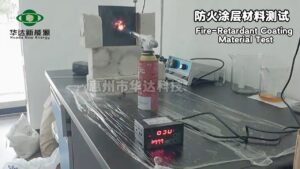
huadaenergy is a pioneer in applying a newly developed fire-resistant coating to energy storage systems. The material is jointly developed by Hunan Yinsuo Technology and Changsha TopMaterial, with research roots at the State Key Laboratory of Powder Metallurgy, Central South University — an application first, not a claim to the material patent. Material test files report that a 2.5 mm coated steel plate withstood an 800–850 °C burner for 30 minutes without burn-through, with a peak back-face temperature of 154.8 °C below the 300 °C limit (YJ2025060240); cross-cut adhesion reached grade 0 under GB/T 31586-2015 (EMT02R000171C01); RoHS screening found 256 mg/kg lead against a 1000 mg/kg limit (A2260349272101001C); and an SDS follows REACH 2020/878 (XG26165519). The reports were issued to the material developers, cover only tested samples, are for internal reference, and are not huadaenergy certificates.
Aplicaciones reales
A 215kWh cabinet BESS earns its place where demand charges, rooftop solar or an unreliable grid make the timing of electricity expensive. The same cabinet serves different loads depending on how the EMS is configured.
Factories and Workshops
A plant with a sharp 100 kW peak for two hours can charge overnight and discharge through the peak window, flattening energy cost and billed demand. Production lines keep running through short outages, with no diesel delay. Full-function testing and batch traceability matter more here than brochure figures.
Plazas de carga de VE
Fast chargers create steep, short grid spikes. A cabinet on site absorbs them, cutting connection capacity needs while chargers stay available — often the difference between a viable and a stalled project. See the CCS2 DC fast charger range for paired equipment.
Solar-Heavy Sites and Weak Grids
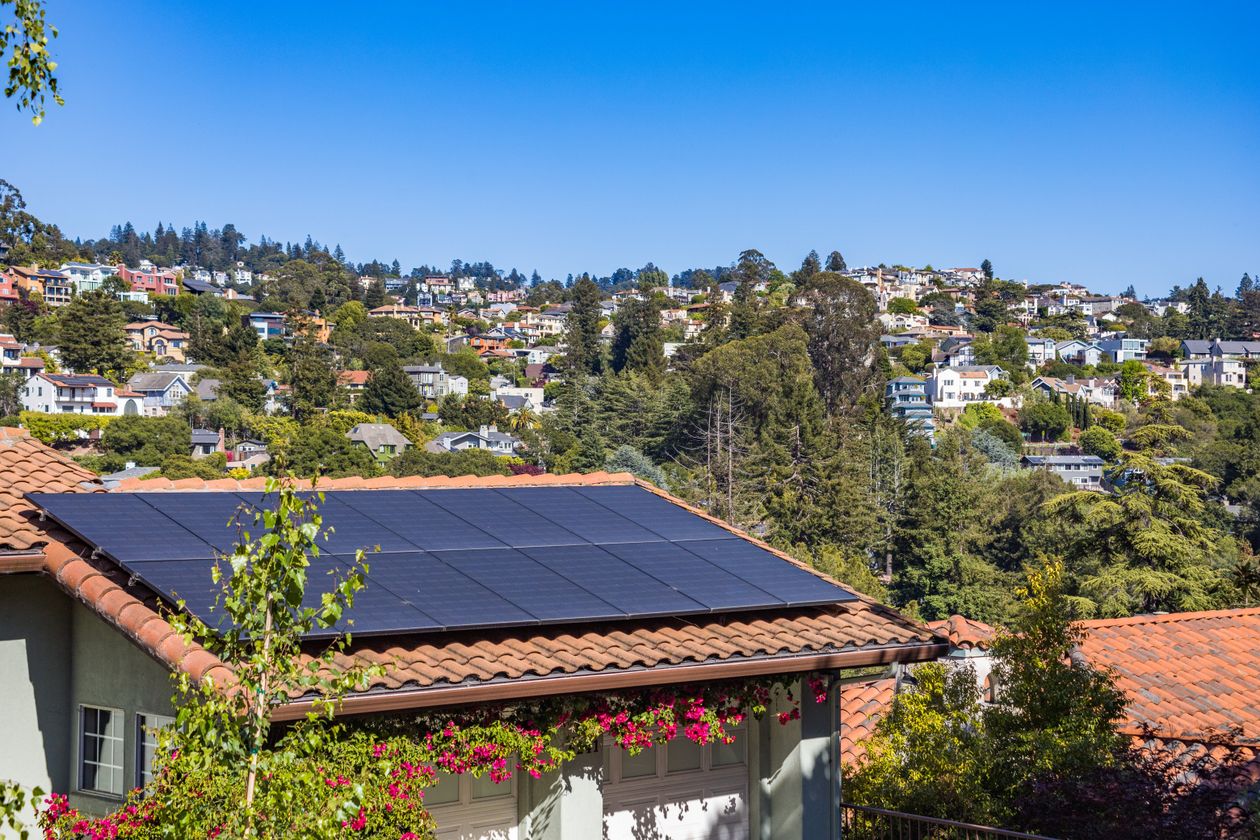
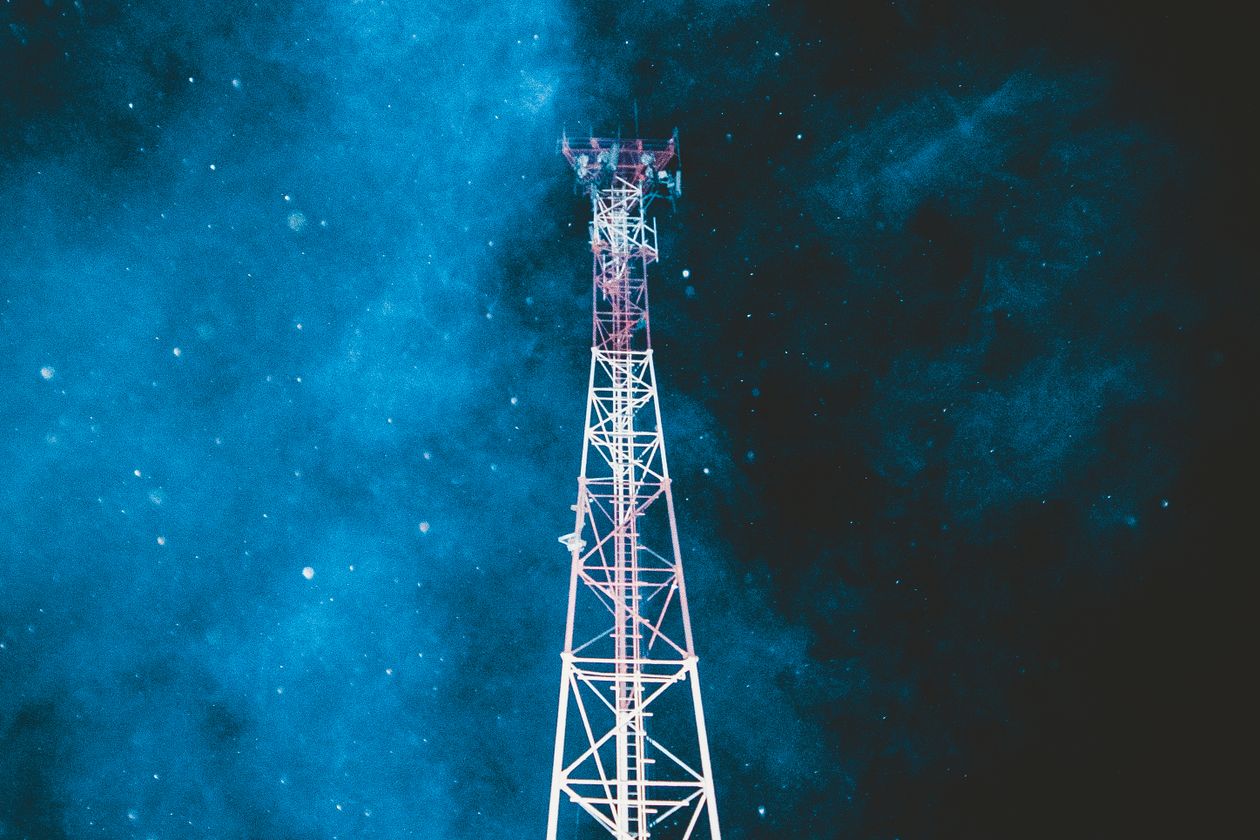
When rooftops generate more than the site uses, the MPPT takes surplus and the EMS stores it for the evening peak. Remote towers use the same cabinet as a buffer on unstable supply. Multi-cabinet dispatch logic is covered in the flexible power dispatch article.
Cabinet BESS vs Alternatives
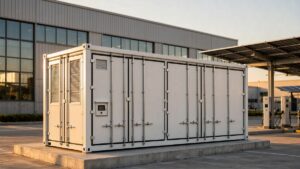
For a site with under 2.5 m² to spare and no dedicated O&M team, a 215kWh cabinet BESS is simpler than a container and more useful than a grid-only connection. The comparison below is indicative, not a quote.
Versus Grid-Only Supply
The product page’s example uses a 0.85 USD/kWh peak-valley spread and 330 operating days: one full 215 kWh cycle a day shifts about 71 MWh a year, roughly 60,300 USD of arbitrage value before demand savings. Those are assumptions, not a return commitment. The 500 kWh container fits when shifted energy exceeds one cabinet.
Versus a Containerized System
| Choice | 215 kWh cabinet | 500 kWh–2 MWh container |
|---|---|---|
| Space | Under 2.5 m², ground-set | 20–40 ft footprint and lifting |
| Instalación | Pad, cables, grid tie | Civil works, crane, commissioning |
| Thermal design | Air cooling, no coolant loop | Liquid cooling at higher energy density |
| Scaling route | Add cabinets or move up the H098 range | Sized for utility-scale durations |
Larger containerised systems follow the same sizing logic; the choice turns on land, duration and maintenance.
How to Choose and Configure
Choose a 215kWh cabinet BESS by matching three numbers: your peak load, your tariff spread and your available PV roof area. Capacity alone does not decide whether a project works.
Five Checks Before Ordering
- Peak profile: confirm the kW peak and how many hours it lasts; 100 kW for about two hours is the cabinet’s window.
- Tariff structure: check both the energy spread and any demand charge, since the two are saved differently.
- PV plan: confirm roof area and DC voltage so the 200–950 V MPPT window is used properly.
- Site conditions: verify the pad, access for a 2850 kg unit, ambient range and local fire requirements.
- Documents: request the report numbers, current dates and market-specific marks before tender submission.
OEM, ODM and Custom System Design
huadaenergy is the source factory for the H098 range: capacity, appearance, communication protocol and control logic can be built to a distributor’s or EPC’s specification. Production follows the confirmed configuration with batch records, full-function testing and reinforced export packing. Engineering can adapt the EMS to local tariffs or dispatch rules — send the site data for a proposed configuration.
Preguntas frecuentes
¿Qué puede alimentar un BESS de gabinete de 215 kWh?
Con su potencia nominal de 100 kW, el armario soporta aproximadamente dos horas de una carga de 100 kW, o más tiempo con una carga menor. El tiempo de funcionamiento real depende de la profundidad de descarga, la temperatura y el perfil de carga.
¿Puede la energía solar en la azotea conectarse directamente?
Sí. El MPPT integrado acepta hasta 120 kW de PV a un máximo de 850 V, con un rango de trabajo de 200–950 V, por lo que no se necesita un inversor PV separado.
¿El H098-215kWh es enfriado por aire o enfriado por líquido?
Air-cooled. There is no coolant loop to top up and no leak risk, which lowers the maintenance threshold for sites without an O&M team.
¿Qué certificaciones posee?
Los archivos de prueba en registro cubren IEC 63056:2020, verificación de baja tensión y EMC, IEC 62933-5-2 y RoHS; la página del producto también enumera IEC 62933-2-1, EN 61000-6, UN38.3, MSDS, RoHS 2.0 y SIRIM MyHIJAU. Solicite los documentos sellados vigentes para su mercado.
¿Puedo ampliar la capacidad más adelante?
Sí. La serie H098 abarca de 50 a 315 kWh, y se pueden planificar varios gabinetes en un solo sitio. Comience con la carga que tiene y añada capacidad a medida que crezca el consumo.
¿Apoyan pedidos OEM y ODM?
Sí. huadaenergy admite la personalización de capacidad, apariencia, protocolos de comunicación y lógica de control, con un diseño de sistema específico para cada proyecto desde fábrica.
Acerca de huadaenergy
Source Factory and Support
huadaenergy builds the H098 cabinet and container ranges in Huizhou, with cell and module traceability, full-function testing and export packing handled in house. Share your site type, load and target market through the página de contacto for a configuration and quotation.
Last updated: 2026-11-24