A 1MWh containerized BESS is a 20-foot shipping container holding roughly 1,000 kWh of lithium iron phosphate storage, a 500 kW power conversion system and the controls to run it, all pre-wired and pre-tested at the factory. If you are weighing storage sizes for a factory or a solar project, this is the capacity that often makes the business case work without the cost and lead time of a custom-built plant. This guide covers what the 500 kW / 1,005.3 kWh configuration actually delivers, where it fits, how it compares with diesel and grid upgrades, and what to check before placing an order.
What Is a 1MWh Containerized BESS?
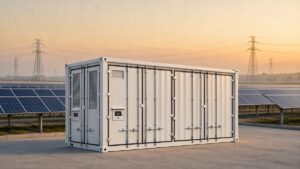
A 1MWh containerized BESS stores about 1,000 kWh of energy in a standard 20-foot container and can deliver 500 kW of power, enough to cover a two-hour peak event at a mid-sized industrial site. It is sold as a complete unit: battery racks, PCS, BMS, EMS, fire suppression and thermal management arrive already installed.
The H098-1MWh Configuration
The huadaenergy H098-1MWh uses a 598.4V, 1,680Ah LiFePO4 battery bank rated at 1,005.3 kWh, paired with a 500 kW rated PCS and a 550 kW peak. AC output is 400V with a tolerance of minus 20 to plus 15 percent. The container measures 6,058 by 2,438 by 2,591 mm and weighs 16,200 kg, which keeps it inside the dimensions of a normal 20-foot shipping container for road, rail and sea transport.
What Actually Arrives on Site
The unit leaves the factory after full-function testing. On site it needs a prepared foundation, cable connection and grid tie, then it is ready to run. Most integration work has already happened in the factory. The huadaenergy 1MWh containerized ESS page carries the full configuration.

Why the 1MWh Class Is Gaining Ground in 2026
The 1MWh class is growing because grid constraints and rising solar output are turning on-site storage from an optional extra into a practical tool for managing peaks and absorbing surplus power.
Storage Is Scaling Fast
The IEA’s Global Energy Review 2026 reports roughly 108 GW of new battery storage deployed worldwide in 2025, up about 40 percent on 2024, with around 80 percent of that capacity utility-scale. Large installations still dominate, but the same report notes that commercial and industrial users are looking at batteries to control demand peaks, shift consumption away from expensive hours and reduce exposure to volatile tariffs.
There Is More Surplus Power to Store
The IEA’s Renewables 2026 outlook puts nearly 4,800 GW of renewable capacity additions between 2026 and 2031, 57 percent more than the previous six-year period, with solar providing more than three quarters of the growth. The same report estimates technical curtailment of wind and solar at nearly 200 TWh in 2025 and warns it could exceed 800 TWh by 2031 if integration does not improve. Storage is not the whole answer, but for a site with its own solar it changes the value of the power it already generates.

The Numbers That Actually Decide the Fit
Four figures decide whether a 1MWh containerized BESS fits an application: usable energy, discharge power, cycle life and the temperature band it must work in.
A Short Table, Not a Wall of Numbers
| Item | H098-1 MWh | Porque é importante |
|---|---|---|
| Capacidade da bateria | 1,005.3 kWh (598.4V / 1,680Ah) | Defines how long a peak can be covered |
| Potência nominal / de pico | 500 kW / 550 kW | Defines how many loads can be served at once |
| Saída CA | 400V, minus 20 to plus 15 percent | Matches standard industrial switchgear |
| Vida útil do ciclo | over 6,000 cycles | LFP cells rated for daily cycling |
| Temperatura de funcionamento | discharge minus 20 to 50 C, charge minus 5 to 50 C | Sets the need for HVAC and siting |
| Comunicação | RS485 / CAN, 4G to cloud | Remote monitoring and on-site integration |
| Contêiner | 20 ft, 6,058 x 2,438 x 2,591 mm, 16,200 kg | Standard transport and crane handling |
Power and Energy Are Different Questions
A 500 kW rating says how hard the system can push at a given moment; 1,005.3 kWh says how long it can keep pushing. Together they describe a two-hour system at full output, which suits peak shaving, load shifting and bridging generator start-up. If your peak lasts eight hours, a 1MWh container alone is the wrong tool, and the sistema em contentor de 1MW/3MWh or a parallel layout is worth looking at.
Where a 1MWh Container Earns Its Keep
A 1MWh container suits sites where demand is predictable and peaks are short: factories, mining sites, renewable plants, microgrids and EV charging hubs.
Factories and Industrial Parks
A continuous production line pays demand charges on its highest interval, not its average. The BESS discharges over that interval, flattening the bill without changing how the line runs. Several units can be paralleled as a site grows. The ESS em gabinete de 315kWh suits a smaller site that does not yet need a full container.

Solar and Wind Sites
Where solar output peaks at midday and the site consumes in the evening, the container stores the surplus instead of exporting it at a low price or curtailing it. The EMS can be set to charge from PV first and top up from the grid off-peak. The 500kWh containerized ESS covers projects with a smaller generation profile.

Remote Sites, Microgrids and Charging Hubs
For a mine or a remote industrial camp, the container bridges the gap when the grid fails or a generator is starting. In microgrid mode it can island, then reconnect under utility dispatch. EV charging hubs use it to absorb a short, high-power draw without triggering a demand spike that the utility would charge for.

1MWh BESS vs Diesel and Grid Upgrades
For short, repeatable peaks, a 1MWh BESS usually beats running diesel or paying for a grid upgrade, though it does not replace either in every case. The right comparison uses your duty cycle and local tariff, not the equipment price alone.
Three Ways to Handle a Peak
| Opção | Strength | Limit |
|---|---|---|
| Gerador a diesel | Fast to buy, familiar to operate | Fuel cost, running hours, emissions and local noise rules |
| Grid upgrade | Suits long, continuous load growth | Long approval and construction lead time |
| 1MWh BESS | Pre-tested, silent, fast response, parallel-able | Two-hour duration at full power; needs a clear revenue or savings case |
A Worked Example, Based on Assumptions
Consider a plant with a 300 kW peak that lasts two hours a day on 250 working days. That is roughly 150,000 kWh of shifted energy a year. If a local tariff charges a demand fee on the peak interval, or if peak energy costs materially more than off-peak, the savings can be estimated from those two numbers; if the tariff is flat, the case collapses to backup value alone. These figures are illustrative assumptions, not a quotation or a guarantee of savings. Ask for a calculation using your own meter data.
Como Escolher o Sistema BESS Contentorizado Adequado
Choose by matching the storage to your load profile, tariff structure, grid connection and site conditions, then verifying the documents rather than the brochure. A container is a standard platform; the configuration around it is not.
A Practical Checklist
- Plot a typical day and a peak day from meter data, including how long the peak lasts.
- Confirm the tariff: demand charge, time-of-use spread and any demand-response payment.
- Check the grid connection point and the interconnection study requirement before ordering.
- Match the power rating to the loads you actually want to cover, not to total site capacity.
- Ask about operating temperature, HVAC load and how the unit behaves at your site’s extremes.
- Request dated test reports tied to the exact model, plus the factory test procedure.
Why 1MWh Is a Sensible Starting Point
A 1MWh container is large enough to matter on a factory bill, small enough to ship as a standard unit, and expandable by adding containers later. Starting at that size and parallel-growing reduces the risk of buying more duration than the site can use. The 2MWh containerized ESS is the next step when the load profile justifies it.
Certifications and What Buyers Should Request
The H098-1MWh product page lists IEC, UN38.3, MSDS and RoHS under certification standards, with CE mentioned in the product summary; a buyer should ask for dated reports tied to the exact model and configuration rather than relying on a logo. Standards listed on a page are not the same as a certificate in hand for your market.
What the Listed Standards Cover
UN38.3 is the transport safety test that carriers expect for lithium batteries moving by sea or air. MSDS is the material safety data sheet used for handling and shipping declarations. RoHS addresses restricted substances in electronic equipment. IEC is a family of international standards for battery systems and power conversion, so the specific part number matters: ask which IEC standard was applied and by which laboratory. CE in a product summary is a manufacturer’s conformity statement for applicable EU rules, not a performance certificate.
Documents to Ask For Before Ordering
Request the report number, issue date, applicant name, tested model and the scope of each document. Check that they cover the configuration you are buying, not a similar unit. For a tender, ask for a stamped datasheet and agree in writing which documents will be supplied with shipment. huadaenergy builds to the confirmed configuration and keeps cell and module batch records on file; certification requirements can be discussed for specific regional grid and project needs.

Perguntas frequentes
Por quanto tempo um contêiner de 1MWh pode alimentar minha instalação?
Com uma potência máxima de 500 kW, 1.005,3 kWh dura cerca de duas horas antes de perdas e configurações de reserva. Uma carga mais leve dura mais tempo: uma carga de 100 kW, em teoria, funcionaria cerca de dez horas. O tempo de execução real depende da capacidade utilizável, da temperatura e de como o EMS reserva margem de operação.
Pode substituir o meu gerador a diesel?
For short peaks and backup bridging, often yes. For days of continuous supply, no. Many sites keep the generator and use the BESS to cut its running hours; the container supports grid, diesel and solar inputs so the two can work together.
1MWh é suficiente para o corte de picos?
Depende da altura e da duração do seu pico, não do seu consumo anual total. Um pico de duas horas e algumas centenas de quilowatts é adequado; um pico que dure toda a tarde pode exigir um sistema maior ou de maior duração.
Que certificações possui o H098-1MWh?
The product page lists IEC, UN38.3, MSDS and RoHS as applicable standards, and mentions CE in the summary. Ask for the actual reports with numbers, dates, applicant and tested model; standards on a page are a starting point, not a complete document pack.
Can huadaenergy customise the container for my project?
Yes. As the source factory, huadaenergy supports OEM and ODM work on capacity, power, communication protocols and enclosure details, and can propose a system design around your load profile and site conditions. Development starts from the customer’s application rather than a fixed catalogue.
What does installation involve?
The container arrives pre-wired and pre-tested. Your team prepares the foundation, brings cables to the connection points and completes the grid tie; huadaenergy supports acceptance testing. Civil works and interconnection approval remain site responsibilities.
Sobre a huadaenergy
Fabricado na origem em Huizhou
huadaenergy manufactures portable power stations, LiFePO4 batteries, home storage and containerized energy storage at its Huizhou facility, with batch traceability and full-function factory testing before shipment. We are a source factory, not a trading middleman: OEM and ODM work, custom system design and development against a customer’s requirements are all part of the job. For a stamped datasheet, a document pack or a project discussion, see the 2.5MWh containerized system page or contact sales@huadaenergy.com / +86 138 2316 3795. Last updated: 2026-11-27