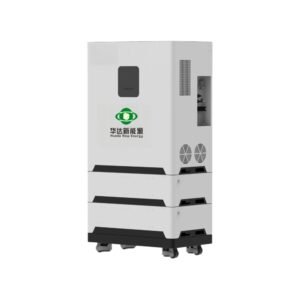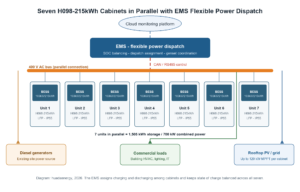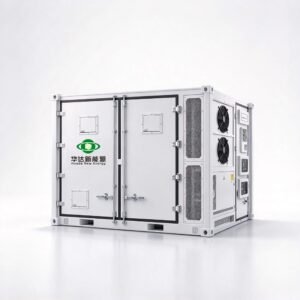
De H096 10kWh stapelbare thuisbatterij is een alles-in-één energieopslagtoren die 10,24 kWh bruikbare LiFePO4-capaciteit combineert met een ingebouwde omvormer, zodat een huishouden overdag zonne-energie kan opslaan en 's nachts daarop kan draaien zonder een aparte omvormer te kopen of af te stemmen. Hij is geschikt voor huiseigenaren die vandaag back-upstroom willen en morgen ruimte om uit te breiden: hetzelfde platform breidt uit van 5,12 kWh naar 20,48 kWh door extra modules te stapelen. Deze gids legt de specificaties, certificeringen, totale kostenpositie en selectiecriteria uit die distributeurs, installateurs en huiseigenaren moeten controleren voordat zij in 2026 een 10kWh stapelbare thuisbatterij bestellen.
Wat is de H096 10kWh stapelbare alles-in-één thuisbatterij?
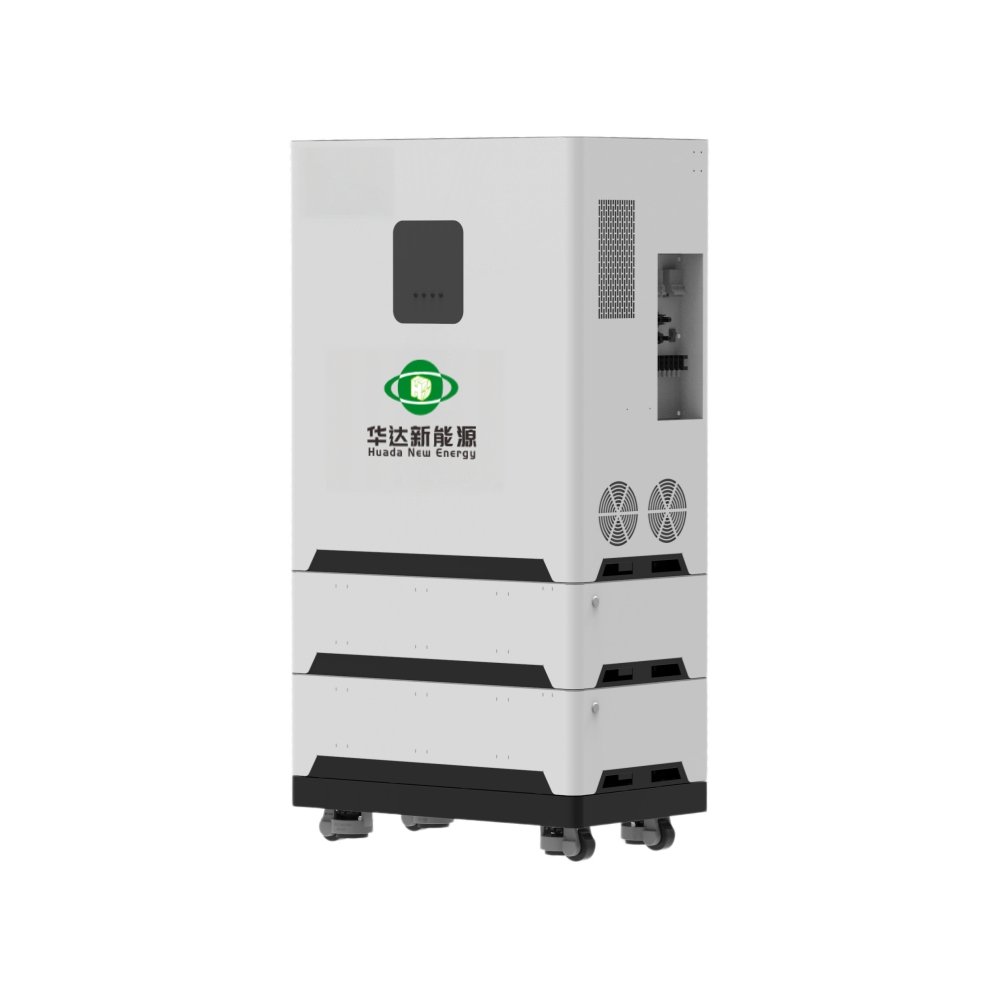
De H096-(5-20)kWh stapelbare is een vloerstaande thuisbatterij waarbij twee 51,2V / 5,12kWh LiFePO4-modules met een geïntegreerde omvormer zijn gestapeld tot één toren van 637 × 387 × 1075 mm en 169,8 kg. De toren rolt op zijn basis naar zijn plaats, zodat één installateur hem kan plaatsen zonder kranen of wandbevestigingsmateriaal. Netaansluiting is eenfasig L+N+PE, en de bedrade verbindingen zijn RS485 / CAN voor omvormers en energiebeheerapparatuur, plus WiFi en Bluetooth voor de mobiele app.
Waarom de ingebouwde omvormer belangrijk is
Omdat de omvormer is geïntegreerd, is er geen aparte omvormer om te betrekken, te dimensioneren en af te stemmen — een van de meest voorkomende oorzaken van kostenoverschrijdingen en inbedrijfstellingsvertragingen bij thuisopslagprojecten. Het apparaat wordt gemonteerd, gestapeld en volledig functioneel getest geleverd, zodat het werk ter plaatse beperkt blijft tot positioneren, bedraden en inschakelen.
De uitbreidingsladder: 5,12 tot 20,48 kWh
Elke module voegt 5,12 kWh toe op hetzelfde platform: één module geeft 5,12 kWh, twee geven 10,24 kWh, drie geven 15,36 kWh en vier geven 20,48 kWh. Huishoudens die een EV-lader of een warmtepomp verwachten, kunnen beginnen bij 10,24 kWh en later modules toevoegen in plaats van het hele systeem te vervangen — de 20,48 kWh-configuratie van dezelfde serie vormt het maximum van het platform.
Waarom alles-in-één thuisbatterijen terrein winnen in 2026
Alles-in-één-stacks winnen marktaandeel omdat zij engineeringwerk wegnemen op precies het moment dat de vraag naar thuisopslag zich verbreedt voorbij de vroege adopters. Europa installeerde in 2025 36 GWh batterijopslag, een stijging van 48% jaar-op-jaar en een twaalfde opeenvolgend record, waarbij het cumulatieve park de 100 GWh passeerde (SolarPower Europe, 2026). Residentiële opslag droeg 12,3 GWh aan dat totaal bij, en de vooruitzichten voor 2026 overschrijden 50 GWh across alle segmenten.
Kostenontwikkeling versterkt de verschuiving. Lithium-ion-packprijzen daalden met 81% naar een recordlaagte van $108/kWh in 2025, en packprijzen voor stationaire opslag daalden met 45% naar $70/kWh — voor het eerst het laagste van alle segmenten (BloombergNEF Battery Price Survey, december 2025). Ook de dimensionering convergeert: de gemiddelde nieuwe thuisbatterij in Duitsland, de grootste residentiële markt van Europa, bereikte in 2025 ongeveer 10,3 kWh (RWTH Aachen Battery Charts, 2026) — bijna precies de 10,24 kWh-configuratie die hier wordt behandeld. Een alles-in-één-toren van die omvang betekent één onderdeelnummer om te offreren, één installatiemethode om te trainen en één app voor de huiseigenaar.
Belangrijkste specificaties en wat ze betekenen
De onderstaande specificatietabel behandelt de tweemodule-configuratie van 10,24 kWh samen met de platformlimieten (zoals gepubliceerd op de officiële productpagina).
| Item | H096 (5-20)kWh stapelbaar, 10,24 kWh-configuratie | Wat het betekent voor kopers |
|---|---|---|
| Bruikbare capaciteit | 10,24 kWh (2 × 5,12 kWh-modules) | Dekt een volledige avond van typisch huishoudelijk gebruik plus ochtendbijlading |
| Batterijmodule | 51,2V / 5,12 kWh / 51,8 kg, LiFePO4 | Veilige, thermisch stabiele chemie; modules zijn licht genoeg voor hantering door twee personen |
| Levensduur | 5.000+ cycli met 80%+ capaciteit behouden | 10,24 kWh × 5.000 cycli ≈ 51 MWh levensduurdoorvoer |
| Spanningsbereik | 40 V – 58,4 V (nominaal 51,2 V) | Standaard 16S LiFePO4-venster, breed genoeg voor volledige lading en afschakeling |
| Max. laad-/ontlaadstroom | 80 A (≈4,1 kW bij nominale spanning, afgeleid) | Bedient zware huishoudcircuits; 110% overbelasting vangt aanloopstromen van motoren op |
| Netaansluiting | L+N+PE eenfasig | Standaard Europese eenfasige bedrading, geen driefasig werk nodig |
| Communicatie | RS485 / CAN; WiFi + Bluetooth-app | Vast bedrade BMS/EMS-integratie plus telefoonmonitoring zonder extra hardware |
| Afmetingen / gewicht | 637 × 387 × 1075 mm / 169,8 kg | Past in een technische ruimte of garagehoek; rolt op zijn plaats, geen kraanwerk |
| Bedrijfstemperatuur | Laden 0–50 °C; ontladen −20–50 °C | Onverwarmde garages en technische ruimtes zijn prima voor ontladen in de winter |
| Beschermingsniveau | IP20, installatie binnenshuis | Plan een overdekte locatie; dit is geen behuizing voor buitengebruik |
| Certificering | CE / FCC / RoHS | Zie de certificeringssectie hieronder voor wat elk certificaat dekt |
Certificeringen uitgelegd: wat CE, FCC en RoHS betekenen voor kopers
De H096 stapelbare serie is gecertificeerd volgens CE, FCC en RoHS, zoals vermeld op de productpagina, en elk keurmerk beantwoordt een andere importvraag. Distributeurs moeten deze drie keurmerken beschouwen als het toegangsbewijs voor de twee grootste opslagmarkten, en het gestempelde datasheet opvragen voor aanbesteding of nutsdocumentatie via het formulier op de productpagina.
| Certificering | Rechtsgebied | Wat het dekt |
|---|---|---|
| CE | European Union / EEA | Conformity with EU health, safety and environmental protection legislation, including low-voltage and EMC directives relevant to a grid-connected storage tower |
| FCC | United States | Electromagnetic interference limits for the WiFi, Bluetooth and RS485/CAN electronics sold into the US market |
| RoHS | EU, widely referenced globally | Restriction of hazardous substances such as lead, mercury and cadmium in the unit’s materials |
| IP20 | IEC 60529 rating scale | Protected against solid objects over 12.5 mm; no water protection — install indoors |
Beyond the marks, protection is enforced at module level: the smart BMS guards against overcharge, over-discharge, short circuit, over-temperature, over-voltage and over-current faults, and every tower is full-function tested before shipment. For OEM / ODM programmes, capacity, branding, enclosure and communication protocol can be customized, and the manufacturer documents multiple patents and High-Tech Enterprise certification. If your market requires additional approvals beyond CE / FCC / RoHS, ask for the certificate pack before contracting — the H096 10kWh all-in-one product page lists the same certification basis across the series.
H096 Stackable vs Lead-Acid and Split Systems
The H096 stackable wins on lifetime energy per footprint and on installation simplicity against both alternatives it typically competes with. The comparison below uses industry-typical figures and the specifications above.
| Criterium | H096 stackable all-in-one | Lead-acid bank + inverter | Split LiFePO4 + hybrid inverter |
|---|---|---|---|
| Levensduur | 5,000+ @ 80% retention | ~500–1,500 deep cycles (industry typical) | 3,000–6,000 (chemistry-dependent) |
| Lifetime throughput at 10 kWh | ≈51 MWh | ≈5–15 MWh, plus 1–3 battery replacements | ≈30–60 MWh |
| Equipment to source | One tower (battery + inverter) | Batteries, inverter, cabling, ventilation | Battery cabinet, inverter, comms matching |
| Installatie | Place, wire, switch on | Heavy bank assembly, venting, commissioning | Two vendors to coordinate, matching study |
| Voetafdruk | 0.25 m² floor area | Larger, needs ventilation clearance | Two wall/floor units |
| Bewaking | WiFi/Bluetooth app, module-level BMS | Basic or none | Depends on inverter brand |
A ten-year cost view makes the cycle-life gap concrete. Based on assumptions — one cycle per day at 80% of 10.24 kWh usable, electricity valued at €0.25/kWh, and lead-acid replacement every 3–4 years at industry-typical cycle counts — the H096 tower delivers roughly 30 MWh of shifted solar over ten years without battery replacement, while a lead-acid bank of equal daily throughput requires two to three replacement purchases and still ends the decade with a younger but smaller bank. Buyers should run the same arithmetic on their local tariff before deciding; the assumptions matter more than any single price quote.
Praktijktoepassingen
The H096 stackable earns its keep in homes where consumption is changing, not fixed. Three scenarios cover most enquiries Huada receives.
Evening self-consumption for solar homes
Surplus midday PV charges the stack instead of feeding out at low export rates; the tower discharges through the evening peak. At 10.24 kWh, a household running cooking, lighting, appliances and a heat-pump cycle overnight typically covers most of its non-daylight consumption from storage.
Backup through grid outages
When the grid drops, the built-in inverter switches to backup mode so essential circuits keep running. Discharge is rated to −20 °C, which matters for garages and plant rooms in continental winters.
Growing loads: EV chargers and heat pumps
Start with two modules, then add a third when the EV arrives and a fourth with the heat pump. The stacking interface on the tower is prepared mechanically and electrically for modules three and four, and the 5.12 kWh module is the building block across the range.
How to Choose the Right Stackable Home Battery
The right stackable comes down to five checks that separate a fit-for-purpose tower from a spec-sheet bargain.
- Size to your evening load, not your roof. Match daily kWh consumption after sunset; 10.24 kWh suits most four-person households, and the platform expands to 20.48 kWh.
- Confirm the electrical interface. Single-phase L+N+PE here — verify it matches your market’s wiring before quoting.
- Check communication options. RS485 / CAN for hard-wired integration plus WiFi and Bluetooth app monitoring covers both installer and homeowner needs.
- Read the cycle-life definition. Ask cycles to what depth of discharge and at what retained capacity; 5,000+ cycles at 80%+ retention is the figure to compare against.
- Verifieer certificeringen voor uw markt. CE / FCC / RoHS as listed; request the stamped datasheet and certificate pack for utility or tender submissions.
For households that prefer wall or floor formats instead of a tower, the 10kWh floor-standing battery en de 15kWh floor-standing model share the same LiFePO4 platform philosophy; a previous guide compares them in detail in our 15kWh home energy storage article.
Veelgestelde vragen
Hoeveel kost een stapelbare thuisbatterij van 10 kWh?
De prijsstelling is afhankelijk van de configuratie, de bestemmingsmarkt en het ordervolume, en wordt daarom op aanvraag geoffreerd in plaats van vermeld. Als marktbenchmark bedroegen de gemiddelde prijzen voor lithium-ionpakketten $108/kWh in 2025 en bereikten stationaire opslagpakketten $70/kWh (BloombergNEF, 2025). Vraag een offerte aan met uw maandelijkse verbruik en essentiële belastingen voor een exact cijfer.
Kan ik het 10kWh-systeem later uitbreiden?
Yes. The platform takes one to four 5.12 kWh modules, so capacity can grow from 5.12 kWh to 20.48 kWh by stacking additional modules — no inverter replacement and no system swap are needed.
Omvat de H096 een omvormer?
Ja. De omvormer is in de toren ingebouwd, waardoor de selectie en afstemming van de omvormer en een aparte wandkast uit uw project komen te vervallen. De netaansluiting is eenfasig L+N+PE met 110%-overbelastingscapaciteit voor inschakelpieken.
Hoe lang zal een batterij van 10 kWh mijn huis van stroom voorzien?
Het hangt af van de belastingen die je back-upt. Ter illustratie: essentiële circuits met een gemiddeld verbruik van 0,8 kW zouden ongeveer 12 uur draaien op een volledige 10,24 kWh; zwaarder gebruik van het hele huis verkort dat. Dimensioneer op basis van je lijst met essentiële belastingen rather dan op het totale verbruik.
Welke certificeringen heeft de H096 stapelbare?
De productpagina vermeldt CE-, FCC- en RoHS-certificering, met een IP20-behuizingsclassificatie voor installatie binnenshuis. Certificaatsdocumenten en een gewaarmerkte datasheet zijn op verzoek beschikbaar voor regionale import- en nutsvereisten.
Is LiFePO4 veiliger dan andere lithiumbatterijen voor thuisgebruik?
LiFePO4-chemie wordt gekozen vanwege thermische stabiliteit en lange levensduur, wat de reden is dat het nieuwe stationaire opslag domineert. In deze toren voegt BMS-bescherming op moduleniveau beveiligingen toe tegen overladen, overontladen, kortsluiting en thermische fouten, en elke geassembleerde eenheid wordt vóór verzending volledig functioneel getest.
Over Huada Energy
Huada Energy (Huizhou Huada Technology) manufactures household and commercial energy storage — stackable towers, wall and floor-standing batteries, cabinet and container ESS, EV charging stations and 12V–51.2V LiFePO4 batteries — with OEM / ODM customization for distributors and installers worldwide. Every home tower is assembled, stacked and full-function tested before shipment, and factory visits are welcome. Explore the complete stackable home battery range or contact sales@huadaenergy.com / +86 138 2316 3795 for a capacity recommendation and quotation.
Last updated: 2026-10-30