12V-200Ah-LiFePO4-Batterie-Leitfaden: Markt und technische Daten 2026
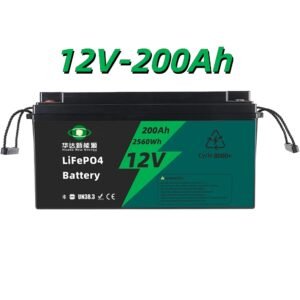
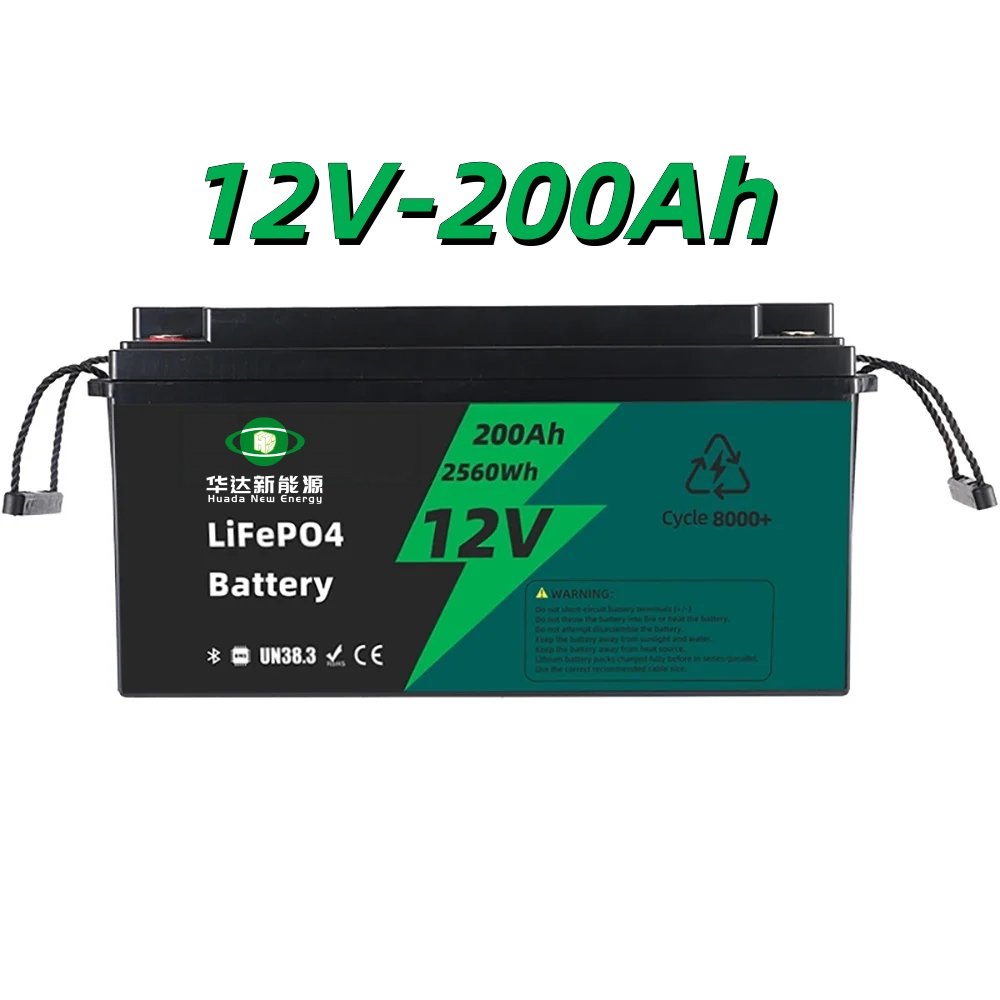
Die 12V 200Ah LiFePO4 battery has become the default upgrade for buyers still running deep-cycle lead-acid batteries in RVs, boats, solar systems and standby power. A single huadaenergy 12V 200Ah unit stores 2,560 Wh of usable energy, delivers more than 8,000 cycles at 0.2C, and drops into the same footprint and voltage window as the lead-acid battery it replaces. This guide reviews verified 2026 market data, the specifications that actually matter, the certifications to confirm before you import, and how the numbers compare with lead-acid over a full service life.
Last updated: 2026-10-31
What Is a 12V 200Ah LiFePO4 Battery?
A 12V 200Ah LiFePO4 battery is a 12.8-volt, 2,560-watt-hour deep-cycle lithium battery built from four prismatic LiFePO4 cells in series (4S1P) with an integrated battery management system, packaged in a lead-acid-compatible case. The huadaenergy version keeps the same installation size and charging profile as a 12V lead-acid battery, so most chargers, inverters and battery bays accept it without modification.
Grade-A prismatic cells give the pack an internal resistance of 35 mΩ or less. M8 terminals carry 200 A of continuous discharge current and 400 A pulses for up to 3 seconds, enough for 2,000–3,000 W inverters without voltage sag. The pack weighs about 22 kg — roughly half of a comparable lead-acid battery — and holds charge in storage, losing no more than 3.5% per month at 25°C. Bluetooth monitoring lets users check state of charge and cell health from a phone, and the IP55 housing resists dust and water jets in RV bays and outdoor cabinets. Buyers who need a lighter option can compare the 12V 100Ah LiFePO4-Batterie aus derselben Plattform.
2026 Market Outlook: Why Lead-Acid Replacement Demand Keeps Growing
The 12V LiFePO4 battery market is growing at close to 19% per year because lithium pack prices keep falling while the installed base of aging lead-acid systems keeps generating replacement demand. Three independently verifiable data points describe the opportunity:
- Segment size: PW Consulting values the global 12V LiFePO4 battery market at USD 3.41 billion in 2025, projected to reach USD 11.52 billion by 2032 — an 18.96% CAGR. The 100–200Ah capacity class was the largest segment at 48% of 2025 revenue, and recreational vehicles were the largest application at 33% (PW Consulting, 2026).
- Replacement wave: Global Info Research sizes the lead-acid-replacement LiFePO4 segment specifically at USD 2.35 billion in 2025, rising to USD 9.2 billion by 2032 — a 21.5% CAGR (Global Info Research, 2026).
- Cost tailwind: BloombergNEF’s 2025 Battery Price Survey put average lithium-ion pack prices at a record-low USD 108/kWh, with LFP packs averaging USD 81/kWh and prices down 93% in real terms since 2010 (BloombergNEF, December 2025).
Regional demand is concentrated where the lead-acid installed base is largest: PW Consulting estimates North America at about USD 920.8 million and Europe at about USD 784.4 million of 2025 revenue. One nuance matters for distributors: the US RV market itself is expected to cool, with RVIA’s Fall 2026 RoadSigns forecast projecting roughly 290,000 wholesale units in 2026, down 15.3% from the 342,220 units shipped in 2025. A softer new-build market does not shrink the battery opportunity — it shifts it toward aftermarket replacement of the existing fleet, exactly the segment where 12V 200Ah drop-in lithium batteries win.
Wichtige Spezifikationen und ihre Bedeutung
The specification table below lists the published parameters of the huadaenergy 12V 200Ah LiFePO4 battery and what each one means in daily operation.
| Parameter | Wert | Bedeutung für Käufer |
|---|---|---|
| Nennspannung | 12.8V (4S1P) | Matches 12V lead-acid chargers and inverters |
| Kapazität / Energie | 200Ah / 2,560Wh | Double the usable energy of a 100Ah unit |
| Lebensdauer des Zyklus | 8,000+ at 0.2C to 80% capacity | Years of daily cycling; 5–13x typical lead-acid |
| Innenwiderstand | ≤35 mΩ | Stable voltage under heavy load |
| Discharge current | 200A continuous / 400A pulse (<3s) | Runs large inverters and motor loads |
| Aufladen | CC/CV to 14.6V, 0–45°C, max 200A | Works with standard lead-acid charger profiles |
| Austrittstemperatur | −20°C bis 60°C | All-season deep-cycle use |
| Selbstentladung | ≤3,5% pro Monat bei 25°C | Ready after seasonal storage |
| Weight / size | ~22 kg / 480 × 170 × 240 mm | About half the weight of equivalent lead-acid |
| Protection / monitoring | IP55 housing, built-in BMS, Bluetooth | Dust- and splash-resistant; app-based monitoring |
| Zertifizierung | UN38.3, CE | Air/sea transport and EU market access |
Two numbers deserve extra attention. First, the 8,000-cycle rating is specified at 0.2C charge and discharge until the pack reaches 80% of original capacity — a realistic daily-cycling condition, not a laboratory ideal. Second, the 80% depth-of-discharge rating means buyers can plan on about 2,048 Wh per cycle, whereas lead-acid systems are typically limited to about 50% depth of discharge to avoid sulfation.
Anwendungen in der realen Welt
The 12V 200Ah format suits any deep-cycle duty where a lead-acid battery used to be the default choice. Four scenarios cover most enquiries huadaenergy receives.
RV and Camper Vans
A single 12V 200Ah battery provides roughly 2 kWh per cycle for lighting, refrigerators, inverters and phone charging — enough for a weekend off-grid without recharging. At 22 kg it is light enough for one person to install, and Bluetooth monitoring removes guesswork about remaining range. With 342,220 RVs shipped in the US in 2025 (RVIA, December 2025), the replacement battery market behind that fleet is substantial.

Solar and Off-Grid Cabins
For small solar systems, two or four units in 12V or 24V banks store daytime generation for evening use. Buyers scaling up beyond 12V usually move to the 24V 200Ah LiFePO4-Batterie or step into a wall-mounted 10kWh stackable home battery for whole-house backup. The 80% usable depth of discharge effectively doubles the capacity a same-size lead-acid bank can deliver.
Marine House Power
IP55 sealing and the absence of liquid acid make the pack a safe house-battery upgrade for sailing and fishing boats, where spilled electrolyte and hydrogen venting are real safety concerns. Low self-discharge keeps the bank ready between trips, and the 400 A pulse rating handles windlass and thruster start-up currents.
Telecom and UPS Standby
Remote telecom sites and small UPS systems run float duty for years. The ≤3.5% monthly self-discharge, sealed IP55 casing and sealed shipping carton make the 12V 200Ah a practical retrofit for sites where maintenance visits are expensive. The larger 24V 100Ah LiFePO4-Batterie covers higher-voltage DC buses in the same product family.

12V 200Ah LiFePO4 vs Lead-Acid: Lifetime Cost
Over a full service life, the lithium option delivers far more energy per dollar despite a higher purchase price. The comparison below uses the huadaenergy product page figures and industry-typical lead-acid assumptions.
| Artikel | Huada 12V 200Ah LiFePO4 | Blei-Säure (gleiche Größe) |
|---|---|---|
| Zyklenlebensdauer bis 80% Kapazität | 8,000+ (0.2C) | Typischerweise 500–1.500 |
| Nutzbare Entladetiefe | 80% (~2,048 Wh/cycle) | ~50% (~1,200 Wh/cycle) |
| Gewicht | ~22 kg | ~45 kg or more |
| Self-discharge (25°C) | ≤3.5% per month | Deutlich höher |
| Wartung | Keine — vollständig versiegelt | Periodic checks and topping-up |
| Estimated lifetime throughput | ~16 MWh | ~0.6–1.8 MWh |
On these assumptions the LiFePO4 pack delivers roughly 13 times more usable energy before replacement, which is why total cost per delivered kilowatt-hour falls well below lead-acid even when the upfront price is two to three times higher. Exact economics depend on local prices and duty cycle, so treat the throughput figures as planning values rather than guarantees.
Certifications Explained: UN38.3, CE and IP55
The huadaenergy 12V 200Ah LiFePO4 battery is listed on its product page with UN38.3 and CE certification, and those two certificates deserve a closer look because they gate transport and EU market access.
UN38.3 is the United Nations transport test series (tests T.1–T.8: altitude, thermal, vibration, shock, external short circuit, impact/crush, overcharge and forced discharge) that every lithium battery must pass before it can ship as air or sea cargo. Certified packs travel as Class 9 dangerous goods with test summaries included — essential for importers arranging freight.
CE confirms conformity with the applicable EU legislation, and for batteries the governing framework is Regulation (EU) 2023/1542. Its compliance calendar keeps tightening:
| EU 2023/1542 Milestone | Datum | Relevance for 12V LFP Buyers |
|---|---|---|
| Conformity and CE marking requirements apply | 18. Aug. 2024 | Batteries placed on the EU market must comply |
| New labelling requirements | 18. Aug. 2026 | Capacity, chemistry and separate-collection marks |
| QR code and battery passport for applicable batteries | 18. Feb. 2027 | Digital record linked to the pack |
| Carbon footprint rules for LMT batteries | 18. Aug. 2028 | Extends to light-means-of-transport packs |
IP55, per IEC 60529, means the enclosure is dust-protected and withstands low-pressure water jets from any direction — appropriate for battery bays, engine rooms and outdoor cabinets, though not for submersion. When comparing suppliers, ask for the actual UN38.3 test summary and the EU Declaration of Conformity rather than relying on logos alone.
How to Choose the Right 12V 200Ah LiFePO4 Battery
Buying decisions should come down to a short checklist rather than brochures:
- Verified cycle-life conditions: confirm the test rate and end-of-life threshold (here: 8,000+ at 0.2C to 80%).
- BMS protection scope: overcharge, over-discharge, over-current and short-circuit protection, with cell balancing.
- Terminal and current rating: M8 terminals rated 200A continuous match most 12V inverter installations.
- Enclosure rating: IP55 for outdoor or semi-exposed installs; check IEC 60529 definitions.
- Transport and compliance documents: UN38.3 test summary plus CE/DoC before committing to a purchase order.
- OEM/ODM support: logo, packaging, capacity and communication (Bluetooth/RS485/CAN) options for distributor branding.
Häufig gestellte Fragen
Kann eine 12V-200Ah-LiFePO4-Batterie meine Blei-Säure-Batterie direkt ersetzen?
Yes. The huadaenergy 12V 200Ah is designed as a drop-in lead-acid replacement with the same 12V voltage window and installation footprint. Chargers that use a standard absorption voltage of 14.0–14.6V work without changes.
Wie lange hält eine 12V-200Ah-LiFePO4-Batterie?
The pack is rated for more than 8,000 cycles at 0.2C charge and discharge until it reaches 80% of original capacity. With one cycle per day, that corresponds to well over 20 years of cycling; calendar life in the field will usually be limited by other factors.
Kann ich mehrere 12V-200Ah-Batterien in Reihe oder parallel schalten?
Yes, banks of multiple units are common for 12V, 24V and 48V systems, but the allowed configuration depends on the BMS design and your charger setup. Tell huadaenergy your target voltage and load profile so the project can be configured correctly before you order.
What charger should I use for a 12V 200Ah LiFePO4 battery?
Use a charger with a CC/CV profile that charges to 14.0–14.6V, charging between 0°C and 45°C. The pack accepts up to 200A of charge current, so a 40–100A charger recharges it quickly without stressing the cells.
Does the battery work in cold weather?
Discharge works from −20°C to 60°C, so winter loads are fine. Charging is specified from 0°C to 45°C; below freezing, charge the pack in a heated space or use a charger with a low-temperature cutoff.
Do you support OEM and ODM orders for distributors?
Yes. huadaenergy offers customized logos, packaging, capacity and communication options (Bluetooth, RS485, CAN) for distributor and project buyers, along with UN38.3 shipping documents for export orders.
Über huadaenergy
huadaenergy (Huizhou Huada Technology) manufactures LiFePO4 batteries and energy storage systems in Huizhou, China, spanning the 12V/24V deep-cycle series, golf cart batteries, portable power stations, home storage (5–20kWh) and containerized commercial-and-industrial ESS. The 12V 200Ah LiFePO4 battery product page carries the full datasheet, and the sales team provides stamped datasheets, UN38.3 summaries and OEM briefs on request. Contact sales@huadaenergy.com or +86 138 2316 3795 for quotations and project support.
Quellen
- PW Consulting, “Global 12V LiFePO4 Battery Market” (2026)
- Global Info Research, lead-acid replacement LiFePO4 battery market report (2026)
- BloombergNEF, Lithium-Ion Battery Price Survey (December 2025)
- RV Industry Association, shipment reports and RV RoadSigns forecasts (December 2025; Fall 2026)
- Regulation (EU) 2023/1542 on batteries and waste batteries
- UN Manual of Tests and Criteria, UN38.3; IEC 60529 (IP ratings)