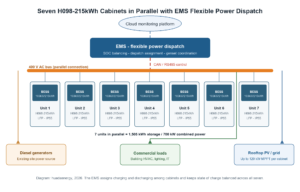
A 100kW/215kWh battery energy storage system in a single outdoor cabinet can cut peak-hour demand charges, lift solar self-consumption and keep production running through grid disturbances. Its real strength appears when cabinets work together: seven H098-215kWh units can run in parallel on one 400 V AC bus while the EMS flexible power dispatch assigns charging and discharging cabinet by cabinet, keeping state of charge balanced automatically. This guide explains that parallel EMS architecture with a live seven-cabinet deployment, then covers the specifications, application scenarios and IEC and SIRIM certifications buyers should verify in 2026.
Diagram: huadaenergy, 2026. Seven cabinets share one 400 V AC bus under a single EMS that balances state of charge across the fleet and coordinates diesel generators, loads and PV.
What Is the 100kW/215kWh Cabinet BESS?
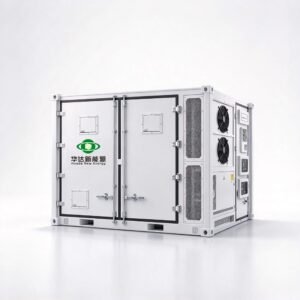
The H098-215kWh is an all-in-one battery energy storage system that integrates a 215 kWh LFP battery, a 100 kW bidirectional PCS, a built-in MPPT solar input and an energy management system inside one IP55-rated outdoor cabinet. The battery sits on a 768 V DC platform with 280 Ah cells and a 672–864 V operating range, while the AC side delivers 400 V three-phase power (3P+N+PE, 138 A rated current, 50/60 Hz) straight to a commercial distribution board.
Because battery, power conversion and EMS are fully commissioned at the factory, on-site work is limited to cable runs, grid connection and start-up. The cabinet measures 1910 × 1297 × 2414 mm and weighs 2,850 kg, a footprint of under 2.5 m² suited to space-constrained commercial sites.
Real-World Deployment: Seven Cabinets, One EMS
The parallel capability of the H098-215kWh is proven in commercial service, not only on paper. At a commercial complex in West Africa, seven cabinets run side by side on one AC bus — 1,505 kWh of storage and 700 kW of combined power in a single row of identical units, all delivered factory-commissioned and energised without on-site battery assembly.
The EMS is what makes the row behave as one plant. Working over CAN and RS485, it assigns charging and discharging cabinet by cabinet under the same flexible power dispatch logic described in our EMS article: when state of charge diverges, discharge favours the fuller cabinets and charging favours the emptier ones, so all seven converge instead of drifting apart. The EMS also coordinates the row with the site’s diesel generators, deciding when the batteries carry the building and when the gensets should rest. Air cooling suits this multi-cabinet layout — no coolant loops to maintain, and any single cabinet can be serviced without taking the plant offline.
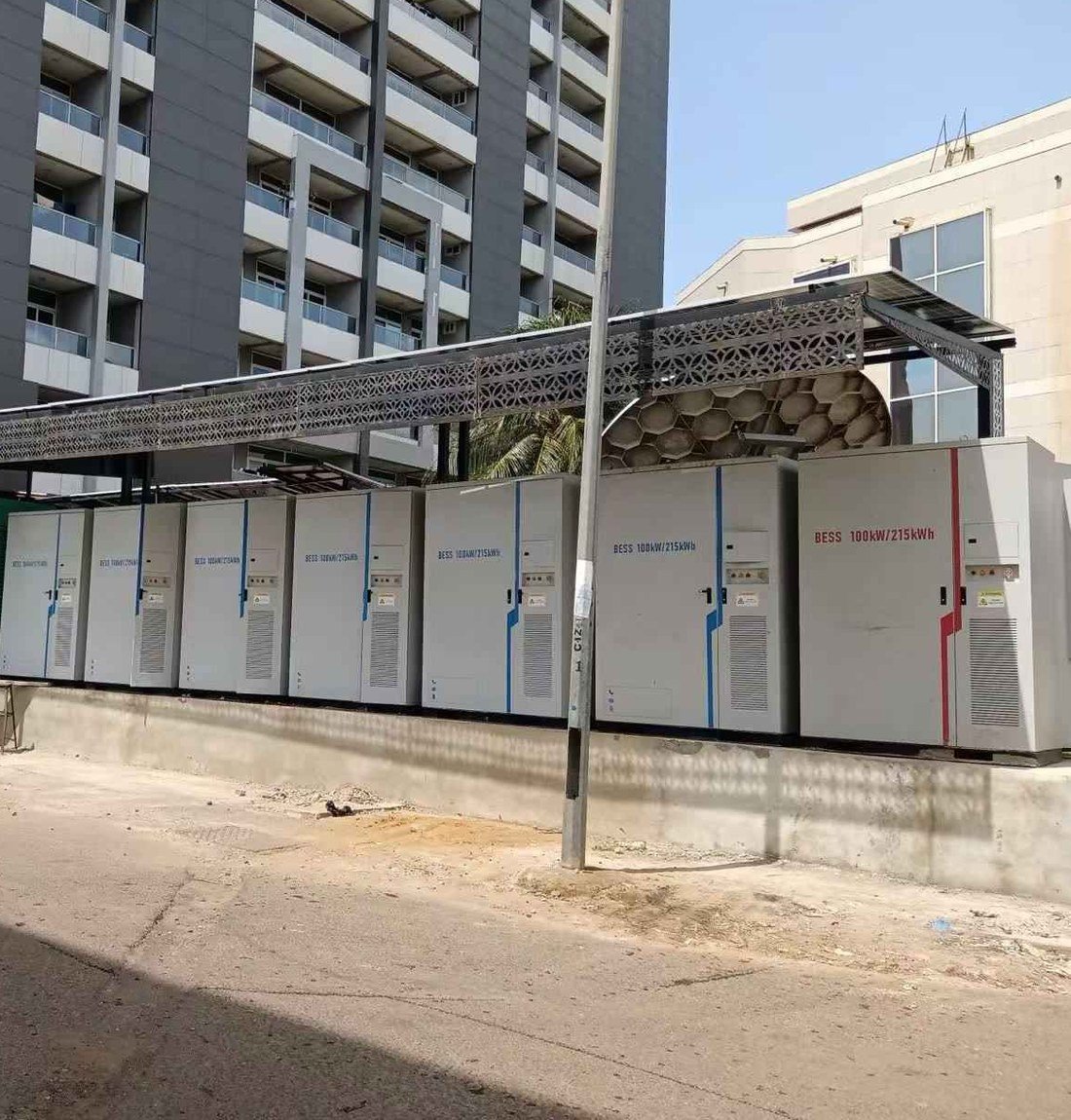
Photo: huadaenergy project record, 2026. Seven H098-215kWh cabinets installed in parallel under the site’s canopy structure.
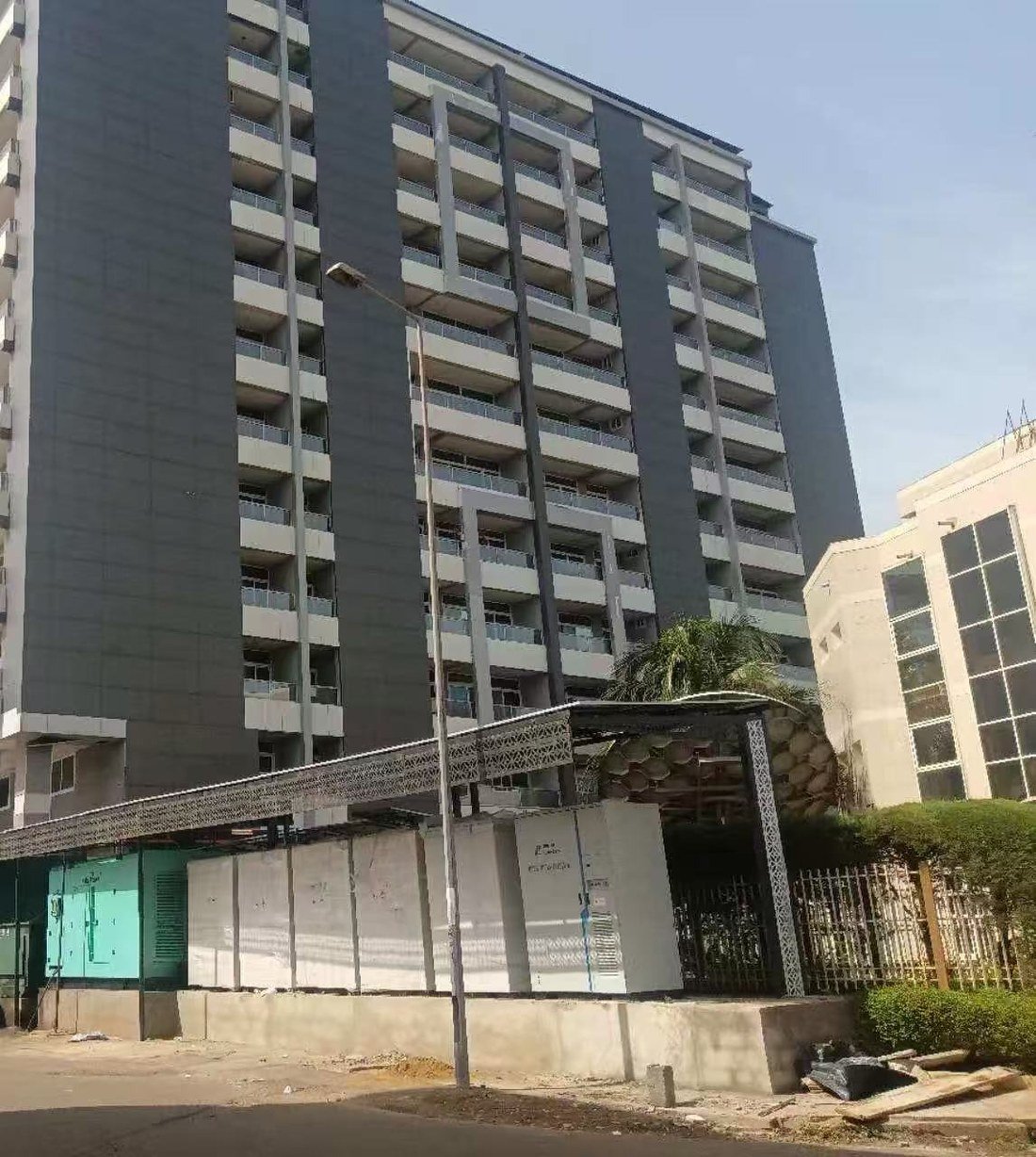
Photo: huadaenergy project record, 2026. The cabinet row sits at the base of the commercial complex.
Key Specifications at a Glance
The numbers that decide procurement are energy, power, PV headroom and environmental ratings — and the H098-215kWh’s figures are summarised below.
| المعلمة | القيمة | ماذا تعني للمشترين |
|---|---|---|
| الطاقة المقدرة | 215 kWh (LFP) | About 2.15 hours at rated power on a full charge |
| القدرة المقدرة | 100 kW PCS, 138 A | Covers a 100 kW block of peak load or fast chargers |
| منصة البطارية | 768 V DC, 280 Ah, 672-864 V | High-voltage string, fewer parallel paths |
| مدخل الطاقة الشمسية | Up to 120 kW, MPPT 200-950 V, max 850 V | Commercial rooftops connect at DC, no external PV inverter |
| خرج التيار المتردد | 3P+N+PE, AC 400 V, 50/60 Hz | Connects to a standard commercial distribution board |
| الهيكل | IP55, 1910 x 1297 x 2414 mm, 2850 kg | Outdoor ground installation, footprint under 2.5 m2 |
| Temperature | Charge 0-50 degrees C, discharge -20 to 55 degrees C | Tropical and high-heat sites; altitude up to 2,000 m |
| الاتصال | RS485 / CAN, cloud EMS | Remote monitoring plus local BMS/EMS integration |
Why Cabinet-Scale BESS Matters in 2026
Commercial-scale storage matters in 2026 because the market behind the meter is growing at record pace. The IEA Global Energy Review 2026 reports 108 GW of new battery storage installed worldwide in 2025 — 40% more than in 2024 — with LFP chemistry at roughly 90% of deployments. Falling cell prices reinforce the case: BloombergNEF’s Battery Price Survey 2025 put average pack prices at $108/kWh. In Southeast Asia, Malaysia’s RP4 tariff period, in force since 1 July 2025, made peak-hour commercial costs larger and more volatile.
Scenario 1: Peak Shaving and Demand Control for Factories
A 100 kW discharge window that covers the 14:00–22:00 peak period can flatten a factory’s 30-minute maximum demand, which is the number TNB’s RP4 tariff bills hardest. Under the Energy Commission’s RP4 schedule, medium-voltage Time-of-Use customers pay 31.32 sen/kWh during the weekday peak versus 27.23 sen/kWh off-peak, plus capacity and network charges totalling about RM97.06 per kW of peak-period maximum demand each month. The H098-215kWh charges at off-peak rates — or from rooftop solar — then discharges up to 100 kW through the afternoon peak, holding recorded demand near the EMS target.
The arithmetic: capping the 30-minute peak by 50 kW removes about RM4,850 per month in demand charges (50 kW × RM97.06) — roughly RM58,000 a year, illustrative and assuming the peak recurs monthly. Model against twelve months of half-hourly meter data first.
Chart: huadaenergy, based on the Energy Commission RP4 tariff schedule effective 1 July 2025. Savings figures are illustrative and based on assumptions.
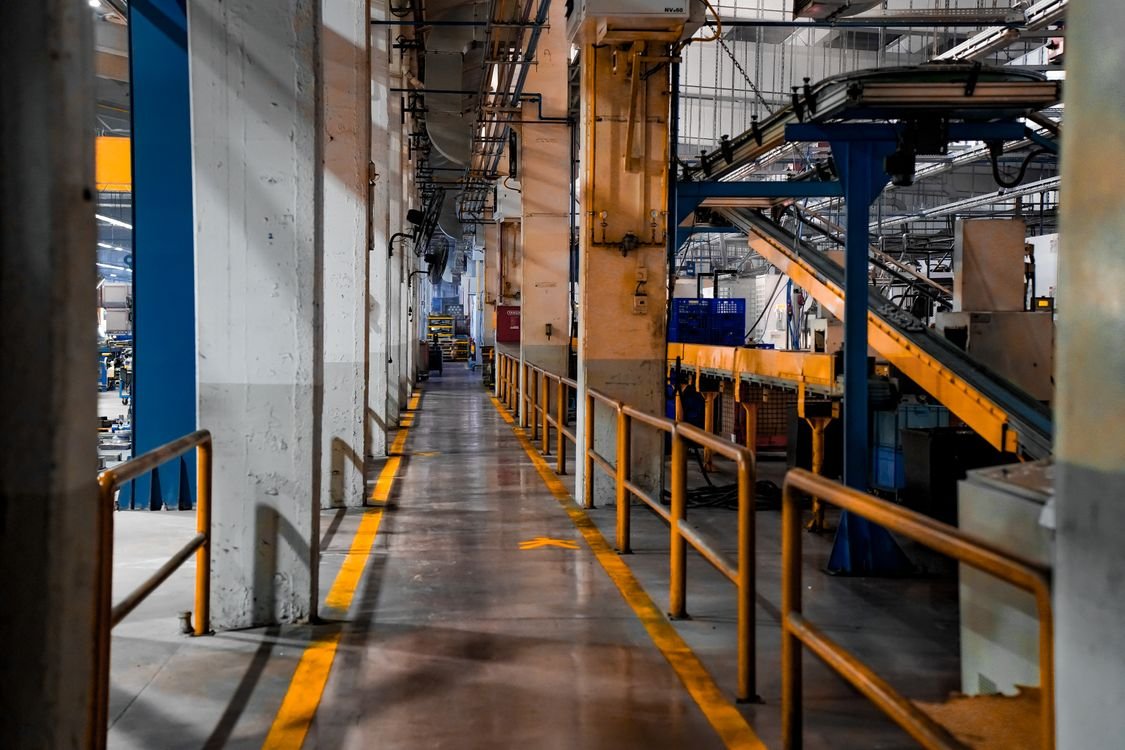
Image: Pexels #34718930, Pexels License. A factory floor like this one draws power throughout the 14:00–22:00 peak window a 100 kW cabinet can serve.
Scenario 2: Higher Solar Self-Consumption with Built-In MPPT
The cabinet’s built-in MPPT accepts up to 120 kW of rooftop PV directly at 200–950 V DC (850 V maximum), so commercial solar connects without a separate PV inverter. Solar charging and off-peak grid charging run in parallel under the EMS: surplus midday generation that would otherwise be exported for little value is stored in the 215 kWh battery, then released into the evening peak, capturing both avoided imports under the 31.32 sen peak band.
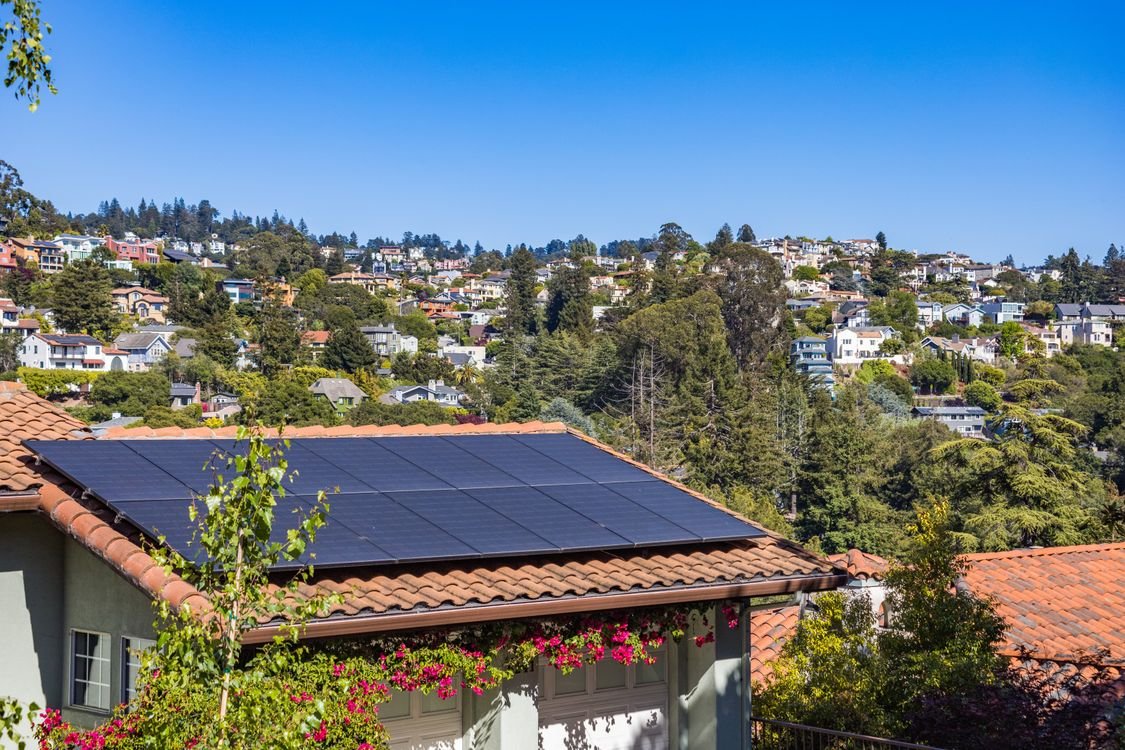
Image: Pexels #12243093, Pexels License. Rooftop PV paired with battery storage raises on-site solar self-consumption.
Scenario 3: Buffering EV Charging Plazas on Constrained Connections
A 100 kW battery buffer lets a constrained grid connection host more charging power than the connection alone would support. The product page lists EV charging plazas alongside factories and industrial parks as primary applications: the cabinet charges off-peak or from solar, then co-supplies CCS2 DC fast charging stations during the afternoon peak, when both tariffs and charging traffic peak. For sites with no usable grid connection, the H096 محطة شحن المركبات الكهربائية خارج الشبكة بقدرة 193 كيلوواط ساعة takes the same logic further.
Scenario 4: Scaling Across an Industrial Park
The H098 platform scales from 50 kWh to 315 kWh per cabinet, and multiple cabinets can be combined for park-level loads. The H098-100kWh (107.5 kWh, 50 kW) suits a mid-size workshop running daily peak shaving; the H098-150kWh (158 kWh, 100 kW) targets sites with high demand charges and existing solar; the H098-215kWh covered here serves factories and EV plazas with up to 120 kW of direct PV; and the H098-315kWh cabinet doubles discharge power to 200 kW. When loads outgrow cabinets, the same family extends into the 2.5MWh liquid-cooled container and 1MW/3MWh systems with coordinated multi-cabinet control.
Chart: huadaenergy, based on H098 product page specifications, 2026.
Certifications Explained: What the H098-215kWh Carries
As listed on the product page, the H098-215kWh is certified to IEC 63056, IEC 62477-1, IEC 62933-5-2:2020, IEC 62933-2-1:2017, EN 61000-6, RoHS 2.0 and UN38.3, and holds Malaysian SIRIM certification with the MyHIJAU mark. Each standard covers a different layer of the system.
| التصديق | النطاق | Why it matters to buyers |
|---|---|---|
| IEC 63056 | Safety of secondary lithium cells and batteries for electrical energy storage systems | The core battery-safety standard for stationary LFP storage; referenced in SIRIM’s 2025 guidelines for industrial storage |
| IEC 62477-1 | Safety of power electronic converter systems (PCS) | Covers the 100 kW bidirectional converter, not just the battery |
| IEC 62933-5-2:2020 | Safety of grid-integrated electrical energy storage systems | System-level ESS safety, complementing cell-level standards |
| IEC 62933-2-1:2017 | EES system parameters and test methods | Standardises the performance figures quoted in datasheets |
| EN 61000-6 | EMC emission and immunity for industrial environments | Confirms the cabinet will not disturb, or be disturbed by, factory equipment |
| RoHS 2.0 | تقييد المواد الخطرة | Required for many export markets and public tenders |
| رقم الأمم المتحدة 38.3 | Transport safety testing for lithium batteries | Mandatory for air and sea freight of lithium batteries worldwide |
| SIRIM + MyHIJAU | Malaysian product certification and official green mark | Market access and green-incentive eligibility in Malaysia |
The Malaysian credentials deserve particular attention. In September 2025, SIRIM together with the Ministry of Investment, Trade and Industry published the first edition of the Guidelines for Certification and Labelling of Energy Storage Batteries, bringing battery energy storage products into the SIRIM Product Certification Scheme, with industrial lithium storage referenced to IEC 62619 and IEC 63056. Certification comes as Type 5 product certification with annual surveillance audits for ongoing exporters, or Type 1B batch certification for single shipments. The MyHIJAU mark, administered through MGTC, places a product in Malaysia’s official green catalogue — a prerequisite for incentives such as the Green Investment Tax Allowance (GITA) and the Green Income Tax Exemption (GITE). For buyers, both safety standards and Malaysian market-access paperwork are already in place; request the stamped datasheet via the product page form for tenders.
How to Choose the Right Cabinet Configuration
Model selection is a load-profile exercise first. Before requesting a quotation, work through this checklist:
- Pull twelve months of half-hourly meter data and identify the 30-minute maximum demand that drives capacity and network charges.
- Confirm your tariff category (voltage level, General or Time-of-Use) and any AFA surcharge in your billing month.
- Estimate mountable PV: the H098-215kWh accepts up to 120 kW of direct PV within its 200–950 V MPPT window.
- Decide the backup scope, since the 400 V three-phase output must match the circuits it will carry.
- Check the site against IP55 outdoor requirements, the −20 °C to 55 °C discharge range and the 2,000 m altitude limit.
- Plan expansion — the series runs 50 / 100 / 150 / 215 / 315 kWh — and request certification documents (IEC, UN38.3, SIRIM) at quotation stage if the project requires tenders.
الأسئلة المتداولة
ما الذي يمكن لخزانة تخزين طاقة البطارية بقدرة 100kW/215kWh تشغيله؟
At rated power it delivers 100 kW for roughly 2.15 hours on a full charge — enough to carry production lines, HVAC, lighting and EV chargers through the evening peak or a grid interruption. Sites with lower peak demand get proportionally longer coverage from the 400 V three-phase output.
كيف تقلل الخزانة رسوم الطلب بموجب تعريفة TNB RP4؟
It discharges during the 14:00–22:00 weekday peak to hold the site’s 30-minute maximum demand at the EMS target. Capacity and network charges total about RM97.06 per kW of peak-period maximum demand each month, so every kilowatt shaved off the recurring peak removes roughly that amount from the bill.
هل يمكن لـ H098-215kWh الاتصال مباشرة بالطاقة الشمسية على السطح؟
Yes. The built-in MPPT accepts up to 120 kW of PV at a maximum input voltage of 850 V with a 200–950 V working range, so commercial rooftop arrays connect at DC without a separate PV inverter. PV charging and off-peak grid charging run in parallel under the EMS.
Which certifications does the H098-215kWh hold?
As listed on the product page: IEC 63056, IEC 62477-1, IEC 62933-5-2:2020, IEC 62933-2-1:2017, EN 61000-6, RoHS 2.0, UN38.3 and MSDS, plus Malaysian SIRIM certification with the MyHIJAU mark. Stamped datasheets for tender submissions are available on request.
كم يستغرق التثبيت؟
The cabinet arrives factory-commissioned, so on-site work is limited to positioning, cable runs and grid connection. There is no on-site battery assembly, no liquid-cooling piping and no third-party PCS integration — commissioning is measured in days, not weeks, for a prepared site.
Can multiple cabinets be combined for larger loads?
Yes. Multiple H098 cabinets share one AC bus under a single EMS that balances state of charge across units, as in the seven-cabinet deployment above; the series spans 50–315 kWh, and larger projects move to containerised 500 kWh–3 MWh systems.
عن huadaenergy
huadaenergy (Huizhou Huada Technology) manufactures LiFePO4 batteries and energy storage systems in Huizhou, Guangdong, China — home storage batteries, cabinet and container C&I ESS, EV charging stations, golf cart batteries and portable power stations. The H098 cabinet series ships with IEC and SIRIM certification and supports OEM/ODM customisation for export markets. تواصل مع huadaenergy للحصول على أوراق البيانات وعروض الأسعار بالجملة.
Last updated: 2026-10-29