A 51.2V golf cart battery is a 16-cell lithium iron phosphate pack that drops into a 48V-class cart and gives you 5,376 watt-hours instead of a tray of heavy lead-acid blocks. The numbers translate into 8,000+ cycles at the stated conditions, a 200A continuous output for hills and full loads, and a battery management system (BMS) watching every cell. This guide explains those specifications in plain language, so a fleet buyer can tell a real upgrade from a spec sheet that only looks good.
What Is a 51.2V Golf Cart Battery?
A 51.2V golf cart battery is a lithium iron phosphate (LiFePO4) pack built from sixteen 3.2V prismatic cells in series, giving a nominal 51.2V platform that matches the 48V-class systems in most golf carts, resort shuttles and utility vehicles. It is a direct swap, not a rebuild.
Why Sixteen Cells in Series
LiFePO4 cells produce about 3.2 volts each. Sixteen in a series string, written 16S1P, add up to 51.2 volts nominal. That is not arbitrary: a 48V lead-acid cart runs around 50 to 52 volts when fully charged, so 51.2V lands in the same window and the charger, controller and motor see a familiar voltage.
Why LiFePO4 and Not Another Lithium Chemistry
LiFePO4, or LFP, is chosen for stability rather than raw energy density. Its crystal structure holds oxygen tightly, so it tolerates heat and overcharge better than nickel-based chemistries such as NMC. For a fleet charging many carts in one room, that margin matters more than shaving a few kilograms off the pack.

Why Golf Fleets Are Moving to Lithium in 2026
Golf courses and resorts are converting their fleets to lithium because the cost over a season is lower despite a higher upfront price: no watering, no terminal cleaning, less downtime and more rounds per charge.
What the Market Data Says
IndexBox’s United States Golf Cart Batteries Market 2026 analysis estimates the market at USD 1.1 to 1.4 billion in 2026, with LFP taking roughly 25 to 30 percent of new pack shipments by value, up from under 15 percent in 2022. It puts a standard 48V LFP pack (100-120Ah) at USD 1,600 to 2,400 against USD 800 to 1,200 for six 8V flooded lead-acid batteries. These are market estimates, not price quotes.
Range and Uptime in Daily Use
IndexBox reports a typical 48V LFP pack delivering 35 to 45 miles per charge versus 25 to 30 miles for lead-acid, and a 15 to 20 percent annual conversion rate in large fleets. The useful gain is finishing a day of back-to-back rounds without a midday swap.

Reading the Specs Without the Jargon
Four numbers decide fit: 51.2V and 105Ah for compatibility, 5,376Wh for runtime, 200A continuous discharge, and 8,000+ cycles.
The Core Numbers
| المواصفات | القيمة | ماذا يعني ذلك للمشتري |
|---|---|---|
| Nominal voltage / configuration | 51.2V, 16S1P | Matches a 48V-class cart platform |
| السعة / الطاقة | 105Ah / 5,376Wh | Energy available for a full day of rounds |
| Continuous / peak discharge | 200A / 600A for 3s | التلال والأحمال الكاملة دون انخفاض في الجهد |
| دورة الحياة | 8,000+ to 80% capacity | Tested at 25 C, 0.5C charge and discharge |
| المقاومة الداخلية | 50 milliohms or less | Lower losses and less heating under load |
| Weight / case | approx. 51 kg, metal | Rugged housing for commercial fleet duty |
| الاتصال | UART؛ Bluetooth / RS485 / CAN اختياري | مراقبة الأسطول والتكامل مع الشركات المصنعة الأصلية |
Amp-hours alone tell you very little: 105Ah becomes meaningful only alongside 51.2V, because watt-hours are volts times amp-hours. Ask for both.
What 8,000+ Cycles Really Means
A cycle is one full charge and discharge. The 8,000+ rating means the cells should hold at least 80 percent capacity after 8,000 cycles under the stated conditions: 25 degrees Celsius and a 0.5C charge and discharge rate.
Test Conditions Change the Answer
Cycle life is comparable only when depth of discharge, temperature and charge rate match. A pack tested gently at room temperature posts a bigger number than one cycled hard on a hot course. IndexBox’s 2026 analysis puts lead-acid at roughly 500 to 1,500 cycles in golf duty, with market LFP packs commonly rated from 2,000 upward. Use the huadaenergy figure with its conditions attached. See the بطارية عربة الغولف 51.2V 105Ah page for the base specification.
Discharge Current and the BMS
The BMS is the small circuit board that makes a lithium pack safe to use: it monitors cell voltage, current and temperature, and opens the circuit when any of them moves outside limits.
Why 200A Continuous Matters
A cart climbing a slope with four passengers draws far more current than one on flat grass. A 200A continuous rating, with a 600A peak for three seconds and 400A for 35 seconds, supplies that surge without the voltage collapsing. Lead-acid sags under the same load, which a driver feels as slowing down.
What the BMS Actually Does
The smart BMS covers overcharge, over-discharge, over-current and short circuit, and reports status through UART. Bluetooth, RS485 and CAN are available for OEM projects wanting state-of-charge and fault data on a fleet dashboard.
Charging, Storage and Daily Care
This pack charges at a nominal 57.6V, cuts off at 40V and accepts 20A standard or 50A maximum charge current, with charging from 0 to 45 degrees Celsius and discharge from minus 20 to 55.
Opportunity Charging Is the Real Benefit
Lithium has no memory effect, so topping up between rounds does not wear it out; a course can plug carts in during a lunch gap. The pack ships at 51 to 52.8V, roughly 30 to 70 percent state of charge, ready to install. Self-discharge is 5 percent or less per month, which suits carts parked through a quiet season.
Where This Battery Actually Earns Its Keep
The same 51.2V pack serves any 48V-class vehicle or machine: golf carts, resort shuttles, utility vehicles, floor cleaners, aerial platforms and small solar banks.
Golf Courses and Resorts
This is the core use. Two-, four- and six-seat carts get the same footprint as the lead-acid tray they replace, so installation is a swap rather than a modification. The بطارية عربة الجولف 38.4V 105Ah covers carts on the smaller 36V-class platform when a fleet runs mixed vehicles.

Utility, Industrial and Standby Roles
Resort shuttles, campus vehicles and UTVs value the continuous current and metal case; floor scrubbers value stable voltage through a shift. With low self-discharge, the pack also works in small solar setups or as a house battery on the water. For a home rather than a vehicle, the 5.12kWh home storage battery uses the same LiFePO4 principles.

Certifications and Fire Safety, Without the Marketing
The product page lists UN38.3 and CE for this 51.2V 105Ah pack, and a buyer should request the dated report for the exact model rather than rely on a logo.
What UN38.3 and CE Cover
UN38.3 is the transport safety test carriers need for air and sea shipment, documented in the shipping papers with each carton. CE is the manufacturer’s declaration of conformity for applicable EU rules. Neither is an independent product certification, and this model does not claim a UL listing. For North America, UL 2271 is the relevant safety standard for light electric vehicle batteries, covering electrical, mechanical and environmental abuse tests; Key Biscayne fire department’s 2026 guidance advises UL 2271-certified packs, cart-specific chargers and designated charging areas. Ask whether your market needs a test report or a certifiable listing.
Passive Fire Protection: A Material We Apply
Fire safety is layered, and huadaenergy has been a pioneer in applying a newly developed fire-resistant coating to energy storage systems. The two-part intumescent material was developed by Hunan Yinsuo Technology and Changding Material Technology, with roots in powder metallurgy research at Central South University; huadaenergy applies it rather than owning the patent. Test files on record include a fire-resistance report (YJ2025060240) in which a 2.5mm coated steel plate withstood 800 to 850 degrees Celsius for 30 minutes with a back-face peak of 154.8 degrees Celsius, and an adhesion report (EMT02R000171C01) recording class 0 under GB/T 31586-2015. The reports name the developers as commissioning party, apply only to the tested samples and are for internal reference; they are not huadaenergy certificates. A passive layer adds margin but does not replace cell or system-level fire tests.
How to Choose the Right Pack
Choose a 51.2V golf cart battery by checking five things: cart voltage, physical fit, current rating, cycle-test conditions and documents. A low sticker price rarely means the lowest cost per season.
Five Checks Before You Order
- Confirm your cart is a 48V-class platform and the old tray dimensions match 550 x 300 x 245 mm.
- Check the continuous discharge rating against your hills, passenger load and terrain.
- Ask for the cycle-life test conditions, not just the headline cycle count.
- Verify the BMS protections and whether UART, Bluetooth, RS485 or CAN suits your fleet system.
- Request the UN38.3 and CE documents for the exact model, with issue dates.
Source Factory, OEM and ODM
huadaenergy is the source factory, not a trading middleman: the logo, shell colour, packaging, capacity and communication protocol can be built to your brief, and the engineering team can propose a system design around your carts and charging routine. Development starts from the customer’s application, and every pack is inspected and functionally tested before shipment. See the صفحة الاتصال, or email sales@huadaenergy.com / +86 138 2316 3795.
الأسئلة المتداولة
هل يمكن لبطارية 51.2V هذه أن تحل محل حزمة حمض الرصاص في عربة الغولف الخاصة بي؟
نعم، إذا كانت عربة الجولف الخاصة بك على منصة من فئة 48 فولت. الجهد الاسمي 51.2 فولت والعلبة المعدنية بمقاس 550 × 300 × 245 مم تتوافق مع صينية الرصاص الحمضي المكافئة، لذا لا حاجة لإعادة التمديدات الكهربائية. تأكد من أن إعدادات الشاحن لديك مناسبة لبطاريات الليثيوم قبل الطلب.
كم عدد الجولات التي تدوم لها شحنة واحدة؟
That depends on terrain, load and speed, not a fixed number. IndexBox (2026) puts a comparable 48V LFP pack at 35 to 45 miles per charge versus 25 to 30 miles for lead-acid. Plan around your own course and charging routine.
ماذا يعني أكثر من 8,000 دورة في الممارسة العملية؟
The cells should retain at least 80 percent capacity after 8,000 full cycles at 25 degrees Celsius with 0.5C charge and discharge. Deeper discharges and higher temperatures shorten that life, so compare figures at the same conditions.
هل يُعد خرج 200 أمبير ضروريًا لعربة غولف عادية؟
For flat courses with light loads, less is enough. The 200A continuous rating and 600A three-second peak are for hills, rough ground and full passenger loads, where a weaker pack sags and slows the cart.
ما الشهادات التي يحملها هذا الطراز؟
The product page lists UN38.3 for transport and CE for EU conformity, with documents supplied for shipment. It does not claim a UL listing. Buyers needing UL 2271 should confirm the report or listing required for their market.
هل يمكن لشركة Huadaenergy تخصيص البطارية لعلامتي التجارية أو أسطولي؟
Yes. As the source factory, huadaenergy supports OEM and ODM work: custom logo, shell colour, packaging, capacity and communication protocols, plus system design around your requirements. Send your application, volumes and target market for a quotation.
عن huadaenergy
Built at the Source in Huizhou
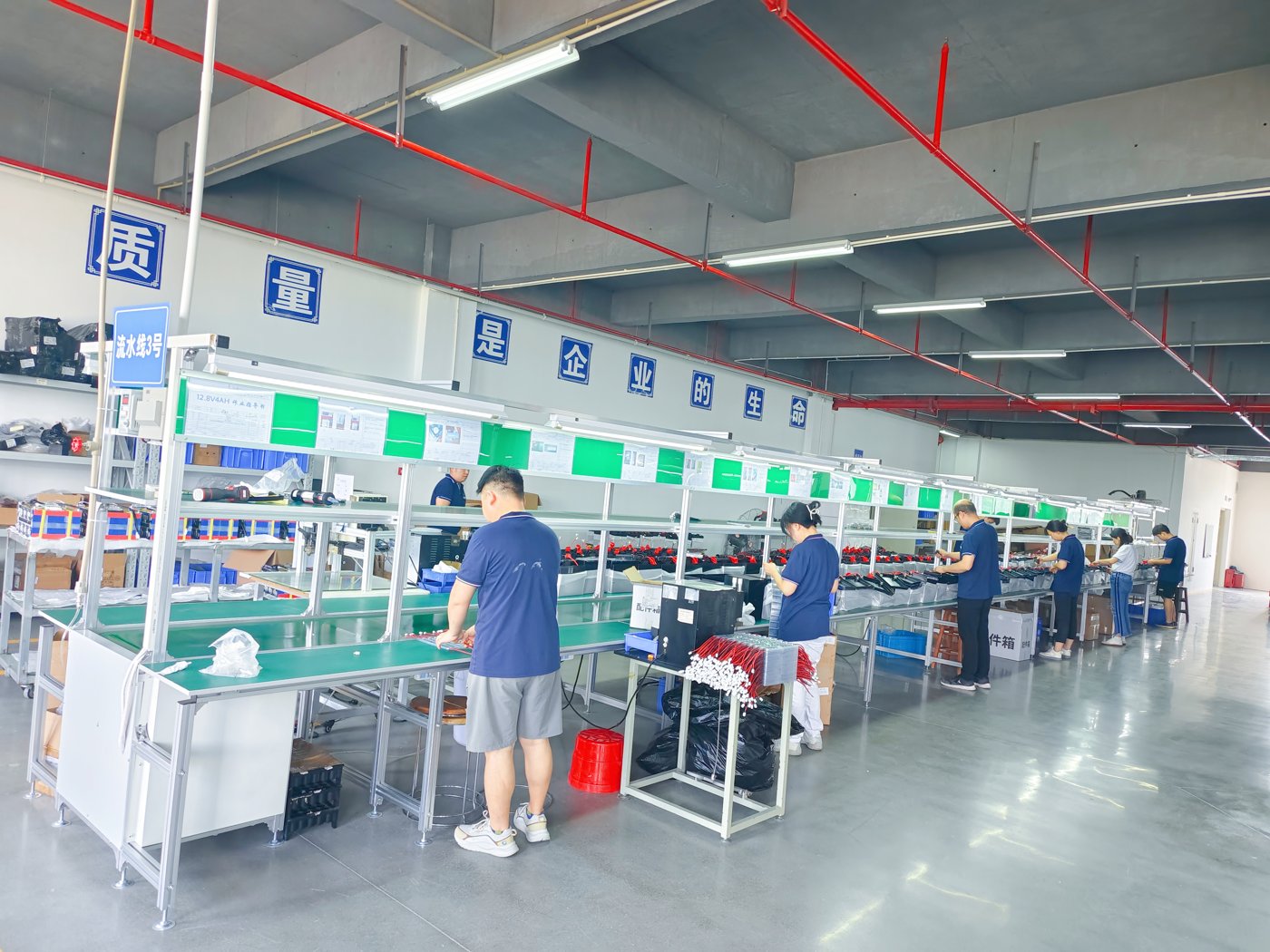
huadaenergy manufactures golf cart batteries, home storage and container energy storage systems at its Huizhou factory, with cell traceability and full-function testing before shipment. For a datasheet, certificate pack or OEM discussion, visit the 51.2V 105Ah golf cart battery page. Last updated: 2026-11-26